
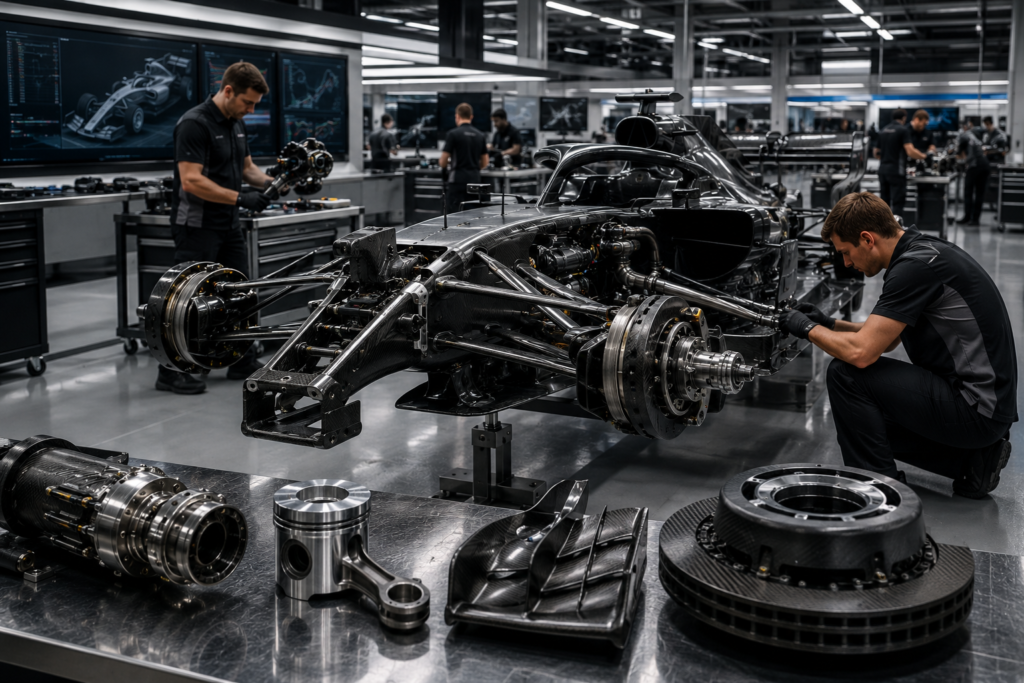
Image Credentials: Image Title: Inside Formula 1: How the World’s Most Advanced Race Cars Are Built. Source: (chatgpt.com) Date: May 2026. Attribution: This image was created using AI-generated imagery (chatgpt.com) by Open Chronicle and does not depict a real-world scene.
By Open Chronicle
Formula 1 cars are often described as the fastest racing machines on Earth, but their true complexity begins long before they ever reach a circuit.
Behind every Grand Prix lies an enormous industrial and technological operation involving thousands of engineers, designers, aerodynamicists, and precision manufacturers working at the absolute edge of modern engineering. Collectively, Formula 1 teams spend more than £1.5 billion every year developing just 10 cars, chasing performance gains measured not in seconds, but in thousandths of a second.
The result is a machine so sophisticated that it pushes the boundaries of physics itself.
Building a modern Formula 1 car is not comparable to manufacturing a road car. Every component is designed for maximum efficiency, minimum weight, and extreme durability under violent operating conditions. From the carbon fiber chassis to the smallest internal engine component, almost every part is custom-built, obsessively tested, and constantly redesigned throughout the season.
Engineering at the Absolute Limit
Modern Formula 1 teams operate more like aerospace companies than traditional racing garages.
Factories run around the clock using advanced simulation software, wind tunnels, artificial intelligence systems, and precision machining technologies to produce components with microscopic tolerances. Around 4,000 specialists across the sport contribute to this relentless development cycle, all focused on finding tiny performance advantages that can decide championships.
Even the smallest parts carry astonishing complexity and cost.
Certain Formula 1 pistons can exceed £50,000 due to the exotic materials and manufacturing precision required to survive inside hybrid turbocharged power units operating at extraordinary temperatures and rotational speeds. Gearboxes, meanwhile, can cost more than £250,000 and must endure brutal stress while remaining incredibly lightweight and compact.
Every gram matters.
Every aerodynamic surface matters.
And every manufacturing decision is dictated by performance.
Carbon Fiber: The Core of Modern F1
At the center of every Formula 1 car is the carbon fiber monocoque, the survival cell that protects the driver while serving as the structural foundation of the car.
Carbon fiber revolutionized Formula 1 because of its remarkable strength-to-weight ratio. It is lighter than aluminum yet incredibly strong, capable of absorbing massive impact forces during accidents.
But producing these components is neither simple nor fast.
Front wings alone can require an entire week of continuous manufacturing due to their intricate aerodynamic shapes and layered carbon construction. Teams use advanced composite engineering techniques, curing materials in giant autoclaves under carefully controlled pressure and temperature conditions.
Every surface is sculpted to manipulate airflow with extraordinary precision.
In Formula 1, aerodynamics are everything.
The Hidden Complexity of Braking Systems
One of the most extreme examples of Formula 1 engineering is the braking system.
Modern F1 cars use carbon-carbon brake discs capable of reaching temperatures exceeding 1,000 degrees Celsius. These brakes are extraordinarily powerful, allowing drivers to decelerate from over 300 km/h to cornering speed in just a few seconds.
Manufacturing them is an intensive process.
Some carbon brake components require up to three months to produce, involving repeated heat treatment cycles and precision machining. Despite their complexity and cost, they remain essential to modern Formula 1 performance because braking efficiency directly influences lap time.
The faster a driver can brake confidently, the faster the car becomes overall.
Endless Development Throughout the Season
Unlike road cars, Formula 1 machines are never truly finished.
Teams continuously redesign components during the season, introducing aerodynamic upgrades, suspension revisions, and cooling improvements almost every race weekend. Entire departments focus solely on development cycles measured in days rather than months.
This relentless evolution is driven by the brutal competitiveness of Formula 1 itself.
A small aerodynamic improvement worth only a tenth of a second per lap can determine grid position, race strategy, and championship outcomes. In a sport where margins are microscopic, engineering becomes warfare.
The pressure is relentless.
More Than Racing Cars
What makes Formula 1 extraordinary is not simply speed, but the level of technological ambition concentrated into a single machine.
These cars represent the combined efforts of some of the world’s brightest engineers operating under enormous financial, technical, and competitive pressure. Every bolt, every aerodynamic vane, and every line of software exists for one purpose only: extracting maximum performance at the limit of possibility.
The modern Formula 1 car is not just a racing machine.
It is a rolling laboratory, an aerospace project, and a masterpiece of extreme engineering all at once.
And behind every race lies thousands of hours of invisible work carried out inside factories that few people ever get to see.