
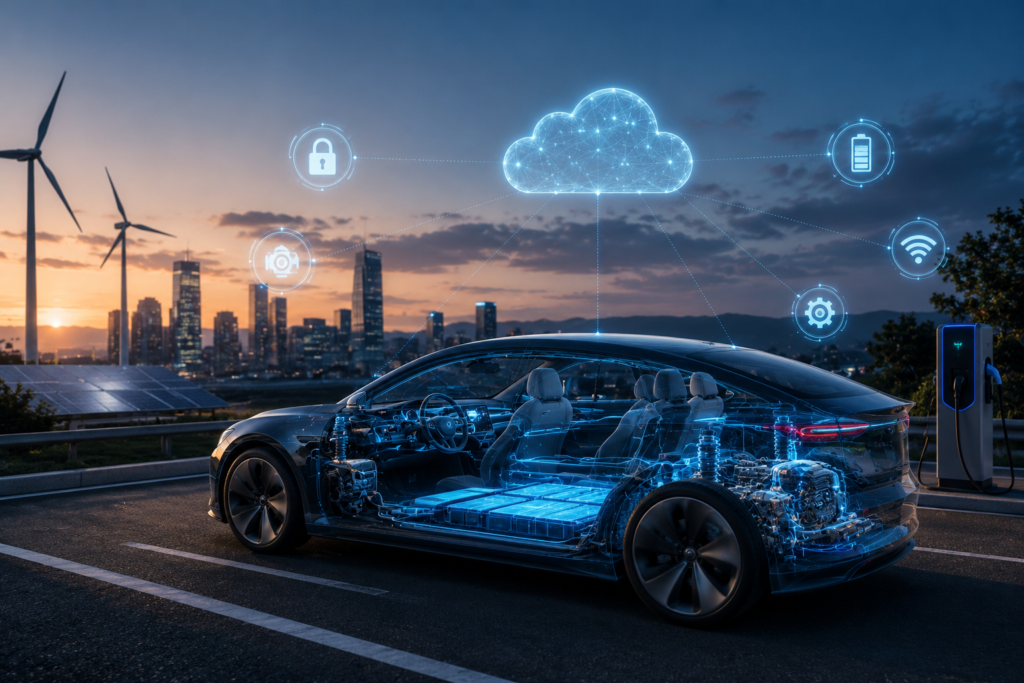
Image Credentials: Image Title: How Electric Vehicles Became “Smartphones on Wheels”. Source: (chatgpt.com) Date: May 2026. Attribution: This image was created using AI-generated imagery (chatgpt.com) by Open Chronicle and does not depict a real-world scene.
By Open Chronicle MotorSport
The modern automobile is undergoing one of the most dramatic transformations in its history. What was once defined primarily by engines, gearboxes, and mechanical engineering is now increasingly shaped by software, cloud computing, and digital ecosystems.
Electric vehicles have accelerated this shift faster than anyone expected.
Today’s EVs are no longer simply transport machines powered by batteries instead of fuel. They are connected digital platforms capable of receiving over-the-air updates, running cloud-based applications, and continuously evolving long after leaving the factory floor.
In many ways, the modern car has become something entirely different.
It has become a smartphone on wheels.
The Rise of the Rolling Computer
Traditional vehicles relied on hundreds of independent mechanical systems operating separately throughout the car. Modern EVs, however, increasingly use centralized computing architectures that function more like data centers than conventional automobiles.
Millions of lines of software code now manage acceleration, regenerative braking, battery cooling, navigation, safety systems, and entertainment interfaces. Instead of dozens of isolated control units, automakers are consolidating functions into powerful domain controllers capable of processing enormous amounts of data in real time.
This transition has fundamentally changed the nature of car ownership.
For decades, vehicles remained largely unchanged once delivered to customers. Improvements only arrived with the next-generation model. Now, software updates can instantly improve vehicle efficiency, battery management, infotainment systems, and even semi-autonomous driving features without the owner visiting a dealership.
Tesla pioneered this approach, but nearly every major manufacturer has now embraced it.
Companies such as Hyundai, Mercedes-Benz, BMW, Rivian, and Volkswagen increasingly treat software development as a central pillar of vehicle engineering. Developers can create, simulate and test applications in cloud environments before deploying them directly to vehicles worldwide through over-the-air updates.
The result is a continuously evolving product rather than a static machine.
The Subscription Economy Enters the Automotive World
The digitalization of vehicles has also transformed the business model of the automotive industry itself.
Historically, automakers relied almost entirely on one-time vehicle sales. Today, software-defined vehicles are opening the door to recurring revenue streams similar to those used by technology companies.
Because manufacturers can install identical hardware across an entire lineup, certain features can now be activated or restricted through software alone.
Heated seats, premium audio systems, advanced navigation tools, and performance enhancements can all be unlocked digitally. Customers may choose to purchase features permanently, rent them monthly, or activate them temporarily through online marketplaces integrated into the car itself.
This approach has sparked debate among consumers.
Supporters argue that subscription systems offer flexibility and allow owners to customize their experience. Critics, however, see them as a controversial attempt to charge repeatedly for hardware already physically installed in the vehicle.
Regardless of opinion, the shift is reshaping how automakers think about profitability.
Increasingly, car companies are being judged not only on horsepower or driving dynamics, but also on interface responsiveness, app integration and software reliability. Partnerships with technology firms have become essential as manufacturers compete to offer seamless digital experiences comparable to smartphones and consumer electronics.
The New Oil Is Data
Perhaps the most valuable element of the connected vehicle revolution is not the car itself, but the information it generates.
Modern EVs continuously collect vast quantities of telemetry regarding driving habits, energy usage, battery performance, charging behavior and system health. This data allows manufacturers to monitor vehicle performance in real world conditions at an unprecedented scale.
The advantages are significant.
Predictive maintenance systems can identify potential component failures before they happen, reducing breakdowns and improving reliability. Battery analytics help optimize charging efficiency and extend lifespan. Engineers can study anonymized usage patterns to improve future vehicle design and software calibration.
Connected EVs are also beginning to play a role beyond transportation.
Vehicle-to-Grid technology, often referred to as V2G, allows electric vehicles to function as mobile energy storage units capable of feeding electricity back into the power grid during periods of high demand. In theory, millions of EVs could eventually help stabilize national energy networks and support renewable energy infrastructure.
But this deep integration raises difficult questions.
As cars become increasingly linked to smartphones, smart homes, and cloud platforms, concerns over privacy and data ownership are growing rapidly. Consumers are beginning to ask who truly controls the information generated by their vehicle, the driver or the manufacturer.
Cybersecurity has also emerged as a critical issue. A modern EV is not just a car anymore. It is a permanently connected computing device, which means it faces many of the same vulnerabilities as any internet-connected platform.
The Automotive Industry Reinvents Itself
The rise of software-defined vehicles has blurred the line between automakers and technology companies.
Legacy manufacturers are now reinventing themselves as mobility service providers and digital platform businesses. At the same time, technology firms are entering the automotive sector with increasing confidence, bringing expertise in software, artificial intelligence, and cloud computing.
This convergence is reshaping the entire industry.
Consumers purchasing vehicles today are no longer evaluating only acceleration figures or fuel economy. They are evaluating operating systems, interface design, connectivity and digital ecosystems.
The car has become part of a broader technological lifestyle.
And as artificial intelligence, autonomous driving, and connected infrastructure continue to evolve, the transformation is only beginning.
The future automobile may still have wheels, but increasingly, its true identity lies in its software.