
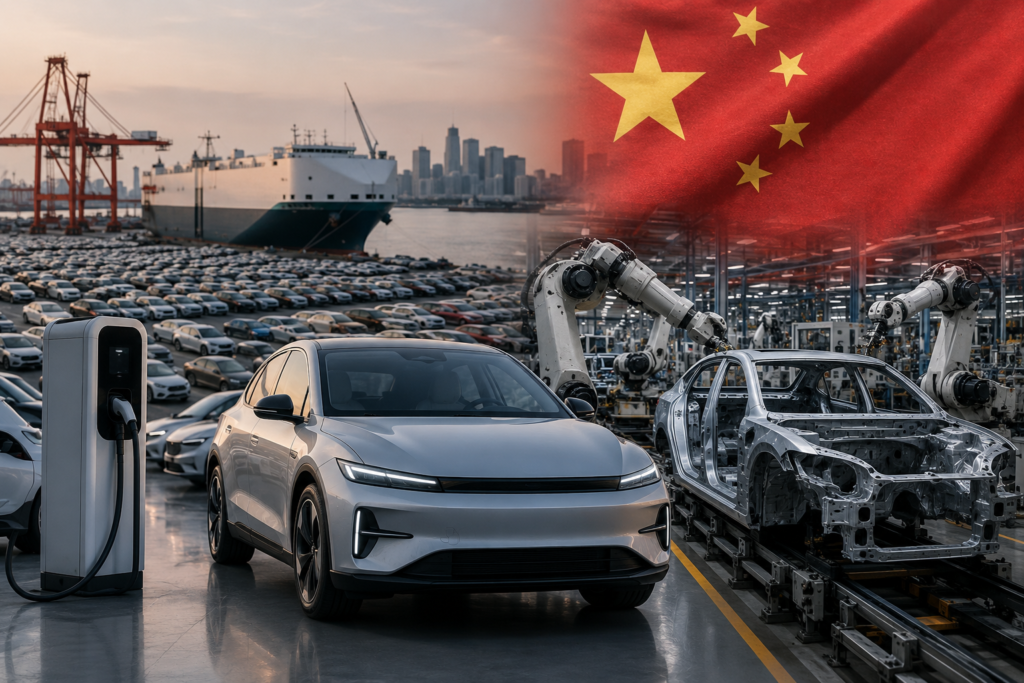
Image Credentials: Image Title: Why China Changed the Global Car Industry. Source: (chatgpt.com) Date: May 2026. Attribution: This image was created using AI-generated imagery (chatgpt.com) by Open Chronicle and does not depict a real-world scene.
By Open Chronicle
For more than a century, the global automotive industry was shaped primarily by Europe, the United States, and Japan. Germany defined engineering prestige, Detroit mastered industrial scale, and Japan perfected reliability and manufacturing efficiency.
Today, however, the center of gravity is shifting rapidly eastward.
China is no longer simply the world’s largest car market. It has become the most disruptive force in the modern automotive industry, reshaping everything from electric vehicle pricing and factory economics to software development and global supply chains.
The consequences are now impossible to ignore.
What began as an ambitious national industrial strategy has evolved into a transformation powerful enough to force legacy automakers across Europe and North America into strategic rethinking, emergency partnerships, and aggressive restructuring.
The global car industry is entering a new era, and increasingly, China is setting the pace.
The Electric Vehicle Revolution Accelerated Everything
Electric vehicles created the perfect opportunity for China to challenge the traditional automotive hierarchy.
Unlike combustion engines, where European, American, and Japanese brands possessed decades of engineering dominance, EVs reset many of the rules. Batteries, software integration and digital ecosystems suddenly became just as important as mechanical engineering.
China moved faster than almost anyone else.
Supported by large-scale industrial investment, government incentives, and aggressive infrastructure expansion, Chinese manufacturers rapidly built expertise across the entire EV supply chain. Companies such as BYD, XPeng, NIO, and Geely evolved from emerging domestic brands into globally ambitious technology-driven automakers.
At the same time, China secured dominant positions in battery production, lithium refining, and critical raw material processing.
This vertical integration created enormous structural advantages.
Chinese automakers were not simply assembling vehicles more cheaply. They controlled many of the industries feeding the EV revolution itself.
Speed Became the New Competitive Weapon
One of the biggest shocks for traditional automakers has been the pace at which Chinese companies operate.
European manufacturers often require years to fully develop new vehicle platforms. Chinese EV companies, by contrast, can move from concept to production dramatically faster, updating software, interiors, and digital features almost continuously.
This agility mirrors the technology sector more than the traditional automotive industry.
Modern Chinese EVs increasingly function like consumer electronics products on wheels. Over-the-air software updates, artificial intelligence systems, advanced infotainment platforms and connected ecosystems are integrated directly into the ownership experience.
Consumers are no longer evaluating vehicles purely on horsepower or mechanical refinement.
They are evaluating user interfaces, software responsiveness, and digital convenience.
That shift has forced legacy manufacturers into uncomfortable territory where traditional engineering excellence alone is no longer enough.
Europe Faces a Strategic Dilemma
Nowhere is this pressure more visible than in Europe.
European automakers remain globally respected for engineering quality, premium branding, and manufacturing expertise. Yet many have struggled to compete with the pricing speed and software flexibility of Chinese EV companies.
The response has been increasingly pragmatic.
Instead of attempting to resist entirely, some manufacturers have chosen collaboration. Partnerships between European giants and Chinese companies are becoming more common as legacy brands attempt to gain access to Chinese software platforms, battery expertise, and production efficiency.
At the same time, Chinese manufacturers are expanding aggressively into European markets with competitively priced electric vehicles that often include digital features traditionally reserved for premium segments.
This creates a profound strategic dilemma for Europe.
Protect the domestic industry too aggressively and risk slowing the EV transition.
Remain fully open and risk weakening Europe’s own automotive manufacturing base.
The European Union is now exploring industrial policies designed to reduce strategic dependency while encouraging local production and technology sharing. Yet balancing competitiveness, sustainability, and industrial sovereignty remains enormously difficult.
Factories, Pricing, and Industrial Pressure
China’s rise has also intensified pressure on manufacturing economies worldwide.
Chinese factories often operate with remarkable scale and efficiency, supported by deeply integrated supply chains and rapid development cycles. This allows manufacturers to reduce production costs significantly while maintaining competitive technology levels.
The impact on global pricing has been dramatic.
Traditional automakers accustomed to higher margins are now facing aggressive price competition in nearly every major EV segment. Several manufacturers have already been forced into price reductions, factory restructuring, or revised investment plans as Chinese competition grows stronger.
Even Tesla, once seen as the industry disruptor, now faces intense pressure from Chinese rivals capable of producing advanced EVs at lower cost and greater speed.
The battle for the future of mobility is becoming increasingly industrial as well as technological.
More Than Cars
China’s automotive rise is ultimately about far more than vehicles themselves.
It reflects a broader transformation in how modern industry operates, in which software, battery supply chains, artificial intelligence, and manufacturing scale are increasingly interconnected.
Cars are becoming digital platforms.
Factories are becoming technology ecosystems.
And the companies capable of integrating hardware, software, and supply chains most efficiently are gaining enormous strategic advantages.
For much of the twentieth century, the automotive world revolved around Europe, Detroit, and Japan.
In the electric era, China has emerged not merely as a participant but as a defining force in shaping what the future of the car industry will look like.
The global automotive order is being rewritten in real time.
And everyone else is now trying to catch up.