
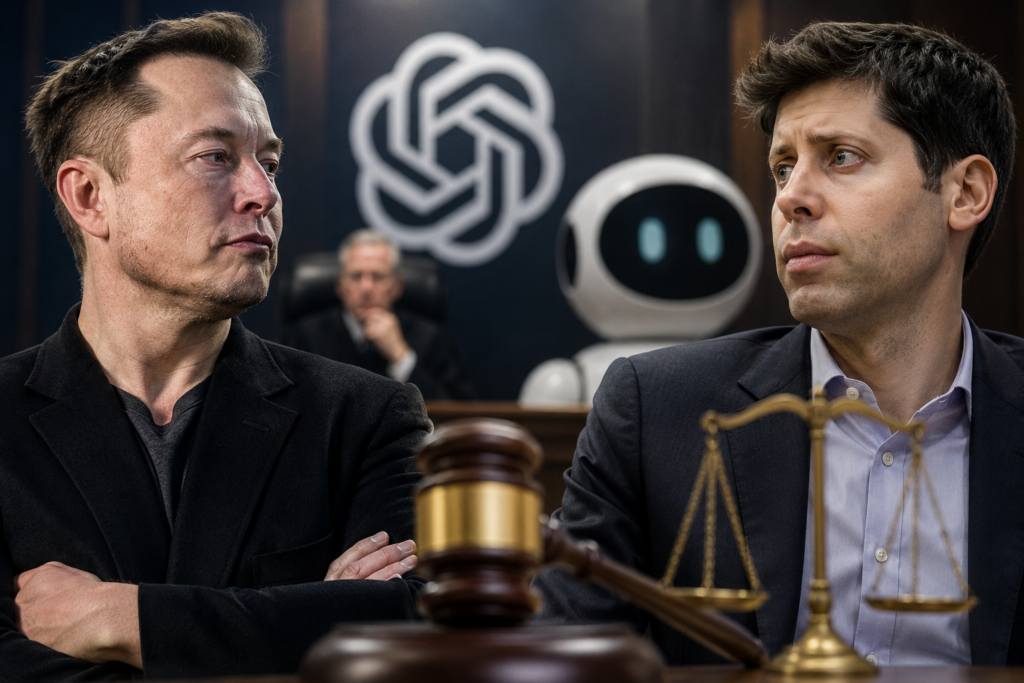
Image Credentials: Image Title: Elon Musk Loses Lawsuit Against OpenAI and Sam Altman Over Nonprofit Claims. Source: (chatgpt.com) Date: May 2026. Attribution: This image was created using AI-generated imagery (chatgpt.com) by Open Chronicle and does not depict a real-world scene.
By Open Chronicle with agencies
A California jury on Monday rejected Elon Musk’s lawsuit against OpenAI CEO Sam Altman and the artificial intelligence company he co-founded, bringing an end to a closely watched legal dispute over OpenAI’s transformation into a commercial AI powerhouse.
The case, which unfolded over three weeks in a US federal court, centered on Musk’s allegation that OpenAI had abandoned its original nonprofit mission and improperly shifted toward a profit-driven business model.
Musk filed the lawsuit in 2024 against Altman, OpenAI, and Microsoft, claiming the company violated what he described as a founding commitment to develop artificial intelligence for the benefit of humanity rather than for private financial gain.
Microsoft, one of OpenAI’s biggest investors, was also accused of helping facilitate what Musk called a breach of charitable trust. However, the court dismissed those claims as well.
The Tesla and SpaceX chief sought sweeping remedies from the court, including forcing OpenAI and Microsoft to surrender up to $134 billion in alleged “ill-gotten gains,” removing Altman and OpenAI President Greg Brockman from leadership positions, and reversing the company’s 2025 restructuring that expanded its for-profit operations.
Musk insisted in court filings that any recovered funds should be redirected to charitable purposes rather than awarded to him personally.
The jury ultimately sided against Musk, concluding that the claims had been filed too late under California’s statute of limitations laws.
US District Judge Yvonne Gonzalez Rogers agreed with the jury’s findings and dismissed the case, saying there was “a substantial amount of evidence” supporting the conclusion that the claims were untimely.
The judge said she was prepared to dismiss the case immediately after the advisory jury reached its decision.
“Claims of breach of charitable trust and unjust enrichment are dismissed as untimely,” Gonzalez Rogers ruled.
Musk was among the founders of OpenAI in 2015 and contributed roughly $38 million to the organization before leaving its board in 2018.
During the trial, Musk argued that he had supported OpenAI on the understanding that it would remain focused on public benefit rather than commercial expansion.
He accused Altman and Brockman of having “stolen a charity” by transforming the organization into one of the world’s most valuable AI companies.
OpenAI’s legal team rejected those allegations and portrayed the lawsuit as an attempt by Musk to undermine a major competitor after failing to gain control over the company.
Since leaving OpenAI, Musk has launched his own artificial intelligence venture, xAI, which later merged with SpaceX earlier this year.
The verdict arrives at a pivotal moment for both companies as they prepare for potential blockbuster stock market listings.
OpenAI reportedly raised $122 billion in funding earlier this year, giving the company a valuation exceeding $850 billion.
Meanwhile, SpaceX was recently valued at approximately $1.25 trillion following its merger with xAI. The company confidentially filed for an initial public offering in April and is expected to begin investor meetings soon.
Musk’s attorney, Steven Molo, said after the ruling that the billionaire reserves the right to appeal the decision.
The legal battle highlighted growing tensions within the rapidly evolving artificial intelligence industry, where questions surrounding ethics, profit motives and corporate control have become increasingly central as AI firms attract massive investments and geopolitical attention.