
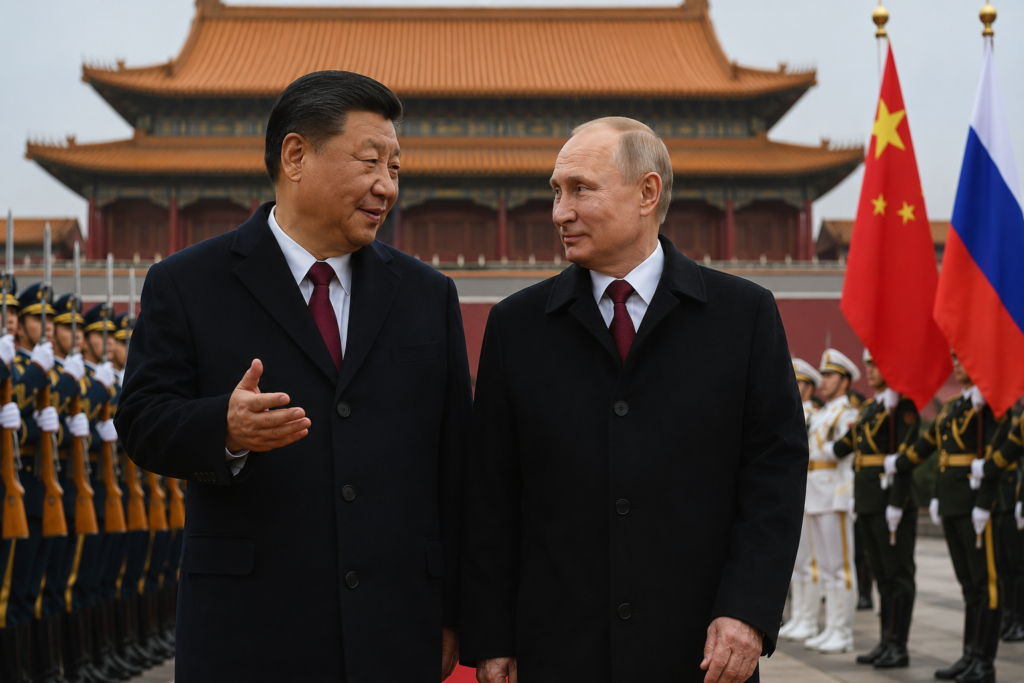
Image Credentials: Image Title: China and Russia Deepen Strategic Ties Amid Global Uncertainty. Source: (chatgpt.com) Date: May 2026. Attribution: This image was created using AI-generated imagery (chatgpt.com) by Open Chronicle and does not depict a real-world scene.
By Open Chronicle with agencies
As Russian President Vladimir Putin prepares to return to Beijing this week for talks with Chinese President Xi Jinping, the enduring partnership between China and Russia once again comes into focus at a moment of deep geopolitical uncertainty.
The visit coincides with the 25th anniversary of the Treaty of Good-Neighborliness and Friendly Cooperation between the two countries, a symbolic milestone that reflects how far relations between Moscow and Beijing have evolved since the end of the Cold War.
While Western leaders often describe the relationship as an “axis” united against the United States and its allies, the reality is more complex. The China-Russia partnership is built less on ideology and more on strategic necessity, economic complementarity, and a shared desire to challenge a Western-led international order.
The personal relationship between Xi and Putin has become one of the most visible symbols of this partnership. The two leaders frequently refer to each other as close friends and have spent years cultivating a carefully managed image of mutual trust.
During a walk through Beijing’s Tiananmen Square last year, the two men were overheard discussing the future of human longevity and organ transplants, a rare unscripted glimpse into a relationship usually shielded from public scrutiny. After nearly four decades combined in power, both leaders appear determined to project stability and continuity.
Yet beneath the symbolism lies a relationship defined by a clear imbalance of power.
China’s Growing Leverage
China has become Russia’s largest trading partner by a significant margin, while Russia represents only a relatively small share of China’s overall global trade. Western sanctions imposed after Russia’s invasion of Ukraine in 2022 accelerated Moscow’s economic dependence on Beijing.
Chinese companies have increasingly filled the vacuum left by Western firms that withdrew from the Russian market. Chinese technology, industrial equipment, and consumer products now dominate sectors once reliant on European or American suppliers.
Reports indicate that China supplies the overwhelming majority of sanctioned technologies entering Russia, including components used in military production and telecommunications infrastructure.
For Moscow, this dependency creates unease. Russian officials and analysts repeatedly stress that Russia does not wish to become subordinate to China.
Still, China has generally avoided publicly exploiting its dominant position. Analysts say Beijing understands that excessive pressure on Russia could generate backlash among Russian elites and undermine the long-term stability of the partnership.
Instead, China has adopted a cautious strategy of strategic patience, allowing Russia to maintain the appearance of independence while gradually deepening economic integration.
Energy and Strategic Interests
One of the pillars holding the relationship together is energy.
Russia possesses vast reserves of oil, gas, and raw materials that China urgently needs to secure its long-term energy stability. The proposed Power of Siberia 2 gas pipeline, which could transport massive volumes of Russian gas to China through Mongolia, is seen as one of the most significant energy projects linking the two countries.
The importance of this cooperation has grown further amid global instability and repeated tensions surrounding the Strait of Hormuz, a vital shipping route for global energy supplies.
China views Russian energy not only as economically attractive but also as strategically reliable in an increasingly fragmented world.
At the same time, Russia benefits from maintaining a powerful customer capable of offsetting losses from reduced access to Western markets.
Partners, Not Allies
Despite their increasingly close ties, China and Russia are not formal military allies.
That distinction matters.
Their relationship is intentionally flexible, allowing both governments to cooperate closely while avoiding obligations that could drag either country into conflicts against its interests.
This flexibility has helped the partnership survive periods of disagreement and competing priorities.
China remains far more cautious than Russia in confronting the West directly. While Moscow often embraces confrontation and unpredictability, Beijing tends to favor gradual economic influence and carefully managed diplomacy.
This difference became visible during recent tensions involving Iran and the United States. While Russia adopted a more openly confrontational tone, China continued to preserve channels of communication with Washington and avoided actions that might escalate the crisis further.
Shared Opposition to Western Dominance
Another powerful force binding Beijing and Moscow together is their common opposition to what both governments describe as Western hegemony.
China and Russia regularly coordinate positions at the United Nations and avoid criticizing each other’s internal policies, including on sensitive issues such as Xinjiang, political repression or opposition crackdowns.
Unlike Western governments, neither country conditions cooperation on human rights or democratic standards.
This mutual political protection has strengthened trust between the two leaderships and created what some analysts describe as an “organic symbiotic relationship.”
The Human Dimension
At the political level, the relationship appears stronger than ever. Putin has now visited China more than twenty times, and bureaucratic cooperation between both governments has become routine.
However, some analysts question whether ordinary Russians and Chinese feel the same level of affinity promoted by their leaders.
Many Russians still look toward Europe for investment, education, and lifestyle aspirations, while Chinese citizens often show limited interest in Russia beyond business opportunities.
Even so, both governments increasingly view the relationship as too important to fail.
With deteriorating ties between Russia and the West, and growing tensions between China and the United States, neither Beijing nor Moscow currently sees a realistic alternative to continued cooperation.
The partnership may be unequal, pragmatic, and sometimes cautious, but it remains one of the defining geopolitical relationships shaping the global order in the 21st century.