
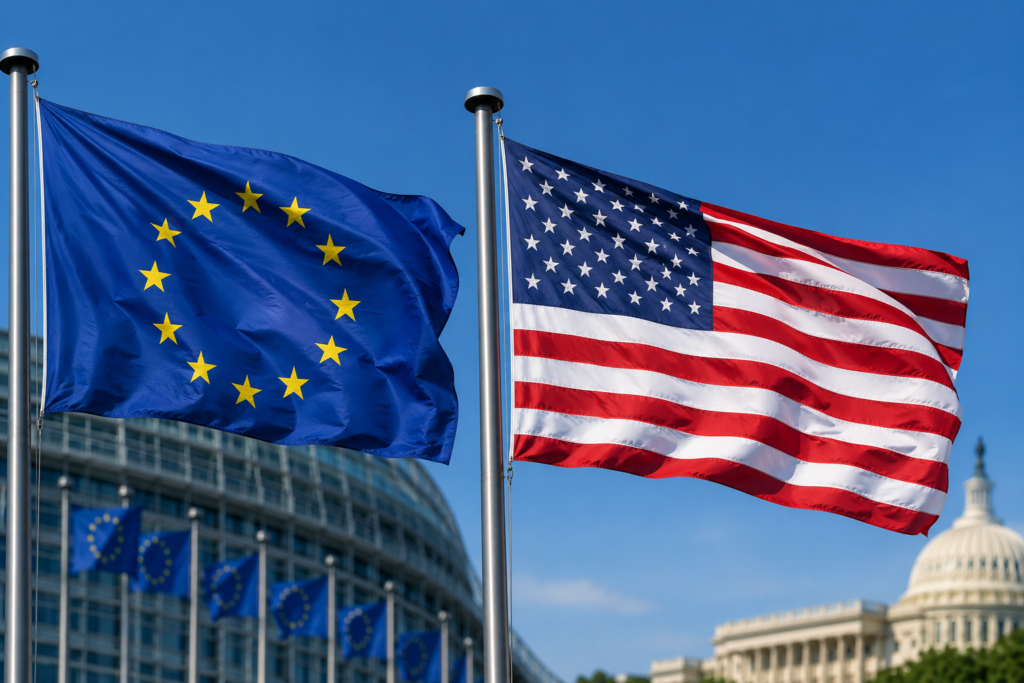
Image Credentials: Image Title: China and Russia Deepen Strategic Ties Amid Global Uncertainty. Source: (chatgpt.com) Date: May 2026. Attribution: This image was created using AI-generated imagery (chatgpt.com) by Open Chronicle and does not depict a real-world scene.
By Open Chronicle with agencies
The European Union is edging closer to approving a contentious trade agreement with the United States as negotiators race to avoid a new escalation in transatlantic tariffs threatened by President Donald Trump.
Senior representatives from the European Parliament, the European Commission, and EU member states gathered in Strasbourg for another round of high-level talks aimed at finalizing the framework of a trade pact first outlined last summer during negotiations at Trump’s golf resort in Turnberry, Scotland.
The negotiations have exposed deep divisions within the European Union itself, with lawmakers, national governments, and Brussels officials struggling to balance economic stability with concerns over making excessive concessions to Washington.
At the center of the dispute is how strongly the EU should protect itself against possible future policy reversals from Trump, whose administration has repeatedly used tariffs as leverage in trade negotiations.
The proposed agreement would see the EU remove tariffs on a range of American industrial and agricultural products in exchange for Washington limiting tariffs on most European exports to 15 percent.
Several European lawmakers, particularly from center-left and liberal parties, have pushed for additional safeguards designed to make the agreement more resistant to sudden policy changes from the White House.
Bernd Lange, the German lawmaker leading the European Parliament’s negotiating team, said discussions were progressing toward what he described as a “solid compromise” that would protect European interests while preserving the deal.
One of the key demands from lawmakers has been the inclusion of a “sunrise clause,” which would delay parts of the agreement until the United States lowers tariffs on European steel and aluminum products, some of which currently face duties of up to 50 percent.
Another proposal under discussion would allow the European Commission to suspend the EU’s own tariff reductions if Washington fails to meet its obligations by the end of 2026.
While members of the European Parliament are demanding stronger protections, several EU governments, particularly Germany, want the deal approved quickly to avoid renewed tensions with the United States.
Officials fear that further delays could provoke Trump into following through on threats to impose a 25 percent tariff on European automobiles, a move that would heavily impact Europe’s manufacturing sector.
The negotiations come at a sensitive moment for the €1.7 trillion transatlantic trade relationship, which accounts for nearly one-third of global cross-border commerce.
Trump’s ambassador to the EU, Andrew Puzder, warned that Washington’s patience was running out, urging Europe to embrace cooperation rather than confrontation.
European negotiators are now attempting to find a narrow middle ground capable of satisfying both EU lawmakers seeking stronger protections and member states focused on preserving economic stability.
Despite legal setbacks to Trump’s broader tariff powers in the United States, European officials remain cautious about the possibility of further trade measures after July, when temporary global tariffs imposed earlier this year are scheduled to expire.
A final vote in the European Parliament is expected later this month, with negotiators eager to avoid a politically damaging rejection that could destabilize EU-US trade relations at a time of growing global economic uncertainty.