
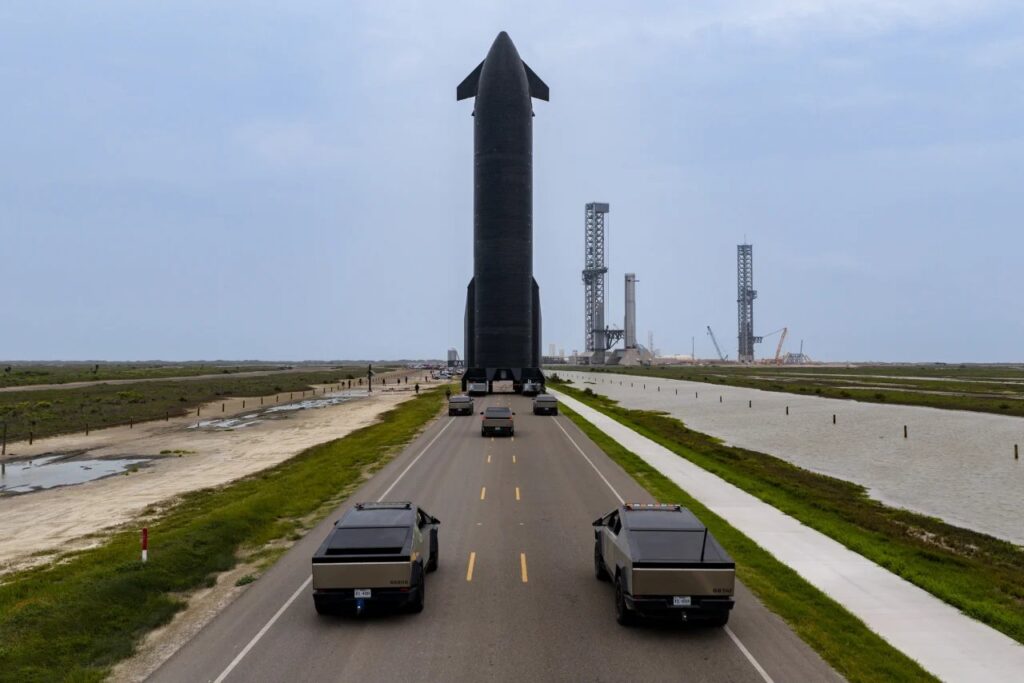
Image: from Mario Nawfal X @MarioNawfal
By Open Chronicle with agencies
SpaceX on Thursday postponed the planned first test flight of its newly upgraded Starship V3 megarocket after technical issues forced engineers to halt the countdown at the company’s South Texas launch facility.
The launch was scrubbed after several delays occurred with just 40 seconds remaining before liftoff. SpaceX spokesperson Dan Huot later confirmed that engineering problems prevented the mission from proceeding as scheduled.
“We are expecting to be able to make another flight attempt tomorrow, but obviously, stay tuned to our social media,” Huot said during the company’s live broadcast.
The mission would have marked the 12th test flight of the Starship program and the first launch of the redesigned Super Heavy V3 booster, the latest and most powerful version of the massive rocket system developed by Elon Musk’s aerospace company.
SpaceX scrubbed the launch of its 12th Starship rocket from Texas and said it will attempt the high-stakes test flight again on May 22, as Elon Musk's space company nears a record-breaking public listing https://t.co/U3qZn9zw6T pic.twitter.com/JOlpJJIfCC
— Reuters Science News (@ReutersScience) May 22, 2026
Standing approximately 408 feet tall, the Starship V3 configuration is currently the largest and most powerful rocket ever built. The upgraded Super Heavy booster is equipped with 33 redesigned Raptor engines, while the Starship upper stage carries six additional engines of its own.
The flight is intended to test a series of major design changes aimed at improving the rocket’s long-term reusability and operational performance.
According to SpaceX, engineers planned to evaluate upgraded propulsion systems, new flight control flaps, and several advanced maneuvering capabilities during the mission.
Among the objectives was the deployment of 22 Starlink satellite simulators, along with testing a new “dynamic banking maneuver” designed to support future precision landings back at the launch site.
The company also intended to intentionally stress some of the vehicle’s flight systems to gather performance data under demanding operational conditions.
“The flight test’s primary goal will be to demonstrate each of these new pieces in the flight environment for the first time,” SpaceX said in a statement published on its website.
The company added that the redesign incorporates lessons learned from years of development and previous Starship flight tests.
Under the planned mission profile, the Super Heavy booster would launch from South Texas before separating from the Starship upper stage during ascent.
After separation, the booster was expected to conduct boostback and landing burns before splashing down in the Gulf of Mexico. Unlike previous demonstrations, however, SpaceX confirmed the booster would not attempt a return-to-launch-site catch during this first V3 test flight because of the extensive redesign.
Meanwhile, the Starship spacecraft itself was set to continue on a suborbital trajectory, performing additional tests before splashing down in the Indian Ocean.
The Starship program remains central to NASA’s long-term lunar ambitions under the Artemis program.
NASA plans to use a modified Starship vehicle as part of the Artemis III mission, currently targeted for 2028, which aims to return astronauts to the Moon for the first time since the Apollo era.
The mission is expected to test docking operations involving NASA’s Orion crew capsule, SpaceX’s Starship, and Blue Origin’s Blue Origin’s Blue Moon lunar lander, though Blue Origin has not yet completed its own first test flight.
Beyond lunar exploration, SpaceX envisions Starship eventually supporting missions to Mars, large-scale satellite deployment, and rapid transportation systems on Earth.
Despite Thursday’s delay, SpaceX officials indicated that another launch attempt could take place within the next 24 hours pending resolution of the technical issues.