
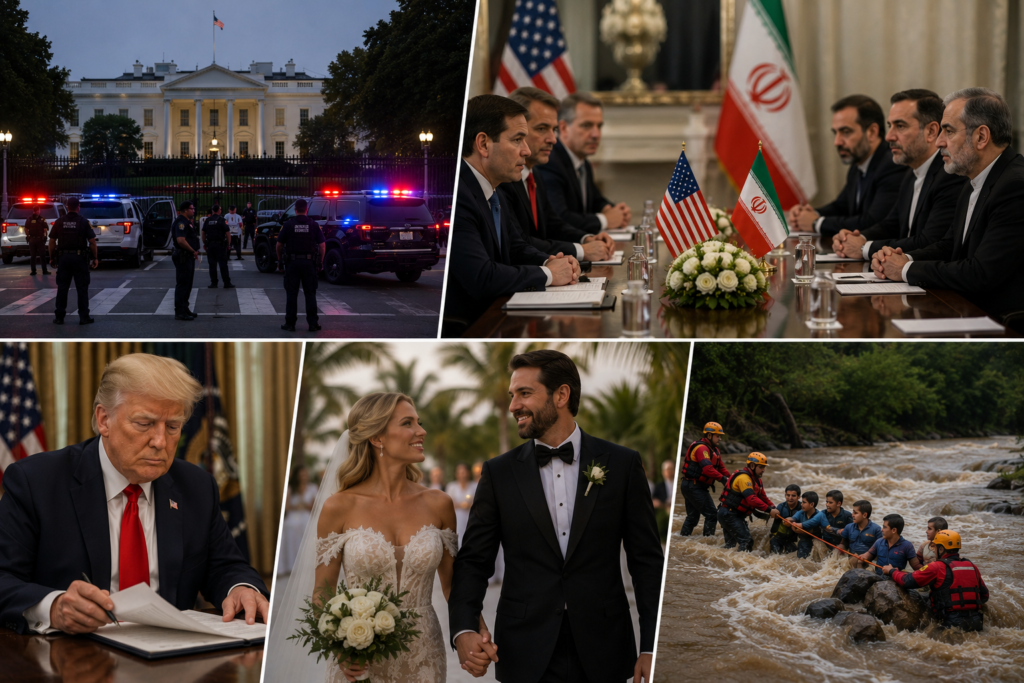
Image Credentials: Image Title: US News Brief: Key Events and Developments for May 24, 2026. Source: (chatgpt.com) Date: May 2026. Attribution: This image was created using AI-generated imagery (chatgpt.com) by Open Chronicle and does not depict a real-world scene.
By Open Chronicle with agencies
The United States faced a turbulent day marked by intensifying diplomacy with Iran, a deadly security incident near the White House, and growing political tensions surrounding President Donald Trump’s foreign policy agenda.
White House Security Scare Ends in Fatal Shooting
A major security alert unfolded in Washington after a gunman opened fire near a Secret Service checkpoint adjacent to the White House complex. According to US authorities, the suspect approached the security area carrying a weapon before opening fire on officers stationed near Pennsylvania Avenue.
Secret Service agents responded immediately, fatally shooting the attacker during the exchange. One bystander was also injured and transported for medical treatment. Officials later identified the suspect as a 21-year-old man from Maryland who reportedly had previous encounters with law enforcement and the Secret Service.
The incident temporarily locked down parts of the presidential complex and caused panic among journalists covering ongoing developments related to US-Iran negotiations. President Donald Trump was inside the White House during the incident but was not harmed.
The shooting reignited concerns about presidential security in the United States, especially amid heightened geopolitical tensions and growing domestic political polarization.
Trump Signals Progress Toward Iran Agreement
At the center of global attention remained the rapidly evolving negotiations between Washington and Tehran. President Trump stated that talks with Iran were progressing “constructively” and described a possible agreement as “largely negotiated,” though he emphasized that negotiations were still subject to final approval and implementation.
Trump confirmed that the US naval blockade targeting Iranian ports would remain fully operational until a formal agreement is signed and certified. According to US officials, American naval forces have redirected dozens of vessels in recent days as part of pressure measures connected to Iran’s restrictions in the Strait of Hormuz.
Secretary of State Marco Rubio also expressed optimism, suggesting that a diplomatic breakthrough could arrive within hours. Reports indicated that both sides were discussing a framework involving a temporary ceasefire, sanctions relief, restrictions on Iran’s nuclear program, and the reopening of the Strait of Hormuz to international shipping.
Despite the apparent progress, divisions remain significant. Iranian officials publicly insisted that Tehran would not surrender all highly enriched uranium stockpiles, while several Republican lawmakers in Washington criticized the proposed framework, warning it could strengthen Iran strategically.
Republican Divisions Over Iran Policy Deepen
The emerging agreement has exposed fractures within Trump’s political base and among Republican lawmakers. Senator Ted Cruz described the negotiations as a potentially “disastrous mistake,” while other conservative figures questioned whether Iran could be trusted to comply with any future arrangement.
At the same time, several Republican allies of the president defended the negotiations as a necessary step to avoid a broader regional war in the Middle East. Analysts noted that the proposed agreement has created unusual political alignments, with criticism emerging simultaneously from hawkish Republicans, pro-Israel voices, and some anti-war activists.
Israeli officials reportedly expressed concern over Washington’s handling of the negotiations, while Gulf states, including Qatar, Saudi Arabia, and Türkiye, continued supporting diplomatic efforts aimed at stabilizing the region.
Domestic Political Tensions Continue to Rise
The White House shooting and the Iran negotiations unfolded amid an already tense political climate across the United States. Congressional debates intensified over executive war powers, foreign policy authority, and national security oversight.
Democratic lawmakers renewed calls for stronger congressional involvement in decisions related to military action against Iran, while several Republican figures accused the administration of moving too slowly or offering excessive concessions.
Meanwhile, the Trump administration continued facing criticism over immigration policy changes affecting green card applicants and asylum seekers. Legal battles over deportation policies and immigration court operations also expanded across several states.
Weather Emergencies and Public Safety Concerns
Beyond politics and diplomacy, authorities in California maintained emergency evacuation orders affecting tens of thousands of residents after fears that a damaged chemical tank at an aerospace-related facility could explode.
Elsewhere, severe weather threatened Memorial Day travel across parts of the Northeast and Midwest, while emergency crews in West Virginia rescued dozens of Boy Scouts trapped by rising floodwaters during a river expedition.
The combination of international tensions, domestic political conflict, security scares, and environmental emergencies contributed to an unusually volatile news cycle across the United States.