
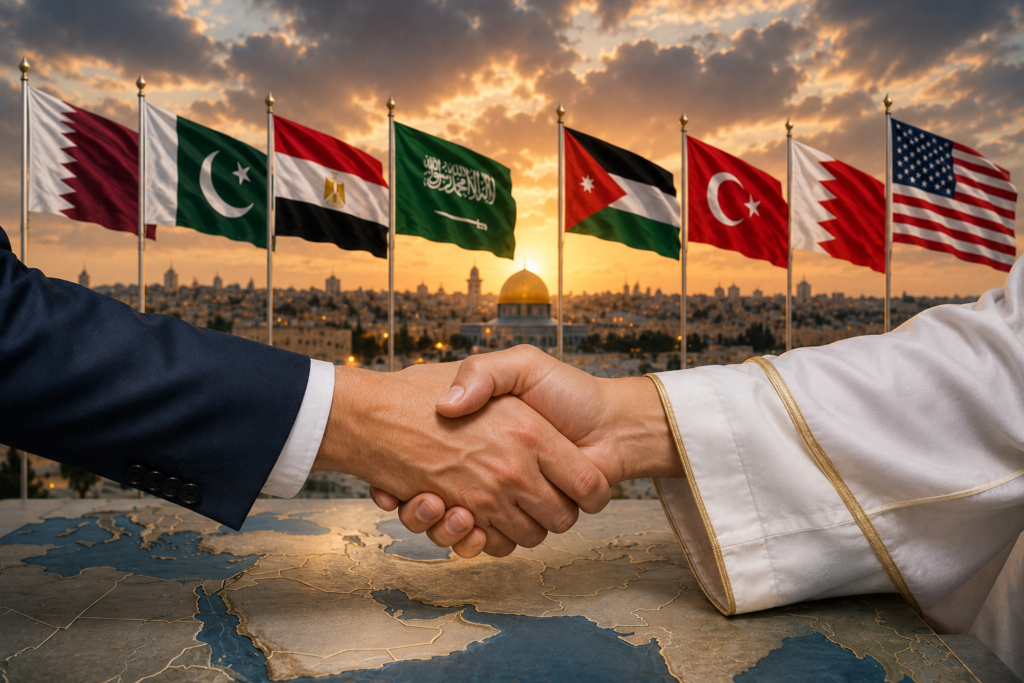
Image Credentials: Image Title: Trump Pushes to Expand Abraham Accords as Part of Emerging Iran Peace Framework. Source: (chatgpt.com) Date: May 2026. Attribution: This image was created using AI-generated imagery (chatgpt.com) by Open Chronicle and does not depict a real-world scene.
By Open Chronicle with agencies
US President Donald Trump has linked ongoing negotiations with Iran to a broader diplomatic initiative aimed at dramatically expanding the Abraham Accords across the Middle East and parts of the wider Muslim world.
In a statement published Monday on Truth Social, Trump said countries including Qatar, Pakistan, Egypt, Jordan, and Turkey should “simultaneously” join the normalization agreements with Israel as part of a larger regional settlement connected to the current US–Iran negotiations.
Trump revealed that he had spoken over the weekend with leaders from those countries, as well as Saudi Arabia and Bahrain. Bahrain was one of the original signatories of the Abraham Accords, alongside the United Arab Emirates, during Trump’s first administration.
“After all the work done by the United States to try and pull this very complex puzzle together, it should be mandatory that all of these Countries, at a minimum, simultaneously sign onto the Abraham Accords,” Trump wrote.
The US president also suggested that Iran itself could eventually become part of the accords once a broader peace agreement is reached and regional hostilities formally end.
The remarks come amid ongoing negotiations between Washington and Tehran over a possible memorandum of understanding intended to transform the current ceasefire into a longer-term diplomatic framework. Talks continue to focus on the Strait of Hormuz, sanctions, Iran’s nuclear programme, and regional security guarantees.
While Trump described negotiations with Iran as “proceeding nicely,” he offered no indication that a final agreement was imminent. American and Iranian officials have both acknowledged progress in recent days, though major disagreements remain unresolved.
The Abraham Accords, first launched in 2020, normalized diplomatic relations between Israel and several Arab states and were widely viewed as one of the defining foreign policy initiatives of Trump’s first presidency. The agreements reshaped parts of the Middle East’s diplomatic landscape by prioritizing economic cooperation, security coordination, and shared concerns over Iran’s regional influence.
Trump’s latest proposal, however, would significantly expand the accords beyond their original scope. Including countries such as Pakistan and Turkey would represent a major geopolitical shift, particularly given the longstanding domestic and regional sensitivities surrounding relations with Israel.
Saudi Arabia’s position also remains critical. Riyadh has maintained informal cooperation with Israel in recent years but has stopped short of formal normalization, often linking any breakthrough to progress on Palestinian statehood and broader regional stability.
The renewed diplomatic push comes at a highly sensitive moment across the region. The war involving Iran, Israel, and the United States has destabilized energy markets, disrupted shipping routes through the Strait of Hormuz, and intensified concerns over wider regional escalation.
Trump appears to be positioning the Abraham Accords not only as a normalization framework, but also as the foundation for a larger political and security architecture intended to stabilize the Middle East after months of conflict.
Analysts note that tying the accords directly to an Iran settlement could complicate negotiations further. Some regional governments may resist appearing aligned with Israel before a final deal with Tehran is secured, while hardline factions inside Iran remain deeply opposed to any regional framework involving normalization with Israel.
Despite the uncertainty, Washington continues to push for rapid diplomatic progress. The White House believes a broader regional agreement could help reduce tensions, reopen critical trade routes and create a new balance of power in the Middle East centered around economic integration and security cooperation.
For now, however, negotiations remain fragile, with both diplomacy and military pressure continuing simultaneously across the region.