
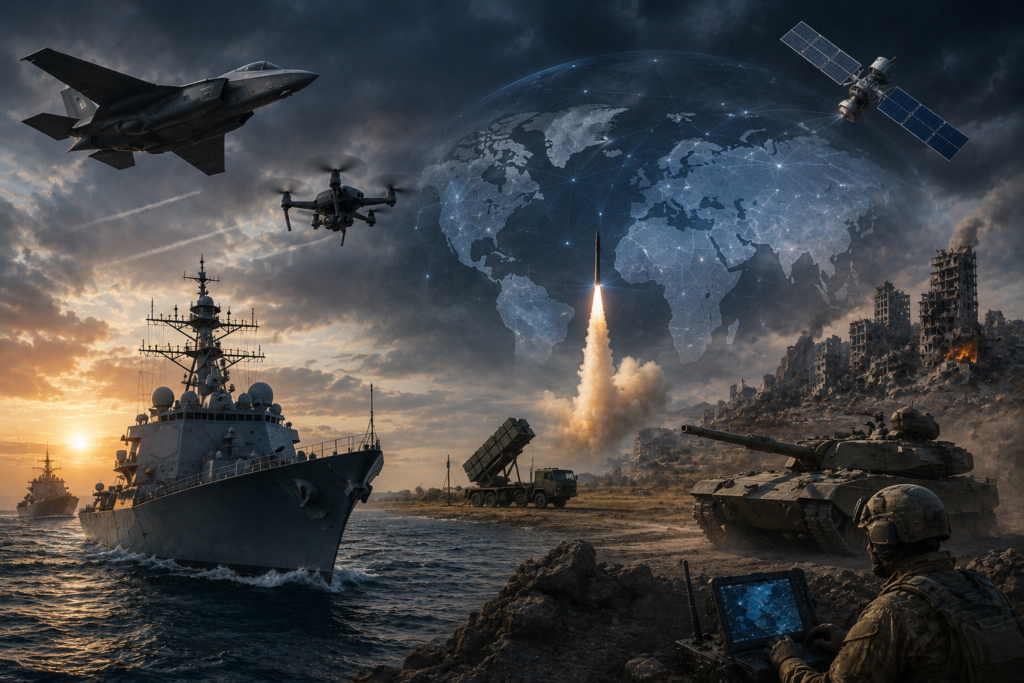
Image Credentials: Image Title: Russia, NATO, and the Expanding Shadow of Modern Warfare. Source: (chatgpt.com) Date: May 2026. Attribution: This image was created using AI-generated imagery (chatgpt.com) by Open Chronicle and does not depict a real-world scene.
By Open Chronicle with agencies
Tensions between Russia and NATO intensified again on Monday as reports emerged of Russian cruise missile warships operating just 30 miles off the British coast, alongside new accusations of GPS jamming targeting a Royal Air Force aircraft carrying UK Defence Secretary John Healey. The developments come amid a broader escalation in military activity stretching from Eastern Europe to the Indo-Pacific, where nations are accelerating investments in drones, missile systems, and artificial intelligence-driven warfare.
The appearance of Russian naval assets near British waters has reignited concerns inside NATO over Moscow’s increasingly aggressive military posture. British officials confirmed that Royal Navy assets monitored the Russian vessel as it moved through international waters close to the UK coastline.
The incident followed another confrontation involving a Royal Air Force aircraft transporting Healey from Estonia. According to British media reports, the aircraft’s GPS systems were jammed for several hours while flying near Russian territory, forcing pilots to rely on backup inertial navigation systems. UK defence sources described the move as “reckless,” particularly because it risked interference with civilian aviation routes.
The UK government has not formally accused Moscow of directly ordering the jamming operation, but security officials say the incident reflects the increasingly hostile electronic warfare environment surrounding NATO’s eastern flank.
Meanwhile, the war in Ukraine continues to evolve into a testing ground for next-generation military technologies. Russian forces launched another large-scale missile attack over the weekend, reportedly involving additional use of the hypersonic “Oreshnik” ballistic missile system. Ukrainian and Western analysts are still examining conflicting reports suggesting that one of the missiles may have accidentally struck Russian-controlled territory in occupied Donetsk.
Germany condemned the latest missile strikes as a “reckless escalation,” while Ukraine called for an emergency meeting of the United Nations Security Council following renewed attacks on Kyiv and other regions.
Electronic warfare is also becoming one of the defining features of the conflict. Reports indicate Russian jamming systems operating from Kaliningrad are increasingly disrupting drone operations near NATO borders, occasionally redirecting Ukrainian drones toward neighbouring alliance states. Military experts warn that the growing sophistication of GPS interference and cyber-electronic attacks could create serious risks for both military and civilian infrastructure across Europe.
At the same time, Western governments are dramatically increasing investment in unmanned systems and AI-assisted combat platforms. The Pentagon announced plans to purchase approximately $500 million worth of AI-enabled drones, many of which were tested under battlefield conditions in Ukraine. The US Army is also pushing first-person-view drone systems down to platoon level in new combat exercises, reflecting how rapidly low-cost drone warfare is reshaping modern military doctrine.
Across NATO, members remain divided over how far military aid to Ukraine should expand. Several major alliance countries reportedly blocked a proposal to increase mandatory military support spending tied specifically to Ukraine assistance. Spain, despite previously pledging €1 billion in aid, was among the countries resisting a NATO framework designed to formalise additional commitments.
The disagreements highlight growing strains inside the alliance as governments balance domestic political pressures, economic uncertainty, and long-term security concerns.
Elsewhere, China’s military modernization continues drawing international attention. New imagery of China’s Y-9GX-18 gunship revealed advanced radar systems, a turret-mounted cannon, and possible directed infrared countermeasure technology. At the same time, Washington released a new report to Congress warning about China’s expanding nuclear and missile capabilities, describing Beijing’s strategic buildup as one of the central security challenges of the coming decades.
Artificial intelligence is emerging as another major battleground shaping future conflicts. Pope Leo XIV warned this week against the rise of AI-driven warfare, arguing that autonomous weapons systems risk lowering the moral threshold for armed conflict. Yet defence companies across the world are accelerating AI integration into missile defence, surveillance, and autonomous drone systems.
Projects such as the US “Golden Dome” missile defence initiative are increasingly relying on AI-powered analysis and automation, marking what analysts describe as a transformative moment for military technology firms.
In Eastern Europe, NATO continues to reinforce its forward presence. Allied airpower exercises, drone integration programs, and multinational training operations are expanding across the Baltic region and Poland. Finnish officials warned that Russia’s military losses remain severe, but cautioned Moscow still retains the capacity for prolonged confrontation.
As the conflict in Ukraine drags deeper into its fourth year, the military balance across Europe appears increasingly shaped not only by conventional weapons but by electronic warfare, AI systems, cyber operations, and unmanned technologies that are redefining how future wars may be fought.