
Image: from Asbarez News X @Asbarez
By Open Chronicle with agencies
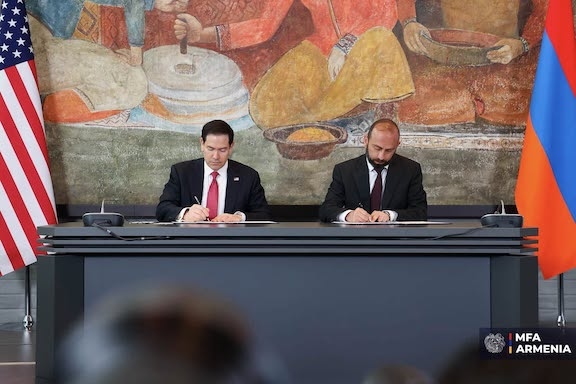
Armenia has signed a historic strategic partnership agreement with the United States in a move widely viewed as a direct challenge to growing Russian pressure on the South Caucasus nation. The agreement, signed in Washington by US Secretary of State Marco Rubio and Armenian Foreign Minister Ararat Mirzoyan, marks one of the most significant shifts in Armenian foreign policy since the collapse of the Soviet Union.
The deal comes just weeks before Armenia heads into crucial parliamentary elections on June 7, where Prime Minister Nikol Pashinyan and his pro-Western Civil Contract party are facing a fragmented but vocal pro-Russian opposition coalition.
The partnership reflects Armenia’s accelerating effort to reduce its historical dependence on Russia and strengthen ties with Western institutions. Over the past year, Yerevan has officially launched a process aimed at eventual accession to the European Union and hosted a major EU summit that reportedly angered the Kremlin.
Армения и США подписали устав о всеобъемлющем стратегическом партнёрстве,также заключили рамочный меморандум по добыче и переработке критически важных минералов и редкоземельных металлов.
Рубио прибыл в Ереван по пути из Индии и ему хватило 1 часа на то, чтобы построить Армению pic.twitter.com/lj6NsJRGr2
— Natalya (@Nancy_NB_713) May 26, 2026
Moscow has responded with growing economic pressure. Russian authorities recently imposed import restrictions on Armenian products, including flowers, mineral water and brandy, while also threatening increases in natural gas prices supplied to Armenia. The measures have been interpreted by analysts as an attempt to weaken public support for Pashinyan’s Western-oriented agenda ahead of the elections.
Beyond the broader diplomatic agreement, Washington and Yerevan also signed a framework focused on Armenia’s strategic mining sector, particularly iron, copper and zinc resources. Rubio described the cooperation as essential for securing reliable access to critical minerals for both countries amid increasing global competition over supply chains and industrial resources.
A major component of the agreement is the development of a 43-kilometer transit corridor through southern Armenia known as the “Trump Route for International Peace and Prosperity,” or TRIPP. The route would provide neighboring Azerbaijan with direct access to its Nakhchivan exclave and onward connections to Türkiye.
The corridor emerged from preliminary peace understandings reached between Armenia and Azerbaijan in 2025 after decades of intermittent conflict over the Nagorno-Karabakh region. Although a final comprehensive peace treaty has not yet been signed, the project is seen as a major geopolitical breakthrough.
For Washington, the corridor offers strategic value far beyond the South Caucasus. It would create a trade route linking Europe and Asia while bypassing both Russia and Iran, reducing dependence on existing regional transit networks and potentially reshaping energy and mineral supply chains.
The agreement also illustrates the growing geopolitical competition unfolding across the Caucasus as Western powers seek to counter Russian and Iranian influence in the region.
Russian President Vladimir Putin recently suggested Armenia could hold a referendum on leaving the Moscow-led Eurasian Economic Union if it wished to pursue EU integration more aggressively. Pashinyan rejected the idea, insisting Armenia would continue balancing its obligations while deepening cooperation with Europe.
The new US-Armenia partnership is likely to further strain already tense relations between Yerevan and Moscow, while simultaneously strengthening Armenia’s position as a key strategic player between Europe, the Middle East and Central Asia.