
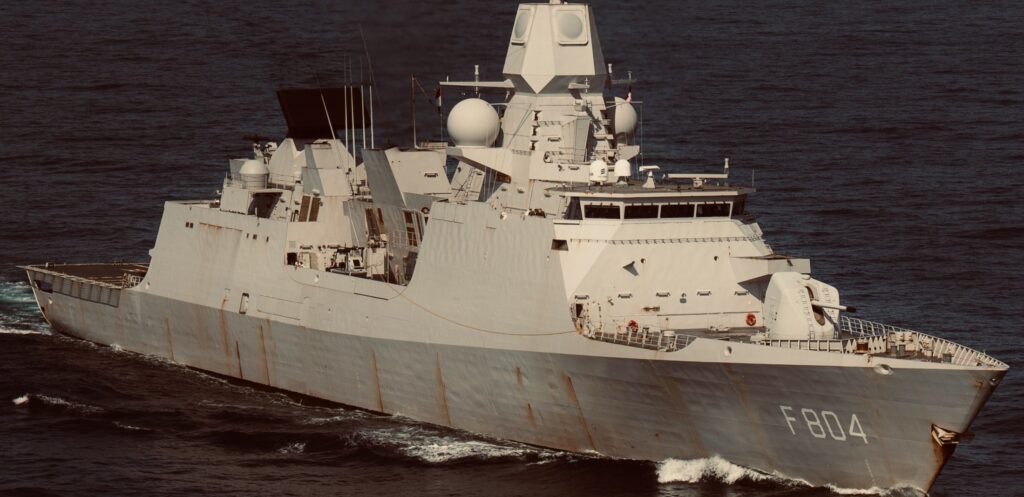
Image: from China Military Bugle X @ChinaMilBugle
By Open Chronicle with agencies
China’s military said it used electronic interference measures to force a Dutch naval frigate away from waters near the disputed Paracel Islands in the South China Sea, escalating tensions over freedom of navigation operations in one of the world’s most contested maritime regions.
Representatives of the Chinese military’s Southern Theater Command announced on Wednesday that the Dutch frigate De Ruyter had “illegally intruded” into what Beijing refers to as the Xisha Islands, according to statements published on official military social media channels.
The Paracel Islands, controlled by China since 1974, are also claimed by Vietnam and Taiwan. The archipelago lies roughly 190 miles from China’s Hainan province and remains a major flashpoint in regional territorial disputes.
🇨🇳❌🇳🇱 A Chinese Navy helicopter briefly approached the Dutch frigate HNLMS De Ruyter while the vessel was sailing through the South China Sea during its Indo-Pacific deployment.
The Dutch side described the interaction as professional, stating that the helicopter simply… pic.twitter.com/8smE5eAVyK— NSTRIKE (@NSTRIKE1231) May 27, 2026
Chinese military spokesperson Zhai Shichen said forces had taken “necessary measures, including verbal warnings and warning electronic interference” after the Dutch vessel and one of its onboard helicopters allegedly entered Chinese-controlled airspace and waters.
“We firmly oppose such acts and solemnly demand that the Dutch side immediately cease its infringement and provocative actions,” Zhai stated.
He also warned that the Dutch ship’s activities were “extremely liable to trigger misunderstanding and miscalculation,” adding that the Chinese military would remain on high alert to safeguard what Beijing considers its sovereignty and regional stability.
The Netherlands has not publicly commented on the incident.
The De Ruyter is currently participating in the five-month Pacific Archer mission, a deployment intended to strengthen ties with allies and support freedom of navigation operations throughout the Indo-Pacific region.
Western nations, including several NATO members, have increasingly expanded naval patrols in the South China Sea in response to China’s growing military presence and territorial claims. Beijing, however, regularly condemns such missions as foreign interference and provocation.
Electronic warfare tactics, including jamming and signal disruption, have become an increasingly common tool in maritime confrontations involving major military powers. Analysts note that such actions allow states to demonstrate force without direct physical confrontation, though they also increase the risk of escalation and accidental conflict.
The South China Sea remains one of the world’s most strategically important waterways, carrying trillions of dollars in global trade annually. Multiple regional states dispute overlapping territorial claims there, while the United States and European allies continue to emphasize the principle of open international navigation.
The latest incident highlights the growing strategic competition unfolding across the Indo-Pacific as China expands its military capabilities and Western powers deepen naval cooperation in the region.