
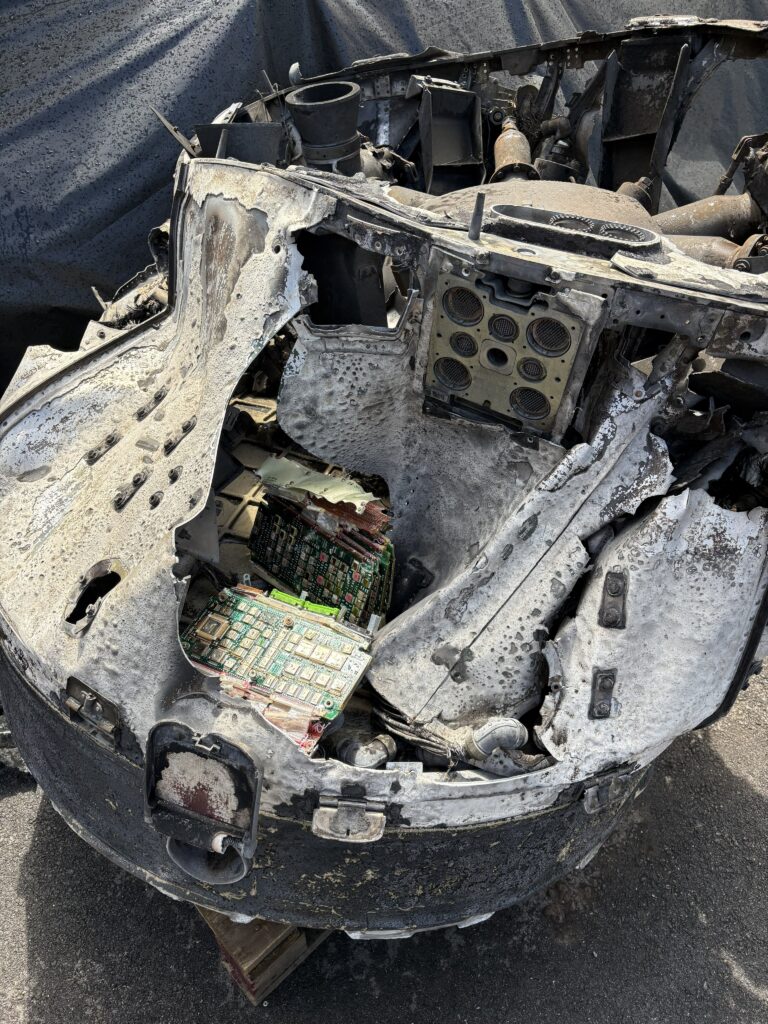
Image: from Dylan Malyasov | X @DylanMalyasov
By Open Chronicle with agencies
Ukrainian investigators have released new details from the wreckage of a Russian ballistic missile that struck an industrial area near Bila Tserkva in the Kyiv region on May 24, offering one of the clearest looks yet inside the missile system Moscow has branded as the Oreshnik.
According to Ukrainian officials and analysis reported by Defence Blog, the weapon used in the attack was the RS-26 Rubezh ballistic missile, which Russia has promoted under the name Oreshnik. The missile was reportedly launched from the Kapustin Yar test range in Russia’s Astrakhan region.
The strike marked the third known combat use of the system, following previous launches against targets in Dnipro in November 2024 and the Lviv region in January 2026.
Ukraine published Oreshnik debris analysis from Bila Tserkva: MIRV separation unit recovered, craters 3m wide/2m deep, zero explosive content confirmed. OSINT analyst @kimhvik2 : evidence of second Oreshnik fired near Donetsk at 00:59, 17 min before Bila Tserkva at 01:16.
Read… pic.twitter.com/I3aOVr0e6W
— Dylan Malyasov | 🧐 (@DylanMalyasov) May 28, 2026
Inert Payloads Instead of Explosive Warheads
Perhaps the most significant discovery was that the missile carried inert warhead simulators rather than explosive payloads.
Investigators found metal and concrete blocks designed to mimic the weight and flight characteristics of real warheads. Similar configurations had reportedly been identified in the two previous Oreshnik strikes.
The missile impacted an industrial zone and a nearby garage complex in Bila Tserkva, approximately 80 kilometers south of Kyiv. No casualties were reported.
Experts examining the site found craters measuring roughly three meters wide and two meters deep, dimensions consistent with impacts from heavy inert objects rather than conventional explosive warheads.
The findings suggest that Russia may be using the missile operationally to demonstrate its capabilities while avoiding the large-scale destruction that would accompany the deployment of its intended payloads.
A Nuclear-Capable System
The Oreshnik is designed as a nuclear-capable missile equipped with multiple independently targetable reentry vehicles, commonly known as MIRVs.
This technology allows a single missile to release multiple warheads during flight, each capable of striking a separate target.
Recovered components indicate the missile contains six primary warhead elements. Investigators say each of these separates into six smaller submunitions during the final phase of flight, creating a distinctive pattern of 36 impact points observed in all known Oreshnik strikes.
Among the debris recovered was a deployment mechanism responsible for separating the reentry vehicles, along with wiring systems linking the warhead elements.
Domestic Components Identified
Electronic components recovered from the missile were found to contain manufacturing dates from 2018, matching evidence collected from earlier Oreshnik incidents.
According to Ukraine’s Commissioner for Sanctions Policy, Vladyslav Vlasiuk, most of the electronic components originated from Russian and Belarusian manufacturers.
Officials identified 57 components produced in Russia and five manufactured in Belarus, highlighting the continued use of domestically sourced technology despite international sanctions.
Evidence Suggests Multiple Launches
Open-source intelligence analysts believe more than one Oreshnik missile may have been launched during the overnight operation.
Analyst Kim Høvik examined footage recorded from different locations and suggested that a second missile may have been observed over the occupied Donetsk region approximately 17 minutes before the confirmed strike on Bila Tserkva.
The possibility of a second launch was later referenced by Ukrainian President Volodymyr Zelenskyy in correspondence addressed to Donald Trump and members of the U.S. Congress.
The fate of the second missile remains unclear. Officials have not confirmed whether it struck a target, failed during flight, or was part of a separate test.
Strategic Significance
Analysts note that the choice of Bila Tserkva as a target may carry strategic significance. Previous Oreshnik strikes targeted different regions of Ukraine, gradually demonstrating the missile’s ability to reach various parts of the country.
By employing inert payloads, Russia can gather operational performance data while limiting casualties and avoiding escalation associated with the use of fully armed warheads.
Ukrainian Air Force spokesperson Colonel Yurii Ihnat said Ukraine continues to monitor launches from the Kapustin Yar range using satellite surveillance and other intelligence assets capable of detecting missile launches through thermal signatures.
The latest findings provide valuable insight into one of Russia’s most closely watched missile systems and offer Ukrainian and Western analysts a rare opportunity to study its design, capabilities and operational use.