
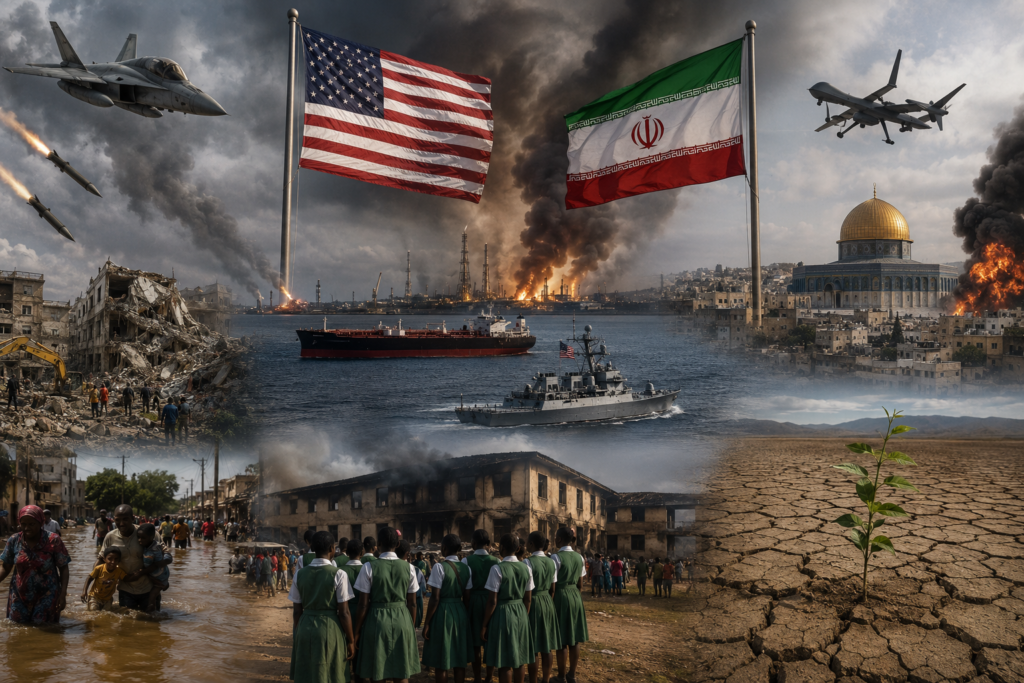
Image Credentials: Image Title: Global News Brief: Key Events and Developments for May 28, 2026. Source: (chatgpt.com) Date: May 2026. Attribution: This image was created using AI-generated imagery (chatgpt.com) by Open Chronicle and does not depict a real-world scene.
By Open Chronicle with agencies
Global Tensions Escalate as U.S. and Iran Exchange Strikes Amid Fragile Hormuz Ceasefire
A fragile ceasefire between the United States and Iran appeared increasingly unstable on Thursday after both sides exchanged new military strikes around the strategically vital Strait of Hormuz, raising fears of a broader regional escalation.
The renewed violence came just hours after U.S. President Donald Trump dismissed reports suggesting that Washington had reached a draft agreement with Tehran over navigation rights and de-escalation measures in the Gulf.
New Airstrikes and Drone Attacks Raise Alarm
According to U.S. officials, American forces carried out fresh airstrikes in southern Iran targeting military infrastructure and drone control facilities after U.S. forces reportedly intercepted several Iranian drones.
Iranian officials, meanwhile, claimed they launched retaliatory strikes against a U.S. airbase and accused Washington of violating the ceasefire framework that had temporarily reduced tensions in recent weeks.
The situation around the Strait of Hormuz remains highly volatile. Iranian authorities reportedly fired on multiple commercial vessels attempting to cross the narrow waterway. At the same time, Kuwait announced that its air defense systems intercepted unidentified missiles and drones amid growing regional instability.
European officials also expressed concern over the deteriorating situation. European Union foreign policy chief Kaja Kallas described the strait as existing in a “strange state between war and peace.”
Trump Issues New Threats Toward Oman
The crisis deepened after reports emerged that President Trump threatened military action against Oman if Muscat were to cooperate with Iran over future control or regulation of shipping through the Strait of Hormuz.
Washington later imposed sanctions on Iran’s newly proposed Hormuz maritime authority, accusing Tehran of attempting to unlawfully impose tolls and restrictions on one of the world’s most important energy corridors.
The White House denied media reports suggesting that a finalized Hormuz agreement had already been drafted, calling the claims a “complete fabrication.”
Regional Instability Spreads Beyond the Gulf
The Middle East crisis continued to spill into neighboring regions.
Israel declared new “combat zones” in southern Lebanon and ordered evacuations after renewed airstrikes reportedly killed several people, including children.
Meanwhile, the Russian state nuclear agency Rosatom announced it was postponing the return of personnel to Iran’s Bushehr nuclear facility due to ongoing security concerns.
Across the Black Sea, shipping agencies reported drone attacks targeting three tankers near Türkiye’s coastline, though crews were said to be safe.
Global Security and Economic Concerns Intensify
Military analysts warned that the continued confrontation could severely strain U.S. defense resources. Reports suggest the conflict is already impacting American military readiness and increasing pressure on weapons stockpiles.
Energy markets also remain on edge as uncertainty surrounding the Strait of Hormuz threatens global oil supplies. The waterway handles a significant portion of the world’s crude exports, making any disruption a major economic risk.
At the same time, international diplomatic efforts appear stalled. Iranian officials insist they will maintain sovereignty over the Strait of Hormuz and reject any foreign limitations on their activities there.
Other Major Developments Around the World
Elsewhere, global headlines reflected growing instability across several regions.
In Kenya, at least 15 schoolgirls were killed in a devastating dormitory fire at a girls’ boarding school, with dozens more injured.
In Uganda, authorities closed the border with the Democratic Republic of the Congo amid fears of a worsening Ebola outbreak.
A new United Nations climate report warned that global temperatures are likely to remain near record highs between 2026 and 2030, increasing pressure on governments to accelerate climate adaptation measures.
Meanwhile, tensions between Russia and NATO continued to rise after a Russian military aircraft reportedly breached Finnish airspace, triggering a response from NATO fighter jets.
Growing Fear of Wider Conflict
Despite diplomatic channels remaining technically open, the latest exchanges between Washington and Tehran underline how quickly the region could slide back into a broader war.
Iranian officials have publicly stated that the possibility of a return to full-scale conflict remains “low,” but the pace of military activity across the Gulf, Lebanon, and surrounding regions continues to fuel uncertainty among allies and global markets alike.