
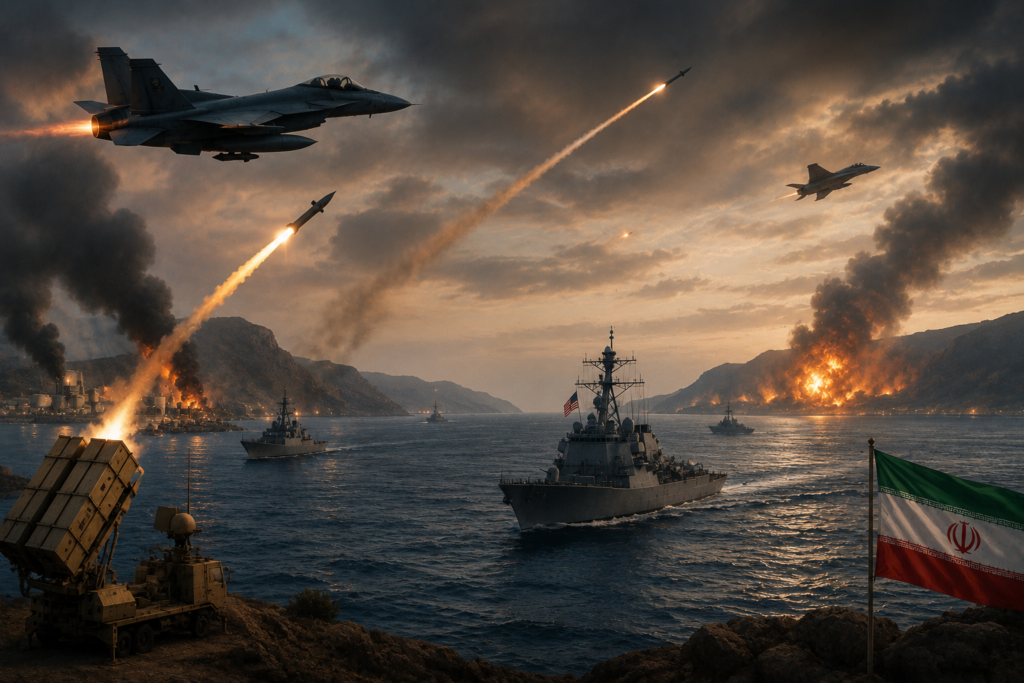
Image Credentials: Image Title: U.S. and Iran Exchange New Attacks as Strait of Hormuz Tensions Escalate. Source: (chatgpt.com) Date: May 2026. Attribution: This image was created using AI-generated imagery (chatgpt.com) by Open Chronicle and does not depict a real-world scene.
By Open Chronicle with agencies
The fragile ceasefire between the United States and Iran came under renewed strain early Thursday after both countries exchanged military strikes around the Strait of Hormuz, deepening fears of a wider regional conflict.
Iran confirmed that American forces carried out strikes near Bandar Abbas Airport in southern Iran, targeting what Washington reportedly described as military assets connected to Iranian naval operations. The attacks marked the second direct U.S. military action against Iran this week.
Iran Launches Retaliatory Strike
In response, Iran’s Islamic Revolutionary Guard Corps, known as the IRGC, announced retaliatory strikes against a U.S. airbase at approximately 4:50 a.m. local time.
“This response is a serious warning so that the enemy knows aggression will not go unanswered,” the IRGC declared in a statement carried by Iranian state media. The statement further warned that any future attacks would trigger a “more decisive” response.
The precise location of the targeted American base and the extent of any damage remain unclear. The U.S. military had not publicly commented on the incident by Thursday morning.
At the same time, the Kuwait Army said its air defense systems were intercepting “hostile missile and drone attacks,” although officials did not immediately confirm whether those threats were directly connected to the U.S.-Iran confrontation.
Hormuz Crisis Remains Central Flashpoint
The latest escalation once again highlighted the strategic importance of the Strait of Hormuz, one of the world’s most critical maritime energy corridors.
According to Iranian media reports citing military sources, the U.S. strikes followed an incident in which the Iranian Navy allegedly fired warning shots at a U.S.-linked oil tanker attempting to transit the strait with its radar system turned off.
The vessel reportedly abandoned its attempt to cross the waterway.
Since the conflict began, Iran has imposed heavy restrictions on maritime traffic through Hormuz, allowing only selected vessels to pass. In response, the United States established a blockade targeting Iranian ports and maritime trade.
Washington has repeatedly stated that ensuring free navigation through the Strait of Hormuz remains one of its primary objectives.
Trump Warns Oman During Cabinet Meeting
Speaking during a Cabinet meeting on Wednesday, President Donald Trump rejected suggestions that Iran or Oman could jointly control the strategic waterway.
“It’s international waters. Nobody’s going to control it,” Trump told reporters.
The president also issued a blunt warning toward Oman amid reports that Muscat and Tehran had discussed future oversight arrangements for the strait.
“And Oman will behave just like everybody else, or we’ll have to blow them up,” Trump said. “They understand that. They’ll be fine.”
The remarks immediately drew international attention and raised further concerns about the increasingly aggressive rhetoric surrounding negotiations.
Diplomacy Continues Despite Military Escalation
Despite the latest clashes, diplomatic discussions between Washington and Tehran have not completely collapsed.
Talks have continued since a ceasefire agreement was reached last month, though repeated incidents at sea and competing demands over Hormuz remain major obstacles.
Iran reportedly insists that maintaining a degree of control over the strait is essential to any final agreement, while the United States and its allies continue to demand unrestricted international access.
The renewed violence now threatens to undermine already fragile negotiations and risks pushing the region closer to another broader military confrontation.