
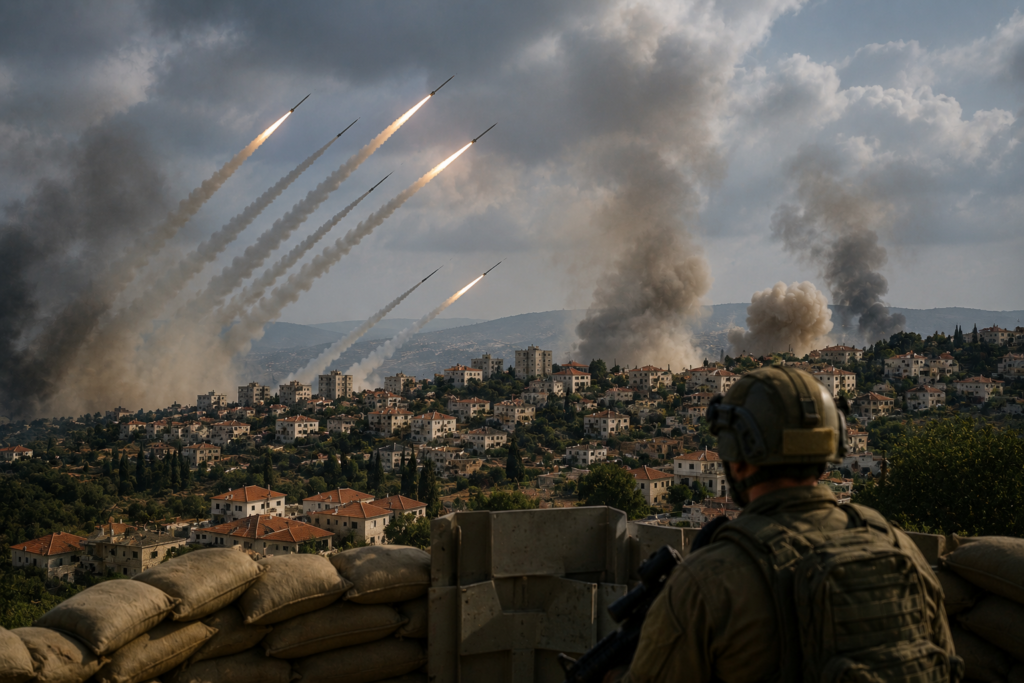
Image Credentials: Image Title: Netanyahu Convenes Emergency War Cabinet After Hezbollah Rocket Barrage Catches Israel Off Guard. Source: (chatgpt.com) Date: May 2026. Attribution: This image was created using AI-generated imagery (chatgpt.com) by Open Chronicle and does not depict a real-world scene.
By Open Chronicle with agencies
Israeli Prime Minister Benjamin Netanyahu convened an urgent security meeting on Saturday after a wave of Hezbollah rocket attacks penetrated deeper into northern Israel than at any point since the latest ceasefire took effect, raising concerns about a significant escalation along the Lebanese border.
The emergency consultation brought together Defense Minister Israel Katz, Israel Defense Forces Chief of Staff Eyal Zamir, and senior military commanders responsible for northern operations, according to Israeli media reports.
The meeting was called after dozens of rockets launched from southern Lebanon reached major northern Israeli cities, including Safed and Nahariya, marking a notable shift in Hezbollah’s operational approach.
Hezbollah Changes Tactics
According to reports from Israeli broadcasters, military officials were surprised by both the scale of the attacks and Hezbollah’s apparent decision to alter its fire policy in response to Israel’s expanding ground operations in southern Lebanon.
For the first time since the ceasefire began on April 17, rockets struck areas significantly deeper inside Israeli territory, challenging assumptions that the border front had entered a period of relative stability.
Israeli media described growing concern within military circles over what appears to be a more aggressive posture from Hezbollah following weeks of increasing tensions.
The attacks triggered air raid sirens across northern communities and reignited fears among residents who had hoped that the fragile ceasefire would prevent a return to large-scale hostilities.
Growing Security Concerns in Northern Israel
Israeli Army Radio reported that warning sirens have sounded 1,099 times across northern Israel since the ceasefire came into effect, highlighting the continued volatility of the situation despite ongoing diplomatic efforts.
Some commentators described the security environment in northern Israel as increasingly unstable, with local authorities facing renewed pressure to protect civilian populations living near the border.
The latest rocket barrage has intensified debate within Israel over the effectiveness of current military and political strategies toward Hezbollah and Lebanon.
Hezbollah Expands Use of Drones
In addition to rocket attacks, Hezbollah announced that it carried out drone operations targeting Israeli soldiers near the settlement of Natua and against the Galilee Forest military camp in northern Israel.
The growing use of drones by Hezbollah has become a significant concern for Israeli defense planners.
Prime Minister Netanyahu has previously described Hezbollah’s drone capabilities as a major threat, citing the challenges involved in detecting and intercepting low-flying unmanned aircraft.
Military analysts note that drones have increasingly become a defining feature of modern conflicts across the Middle East, offering armed groups relatively low-cost but effective means of surveillance and attack.
Ceasefire Under Increasing Strain
The renewed violence comes despite a ceasefire arrangement that was extended for 45 days beginning on May 17 following indirect negotiations mediated by the United States.
Although the agreement was intended to reduce hostilities along the border, clashes and military operations have continued on both sides.
Israel has maintained military actions inside Lebanon, arguing that operations are necessary to counter security threats posed by Hezbollah and other armed groups.
The latest exchange of fire raises questions about whether the ceasefire can survive mounting pressure from ongoing military activity and growing mistrust between the parties.
Humanitarian Toll Continues to Rise
According to figures released by Lebanon’s Ministry of Public Health, Israeli military operations since March 2 have resulted in more than 3,371 deaths across Lebanon.
The continuing conflict has caused significant displacement, infrastructure damage, and humanitarian challenges in several regions of the country.
International observers have repeatedly warned that further escalation could destabilize the broader region, particularly as tensions remain elevated across multiple fronts in the Middle East.
Regional Implications
The latest developments underscore the fragile nature of the security situation along the Israel-Lebanon border. With Hezbollah demonstrating an apparent willingness to expand the reach of its attacks and Israel continuing military operations in southern Lebanon, the risk of a broader confrontation remains significant.
As diplomatic efforts struggle to contain the violence, military and political leaders on both sides face increasing pressure to prevent the border conflict from evolving into a larger regional crisis.