
Image: from China Xinhua Español X @XHespanol
By Open Chronicle with agencies
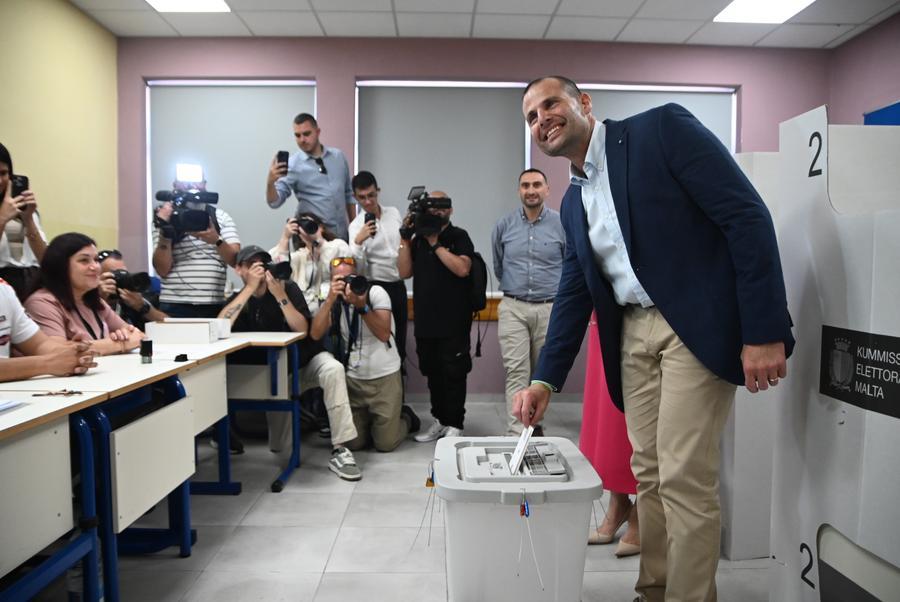
Malta’s governing Labour Party has secured a historic fourth consecutive term in office, delivering a major political victory for Prime Minister Robert Abela amid growing concerns over instability in the Middle East and its potential economic consequences for the Mediterranean island nation.
Preliminary results announced on Sunday confirmed Labour’s victory, prompting celebrations across Malta as supporters gathered in the streets waving red party flags and marking what many described as an unprecedented political achievement.
The result grants Abela, 48, a renewed mandate after he called a snap election a year ahead of schedule. The prime minister argued that Malta needed strong and stable leadership to navigate mounting geopolitical uncertainties, particularly the ongoing crisis in the Middle East, which poses risks to tourism, energy costs, and inflation.
Speaking after the results became clear, Abela declared that Labour had made history.
“All indications appear to show that the Malta Labour Party has made history, winning four elections in a row,” he said.
The election was largely shaped by economic issues. Malta recorded economic growth of approximately 4 percent last year, maintaining one of the strongest performances within the European Union. Labour campaigned heavily on that record, presenting itself as the guarantor of stability during an increasingly uncertain international environment.
The party’s victory was celebrated by supporters throughout the island. Fireworks lit up the night sky while crowds gathered in towns and villages to mark the outcome.
Abela’s main challenger, Nationalist Party candidate Alex Borg, conceded defeat shortly after the preliminary results were announced. Borg, a lawyer and former beauty pageant winner, had campaigned on promises of political renewal and reform.
In a statement posted on social media, he confirmed that he had personally congratulated the prime minister.
Despite longstanding concerns about governance and corruption, these issues played a relatively limited role during the campaign. Malta continues to face scrutiny over reforms following the 2017 assassination of investigative journalist Daphne Caruana Galizia, whose reporting exposed alleged corruption at the highest levels of government. A 2025 report by the Council of Europe noted that the country still faces significant challenges in strengthening anti-corruption measures.
However, economic concerns appeared to dominate voter priorities.
Growth and Growing Pressures
Malta’s economy remains heavily dependent on tourism, online gaming, financial services, and foreign labor. The country enjoys one of the lowest unemployment rates in the European Union, but rapid growth has also created new challenges.
Over the past decade, Malta’s population has increased by nearly 30 percent, driven largely by immigration. The influx has fueled a construction boom across the island, transforming skylines with new developments while also creating traffic congestion and increasing pressure on public services.
Environmental groups have repeatedly warned that rapid urban expansion threatens Malta’s natural landscapes and historic heritage sites, including locations recognized by UNESCO.
As a small island nation with limited natural resources, Malta remains vulnerable to external economic shocks. The government continues to subsidize household energy bills, a policy Labour pledged to maintain throughout the next term.
Climate change also presents growing risks, with experts warning about increasing drought conditions and the potential for desertification across parts of the country. Nevertheless, environmental issues remained largely secondary during the election campaign.
A Dominant Political Force
The result further reinforces Labour’s dominance in Maltese politics. No third party has held parliamentary representation in Malta since before the country gained independence in 1964, leaving Labour and the Nationalist Party as the two primary political forces.
With another decisive victory secured, Abela now begins a new term facing both opportunities and challenges. While Malta’s economy remains strong, regional instability, demographic pressures, environmental concerns, and rising living costs are expected to test the government in the years ahead.
For now, however, Labour’s historic fourth consecutive electoral triumph cements its place as one of the most successful political movements in modern Maltese history.