
Image: from Sami Yousafzai سمیع یوسفزي X @SamiYousafzaii
By Open Chronicle with agencies
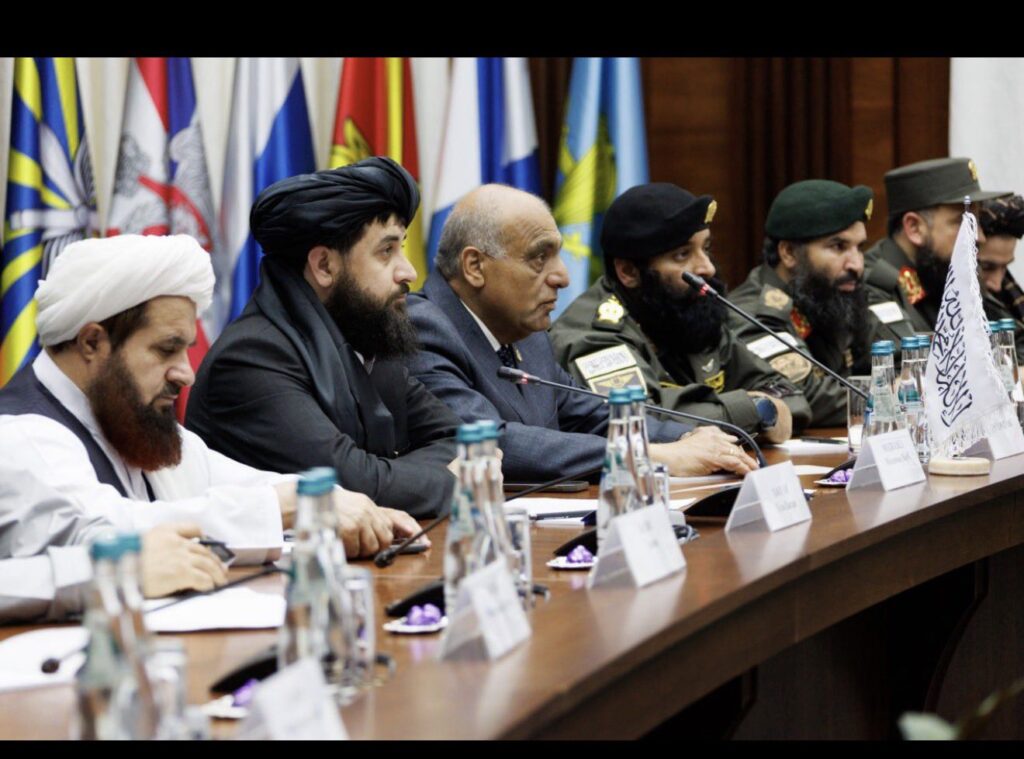
Russia and the Taliban-led government of Afghanistan have signed a military-technical cooperation agreement, marking another significant step in the rapidly expanding relationship between Moscow and Kabul. The agreement comes as the Kremlin seeks what senior Russian officials have described as a “full-fledged partnership” with Afghanistan’s Islamic Emirate.
The deal was reportedly signed on May 27 by Russian Security Council Secretary Sergei Shoigu and Afghanistan’s Defence Minister Mohammad Yaqoob during a security forum held near Moscow. Yaqoob, a prominent figure within the Taliban leadership, is the son of the movement’s founder, Mullah Mohammad Omar.
Although neither side has disclosed the details of the agreement, its signing reflects the growing strategic importance Russia places on cooperation with the Taliban government.
Returning from Moscow, Taliban Defense Minister Mullah Yaqoob announced at Kabul airport that implementation of their new military deal with Russia will begin shortly, warning that Pakistan will "no longer dare to attack" Afghan territory.
The agreement follows escalating border… pic.twitter.com/88BOfdqsN1
— Frontier Files (@frontier_files) May 30, 2026
From Isolation to Partnership
Russia became the first country in the world to formally recognize the Taliban government after removing the movement from its list of terrorist organizations in April 2025. The Taliban had been designated as a terrorist group by Moscow since 2003.
Since then, relations have accelerated. Earlier this month, Shoigu stated that Russia was working to establish a comprehensive partnership with Afghanistan covering security, trade, humanitarian cooperation, culture, and regional development.
According to Russian officials, engagement with the Taliban is viewed as essential for promoting stability across Central Asia and addressing shared security concerns.
🚨🇷🇺 Afghanistan’s Defence Ministry set to activate new military agreement with Russia in the coming days
"Discussions and negotiations are underway to determine how it will be put into practice," Ariana News quotes Afghan Defense Minister Mawlawi Mohammad Yaqoob.
The deal… pic.twitter.com/MyUyPBzAn9
— Sputnik India (@Sputnik_India) May 30, 2026
Security Concerns Along Central Asia’s Borders
One of Moscow’s primary concerns remains the security situation along Afghanistan’s northern frontier with Tajikistan, Uzbekistan, and Turkmenistan.
Russian authorities continue to view extremist groups operating in Afghanistan, particularly the Islamic State Khorasan Province (ISIS-K), as a direct threat to regional stability and Russian national security. The Taliban, which has been engaged in conflict with ISIS-K, is increasingly seen by Moscow as a useful partner in counterterrorism efforts.
The issue has gained additional urgency following a series of cross-border security incidents in the region. Central Asian governments have also strengthened border security measures, while China has expanded cooperation with neighboring Tajikistan to address similar concerns.
Economic Ambitions Behind the Relationship
Beyond security cooperation, Russia sees a stable Afghanistan as a critical link connecting Central Asia with South Asia.
For decades, policymakers have discussed the potential of transforming Afghanistan into a major transit corridor for railways, highways, energy pipelines, and electricity networks connecting the resource-rich states of Central Asia with Pakistan’s ports on the Arabian Sea.
Such infrastructure projects could significantly expand regional trade and provide landlocked Central Asian economies with greater access to global markets. However, instability and conflict have repeatedly delayed these ambitions.
The Taliban government has also promoted plans to develop the Wakhan Corridor, a narrow strip of territory connecting Afghanistan to China. Opening this route could create a direct operational border crossing between the two countries and further integrate Afghanistan into regional trade networks.
Questions About the New Agreement
While the signing of the military-technical cooperation agreement has attracted international attention, analysts caution against assuming it represents a formal military alliance.
Military-technical agreements typically cover a wide range of activities, including arms sales, military training, maintenance services, logistical support, intelligence cooperation, and technical assistance.
Experts note that the lack of publicly available details makes it difficult to assess the agreement’s practical significance.
Ruslan Suleimanov of the New Eurasian Strategies Center argued that a full military alliance remains unlikely. Other analysts point out that Russia’s economic challenges, combined with the ongoing demands of the war in Ukraine, may limit Moscow’s ability to provide extensive military assistance abroad.
Regional Shift Toward Engagement
Russia is not alone in expanding relations with the Taliban administration. Countries such as China, Kazakhstan, and Uzbekistan have steadily increased diplomatic, economic, and trade engagement with Kabul, although they have stopped short of granting formal recognition.
Within the Shanghai Cooperation Organisation (SCO), which includes China, India, Pakistan, Iran, Russia, and several Central Asian states, discussions on Afghanistan’s future role have become increasingly prominent.
Speaking at a recent SCO meeting, Shoigu called for the revival of the organization’s contact group on Afghanistan, signaling Moscow’s desire to integrate the Taliban government more deeply into regional diplomatic structures.
Kazakhstan and Kyrgyzstan have also recently removed the Taliban from their lists of terrorist organizations, reflecting a broader trend toward pragmatic engagement across Eurasia.
A New Phase in Eurasian Geopolitics
The military-technical agreement highlights the evolving geopolitical landscape in Central and South Asia. Five years after returning to power following the withdrawal of U.S. and NATO forces from Afghanistan, the Taliban government is gradually gaining greater regional acceptance, even as many Western countries remain reluctant to recognize it.
For Russia, the partnership represents an effort to strengthen regional security, expand economic connectivity, and counter extremist threats. For the Taliban, it offers an opportunity to reduce diplomatic isolation and attract investment and cooperation from major regional powers.
Whether the new agreement produces substantial military cooperation or remains largely symbolic, it underscores the continuing transformation of Afghanistan’s role in Eurasian politics.