
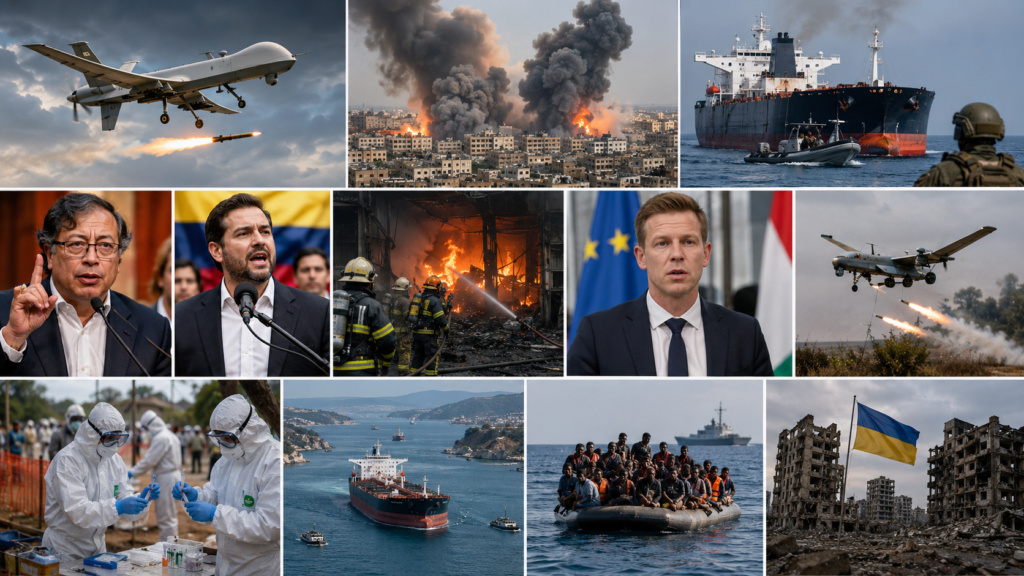
Image Credentials: Image Title: Global News Brief: Key Events and Developments for June 1, 2026. Source: (chatgpt.com) Date: May 2026. Attribution: This image was created using AI-generated imagery (chatgpt.com) by Open Chronicle and does not depict a real-world scene.
By Open Chronicle with agencies
A series of military escalations, diplomatic confrontations, and political developments dominated international headlines on Sunday, highlighting the growing volatility across several regions, from the Middle East and Eastern Europe to Latin America and Asia.
U.S. Strikes Iranian Radar Sites After Drone Incident
Tensions between Washington and Tehran intensified after the United States carried out strikes against Iranian radar installations following the reported downing of an American MQ-1 Predator drone.
U.S. officials described the operation as a defensive measure aimed at protecting American assets in the region. The strikes come as negotiations between the United States and Iran continue over a potential broader agreement intended to stabilize the Gulf and reduce military confrontations.
The incident underscores the fragility of ongoing diplomacy, with both sides continuing to exchange military pressure while publicly expressing support for negotiations.
Israel Expands Military Operations in Lebanon
Israeli Prime Minister Benjamin Netanyahu ordered new strikes against Beirut’s southern suburbs as military operations in southern Lebanon intensified.
The move follows renewed rocket launches attributed to Hezbollah and comes amid growing concerns that the conflict could expand despite international calls for restraint.
Large numbers of residents reportedly fled parts of Beirut after evacuation warnings were issued. Regional and international actors, including Egypt and France, have called for de-escalation and renewed support for Lebanese state institutions.
The latest developments add further uncertainty to an already volatile regional security environment.
France Intercepts Russia-Linked Sanctioned Tanker
French President Emmanuel Macron confirmed that the French Navy boarded and intercepted a tanker linked to Russian oil exports that was allegedly operating in violation of international sanctions.
French authorities stated that the operation was conducted in cooperation with allies, including the United Kingdom.
The Kremlin condemned the action, describing any seizure of Russian-linked vessels as illegal and warning of possible diplomatic consequences.
The interception reflects increasing Western efforts to restrict sanctions evasion through maritime networks often referred to as Russia’s “shadow fleet.”
Colombia Heads Toward Polarized Runoff Election
Colombia’s presidential election produced no outright winner, sending the race into a runoff between a candidate aligned with former U.S. President Donald Trump and a left-wing contender.
The result highlights the growing political polarization within Latin America’s third-largest economy.
Security policy, economic management, relations with the United States, and regional diplomacy are expected to dominate the runoff campaign as voters prepare to choose between sharply different political visions.
South Korea Investigates Deadly Aerospace Plant Fire
South Korean authorities launched an investigation after a fire at a Hanwha Aerospace facility killed five people and injured two others.
Emergency crews responded quickly to the blaze, but the cause remains under investigation.
The incident has raised concerns about industrial safety standards within South Korea’s defense and aerospace sectors, which have expanded rapidly in recent years amid rising global demand for military equipment.
Hungary Faces Constitutional Confrontation
Hungarian opposition leader Péter Magyar threatened legal and constitutional measures to remove the country’s president, escalating political tensions in Budapest.
The dispute adds another chapter to Hungary’s increasingly contentious domestic political landscape, where debates over democratic institutions, constitutional authority, and relations with the European Union continue to shape national politics.
AI and Drones Reshape Modern Warfare
The war in Ukraine continues to demonstrate the growing role of artificial intelligence and autonomous systems on the battlefield.
Reports indicate that Ukrainian forces are increasingly deploying advanced kamikaze drones partially guided by AI-assisted targeting systems against Russian military convoys.
Military analysts suggest the conflict has become a testing ground for next-generation warfare technologies, including autonomous drones, electronic warfare systems, satellite communications, and large-scale data analytics.
These innovations are likely to influence military doctrine far beyond Eastern Europe in the years ahead.
Ebola Outbreak Continues to Expand
Health officials confirmed that Ebola cases in the Democratic Republic of the Congo have reached 282, while international aid organizations continue to support containment efforts.
China announced the deployment of emergency medical teams to assist local authorities, joining a growing international response.
Public health experts remain concerned about the speed of transmission but continue to stress that containment measures can prevent broader international spread.
Maritime Security and the Strait of Hormuz
Shipping companies and maritime organizations are calling for clearer guidance on navigation through the Strait of Hormuz amid ongoing military tensions involving Iran, Gulf states, and Western naval forces.
The waterway remains one of the world’s most critical energy corridors, carrying a significant share of global oil exports.
Recent incidents involving naval blockades, drone activity, and military patrols have heightened concerns among shipping operators about safety and insurance costs.
Europe Debates Migration and Security
European policymakers continue debating stricter migration policies, with new legislation advancing that would allow offshore processing and return hubs outside European Union territory.
Supporters argue the measures are necessary to manage migration flows, while critics warn they raise serious humanitarian and legal concerns.
The debate reflects broader political shifts across Europe as governments balance border security, labor market needs, and human rights obligations.
As June begins, international attention remains focused on several interconnected crises. From the Middle East and Eastern Europe to global health and emerging technologies, policymakers face a rapidly evolving security environment where diplomacy, military power, and technological innovation increasingly intersect.