
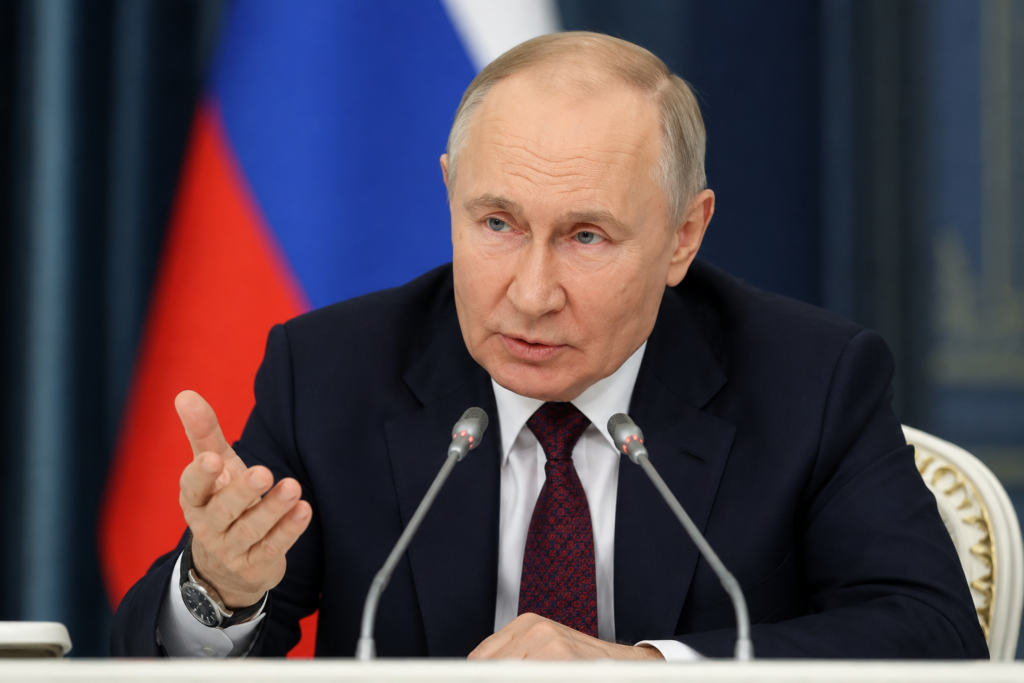
Image Credentials: Image Title: Putin Signals Willingness to Compromise in Ukraine Peace Talks While Claiming Russian Advances. Source: (chatgpt.com) Date: May 2026. Attribution: This image was created using AI-generated imagery (chatgpt.com) by Open Chronicle and does not depict a real-world scene.
By Open Chronicle with agencies
Russian President Vladimir Putin has indicated that Moscow is prepared to make compromises in pursuit of a peace agreement with Ukraine, provided that Kyiv is also willing to make concessions, as diplomatic efforts continue amid ongoing fighting and escalating cross-border attacks.
Speaking to reporters during the St. Petersburg International Economic Forum on Thursday, Putin said that U.S. President Donald Trump had urged Russia to show flexibility in negotiations aimed at ending the conflict.
According to the Russian leader, Moscow remains open to a negotiated settlement despite continuing military operations.
“We are absolutely ready and willing to reach an agreement with Ukraine through peaceful means,” Putin said, while emphasizing that any deal would require reciprocal compromises from both sides.
🇷🇺🇺🇦 Putin answers the question of what he and Zelensky would say to each other if they sat down at a table together to sign the peace deal.
THANK GOD ITS OVER pic.twitter.com/EeEtl1lNsI
— Ty Ty (@OncomingAllure) June 4, 2026
Peace Talks Amid Continuing War
Putin’s remarks come at a time when efforts to reach a lasting settlement remain stalled despite intermittent diplomatic contacts and international mediation attempts.
While expressing readiness for negotiations, the Russian president maintained that Russian forces continue to make gains on the battlefield and that Moscow remains confident in its ability to achieve its strategic objectives.
He rejected suggestions that Russia’s military campaign had become a strategic failure, arguing instead that Russian troops are advancing across multiple sectors of the front.
According to Putin, Russian forces now control all of Ukraine’s Luhansk region and substantial portions of the Donetsk and Zaporizhzhia regions. He claimed that Ukrainian-controlled territory in Donetsk has steadily decreased as Russian troops continue offensive operations.
The Russian president also stated that thousands of square kilometers of territory have come under Russian control in recent months, describing the offensive as ongoing and progressing daily.
Growing Focus on Air Defense
Putin also addressed the increasing frequency of Ukrainian drone strikes deep inside Russian territory, including attacks that recently targeted an oil terminal and naval facilities in St. Petersburg.
The strikes occurred as the city hosted Russia’s flagship economic forum, highlighting Ukraine’s growing ability to reach strategic targets far from the front lines.
While acknowledging that such attacks have caused damage, Putin insisted that Russia possesses the resources necessary to strengthen its defenses.
Russia has an air defense system. Yes, we must improve it. Yes, we must strengthen it. And we will do so,” he said.
Russian authorities have reported a growing number of drone incursions in recent months, prompting increased investment in air defense systems around major cities, industrial facilities, and military installations.
Oreshnik Missile May See Expanded Use
During the briefing, Putin also raised the possibility of wider deployment of Russia’s Oreshnik hypersonic missile system.
The missile, which Moscow describes as capable of traveling at ten times the speed of sound, has been presented by Russian officials as one of the country’s most advanced strategic weapons. Putin noted that the system has not yet been employed to its full potential and suggested its future use could be expanded.
Russia has previously stated that the missile is capable of carrying both conventional and nuclear warheads, although details regarding its operational deployment remain limited.
Competing Narratives of the Conflict
Putin argued that Russia continues to benefit from its domestic industrial capacity, military production infrastructure, and technological expertise, contrasting this with what he described as Ukraine’s continued dependence on military assistance from Western allies.
At the same time, Ukrainian officials maintain that Russian claims regarding battlefield progress are exaggerated and continue to emphasize the effectiveness of long-range drone operations against strategic Russian targets.
The latest statements underscore the complex reality facing negotiators. While both sides continue to speak publicly about the possibility of future peace discussions, military operations remain intense across multiple fronts, with neither Moscow nor Kyiv showing signs of abandoning their core objectives.
As diplomatic efforts continue, the gap between battlefield developments and political negotiations remains one of the central challenges to achieving a lasting settlement in Europe’s largest conflict since World War II.