
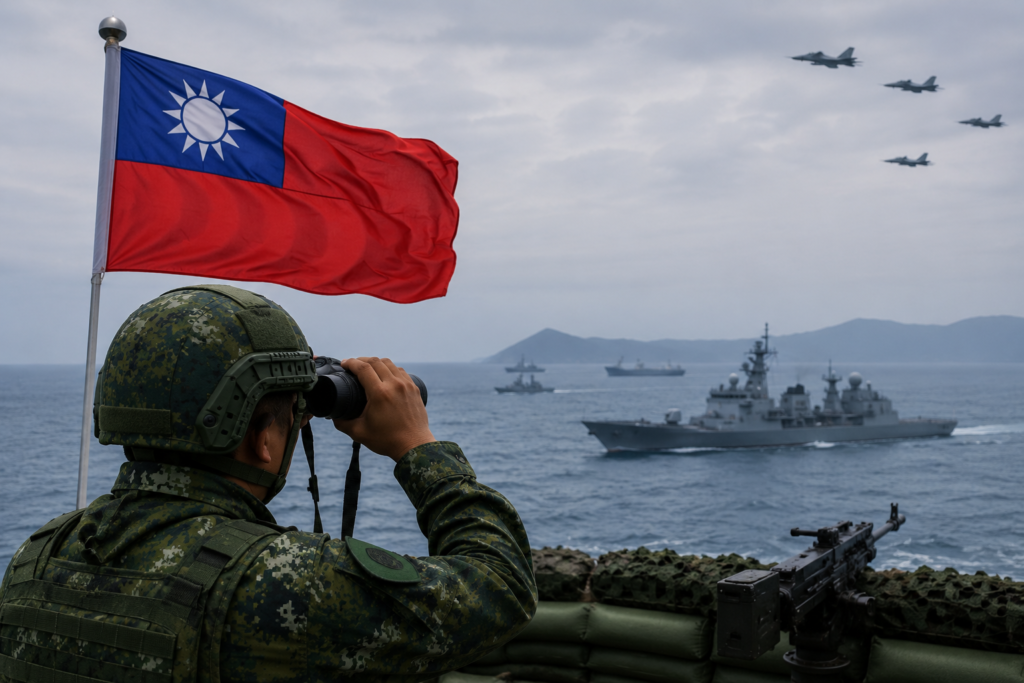
Image Credentials: Image Title: Taiwan Military Hosting Leak Highlights Shifting Balance Across the Taiwan Strait. Source: (chatgpt.com) Date: May 2026. Attribution: This image was created using AI-generated imagery (chatgpt.com) by Open Chronicle and does not depict a real-world scene.
By Open Chronicle with agencies
A reported leak concerning Taiwan’s military hosting arrangements has drawn fresh attention to the changing balance of power between Taipei and Beijing, underscoring growing tensions in the region as China continues to expand its military capabilities and pressure campaign against the self-governed island.
According to reports, details relating to military hosting and defense planning became public, revealing how Taiwan is adapting its security posture amid an increasingly challenging strategic environment. Analysts suggest the disclosure may not have been entirely accidental and could serve as a signal of Taiwan’s determination to strengthen deterrence against potential Chinese military action.
The development comes at a time when Taiwan faces mounting pressure from Beijing, which considers the island part of its territory and has repeatedly vowed to pursue reunification. In recent years, China has significantly increased military exercises around Taiwan, including large-scale air and naval operations that have become a near-daily feature of cross-strait relations.
Observers note that Taiwan’s defense strategy has evolved in response to these growing threats. Rather than attempting to match China’s military strength directly, Taipei has focused on developing asymmetric capabilities designed to make any potential invasion costly and difficult. These efforts include investments in missile systems, coastal defenses, drones, and reserve force modernization.
The reported leak also comes amid concerns in Taipei regarding delays in the delivery of several U.S. weapons systems. Taiwan has ordered billions of dollars’ worth of military equipment from the United States, its principal security partner, but supply chain challenges and competing global demands have slowed the arrival of some key platforms and munitions.
Some security experts believe publicizing elements of military planning could help reassure domestic audiences and international partners that Taiwan remains committed to strengthening its defenses despite procurement delays. Others caution that any disclosure of sensitive military information carries risks, particularly if it provides insights into operational planning or infrastructure.
The broader strategic environment continues to evolve as China’s military modernization accelerates. Beijing has expanded its naval fleet, enhanced missile capabilities, and increased joint-force operations around Taiwan. At the same time, Taiwan has sought closer security cooperation with democratic partners and intensified efforts to improve military readiness.
The incident highlights the increasingly complex security dynamics in East Asia, where military deterrence, political signaling, and information management are becoming as important as traditional military deployments. As tensions remain elevated, both Taipei and Beijing continue to navigate a delicate balance between demonstrating resolve and avoiding escalation.