
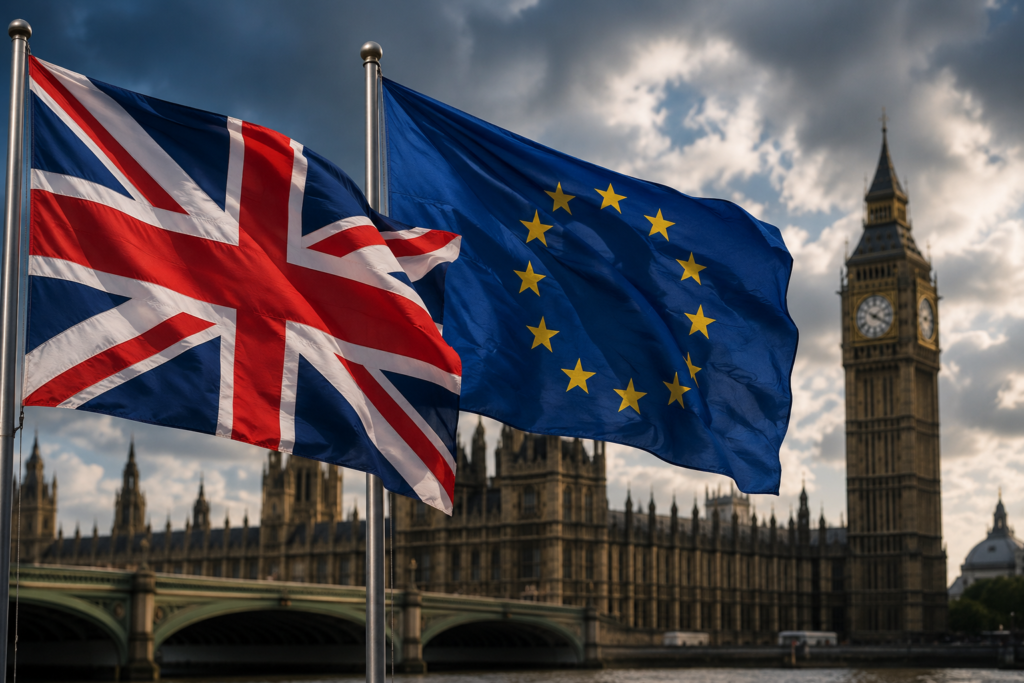
Image Credentials: Image Title: Support for Rejoining the European Union Reaches Majority in Britain, New Poll Shows. Source: (chatgpt.com) Date: June 2026. Attribution: This image was created using AI-generated imagery (chatgpt.com) by Open Chronicle and does not depict a real-world scene.
By Open Chronicle with agencies
A decade after the United Kingdom voted to leave the European Union, a new opinion poll suggests that public sentiment has shifted significantly, with a majority of Britons now supporting a return to the bloc.
According to a survey conducted by Ipsos between May 14 and May 20, 52% of British adults believe the UK should rejoin the European Union. The poll, which surveyed 1,137 respondents, highlights a notable change in attitudes since the historic Brexit referendum of June 2016, when voters chose to leave the EU.
The findings indicate growing dissatisfaction with the long-term consequences of Brexit and suggest that the debate over Britain’s place in Europe remains far from settled.
Growing Calls for a New Referendum
The survey found that nearly half of the respondents support holding another referendum on the UK’s relationship with the European Union. Opinion is divided on the timing of such a vote, with supporters evenly split between holding it before or after the next general election.
When asked how they would vote in a hypothetical referendum today, 52% said they would support rejoining the EU. Only 33% favored maintaining the current arrangement outside the bloc, while around 10% remained undecided.
Kieran Pedley, Director of Politics at Ipsos, said the results demonstrate a clear evolution in public opinion since Brexit was approved ten years ago.
“The debate over the UK’s relationship with Europe remains very much alive among voters,” Pedley noted, adding that attitudes toward Brexit continue to evolve as its economic and political impacts become more widely assessed.
Generational Divide Remains Strong
Despite the apparent shift toward rejoining, the survey reveals deep divisions across age groups.
Younger voters overwhelmingly support returning to the European Union, reflecting a trend that has remained consistent since the original referendum. In contrast, many older voters continue to favor staying outside the bloc, with roughly half of those aged 55 and above opposing re-entry.
The findings underline how Brexit continues to be shaped by generational perspectives on identity, sovereignty, economic opportunity, and international cooperation.
Political Differences Shape Opinions
Political affiliation also plays a major role in attitudes toward Europe.
Supporters of the Labour Party, the Liberal Democrats, and the Green Party showed strong backing for rejoining the EU. Meanwhile, voters aligned with Reform UK, the political movement that traces its roots to the UK Independence Party (UKIP), remained firmly opposed to reversing Brexit.
According to the poll, approximately 70% of Reform UK supporters reject the idea of returning to the European Union, highlighting the continuing strength of Eurosceptic sentiment within parts of the British electorate.
Immigration Remains a Key Point of Disagreement
While respondents broadly agreed that the United Kingdom and the European Union share common interests in areas such as defense, trade, climate policy, and security cooperation, immigration continues to be one of the most divisive issues.
A separate Ipsos survey conducted in April found that many Britons support closer cooperation with European partners on a range of international challenges. However, opinions were far more divided regarding migration and border control.
Around 40% of respondents believed that the UK and EU have conflicting interests when it comes to tackling illegal immigration, compared with only 25% who viewed their interests as aligned.
The issue remains one of the most politically sensitive topics in British public life and continues to influence discussions about the country’s future relationship with Europe.
Rejoining Would Not Be Simple
Despite growing support for rejoining the EU, analysts caution that polling data does not necessarily predict the outcome of a future referendum.
Pedley emphasized that public opinion could change significantly during an actual campaign, particularly if voters were confronted with the practical realities of negotiating a return to the bloc.
“The situation would become much more complex once the public is presented with the concrete costs, benefits, and compromises involved in redefining the UK-EU relationship,” he said.
As the tenth anniversary of Brexit approaches, the poll highlights a country still debating one of the most consequential political decisions in its modern history. While support for rejoining the European Union appears to be increasing, significant political, economic, and social questions remain unresolved.