
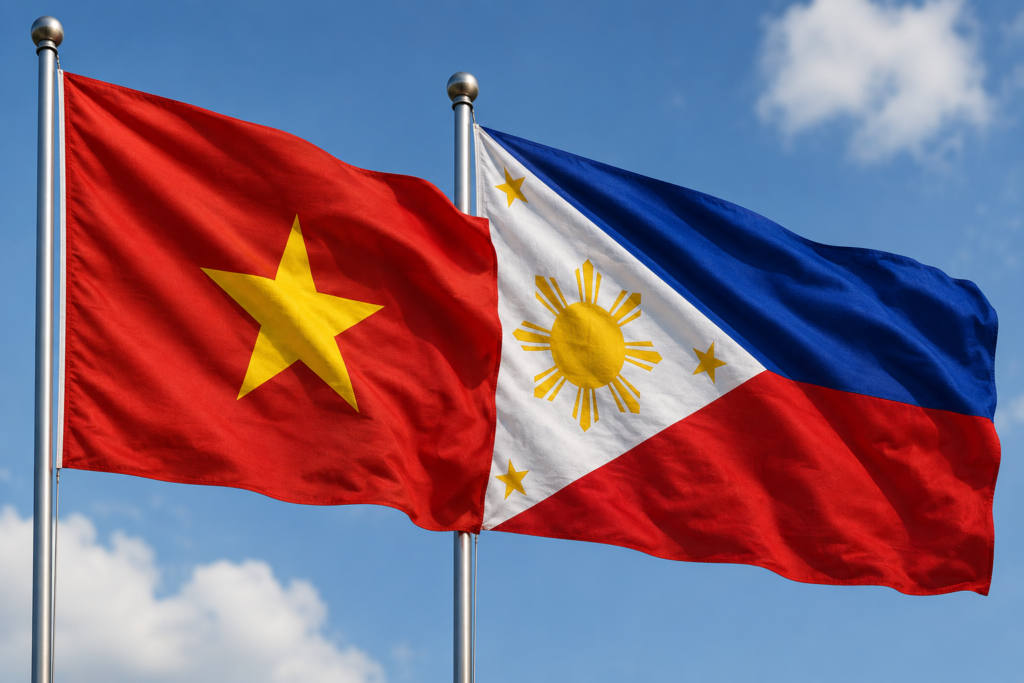
Image Credentials: Image Title: Vietnam and Philippines Deepen Strategic Ties with New Partnership Framework. Source: (chatgpt.com) Date: June 2026. Attribution: This image was created using AI-generated imagery (chatgpt.com) by Open Chronicle and does not depict a real-world scene.
By Open Chronicle with agencies
Vietnam and the Philippines have elevated their bilateral relationship to an Enhanced Strategic Partnership, marking a significant diplomatic milestone with implications that extend across Southeast Asia and the wider Indo-Pacific region. The announcement came during the state visit of Vietnamese General Secretary and President To Lam to Manila, just weeks before the two countries celebrate the 50th anniversary of diplomatic relations.
The agreement reflects a shared determination to strengthen political trust, economic cooperation, and regional security at a time of mounting geopolitical uncertainty. It also makes Vietnam the Philippines’ only enhanced strategic partner within Southeast Asia, highlighting the growing importance both governments attach to their relationship.
The move is widely seen as part of Hanoi’s increasingly active diplomatic strategy. In less than a month, To Lam has overseen the strengthening of ties with several countries, underlining Vietnam’s ambition to play a greater role in promoting stability, development, and cooperation across the Indo-Pacific.
The Philippines is pursuing a dual-track strategy of deeper regional partnerships and domestic modernization, strengthening ties with Vietnam while investing in education, infrastructure#IndoPacificReport #Philippines #Vietnam #IndoPacific #MaritimeSecurity pic.twitter.com/mGu7R01oNr
— IndoPacific Report (@pacific_reports) June 13, 2026
A Broader and More Ambitious Partnership
Officials from both nations stressed that the “enhanced” nature of the partnership reflects a commitment to expand collaboration beyond traditional diplomacy. The two sides agreed to prepare an action plan that will guide cooperation in areas ranging from defence and maritime security to digital transformation, renewable energy, and tourism.
A renewed defence cooperation agreement will update the framework first established in 2010, focusing on maritime operations, military education, and disaster risk reduction. The two governments also pledged to increase high-level exchanges, deepen institutional cooperation, and strengthen links between local authorities and economic sectors.
Economic issues featured prominently in the discussions. Vietnam and the Philippines set a target of reaching US$10 billion in bilateral trade as quickly as possible, while also seeking to reduce trade barriers and diversify exports. Agricultural products, including fresh fruits, are expected to benefit from improved market access, while both countries identified the digital economy, green technologies, the blue economy, and high-tech agriculture as promising sectors for future investment.
Philippine President Ferdinand Marcos Jr. reaffirmed his government’s intention to create favorable conditions for Vietnamese investors, while To Lam called for trade, investment, and tourism to become the main engines of the partnership.
Shared Interests in the South China Sea
The strategic significance of the agreement is closely tied to the evolving security environment in the South China Sea, one of the world’s most contested maritime regions. Both Vietnam and the Philippines have longstanding disputes with China over territorial claims and have repeatedly called for adherence to international law.
In their joint statement, the two countries reaffirmed their commitment to maintaining peace, stability, and freedom of navigation and overflight, while supporting the peaceful settlement of disputes in accordance with the United Nations Convention on the Law of the Sea (UNCLOS) 1982. They also reiterated their support for the 2016 Permanent Court of Arbitration ruling concerning the South China Sea.
Although Vietnam and the Philippines themselves have overlapping maritime claims, both governments have worked to prevent tensions from escalating. In 2024, their coast guards conducted their first joint exercises, and the latest agreement underlines a mutual commitment to resolving outstanding maritime issues through dialogue and peaceful negotiation.
Balancing Regional Competition
The timing of the partnership upgrade reflects broader shifts in the international landscape. Growing rivalry between major powers, concerns about the effectiveness of multilateral institutions, and the perceived weakening of the rules-based international order have encouraged many Southeast Asian nations to diversify and strengthen their strategic relationships.
Analysts also view the agreement through the lens of China’s expanding diplomatic initiatives, including the Global Development Initiative, Global Security Initiative, Global Civilization Initiative, and the newly promoted International Organisation for Mediation. While Beijing presents these mechanisms as efforts to create a more inclusive system of global governance, some regional observers believe they also serve to expand Chinese influence and shape international norms in ways that support its strategic interests.
Against this backdrop, closer cooperation between Manila and Hanoi is seen as part of a broader effort by regional powers to reinforce ASEAN centrality, uphold international law, and maintain a stable balance in the Indo-Pacific.
A Partnership with Regional Impact
The Enhanced Strategic Partnership is more than a symbolic diplomatic upgrade. It creates a framework for deeper cooperation in security, trade, technology, and sustainable development, while providing both countries with greater capacity to respond to shared challenges.
As the Philippines pursues its ambition of becoming an upper-middle-income economy by 2028 and Vietnam continues its drive toward high-income status by 2045, the new partnership could become an important pillar of regional growth and stability.
At a time of increasing uncertainty across the Indo-Pacific, the agreement sends a broader message that closer regional cooperation, respect for international law, and peaceful dialogue remain central to the future of Southeast Asia.