
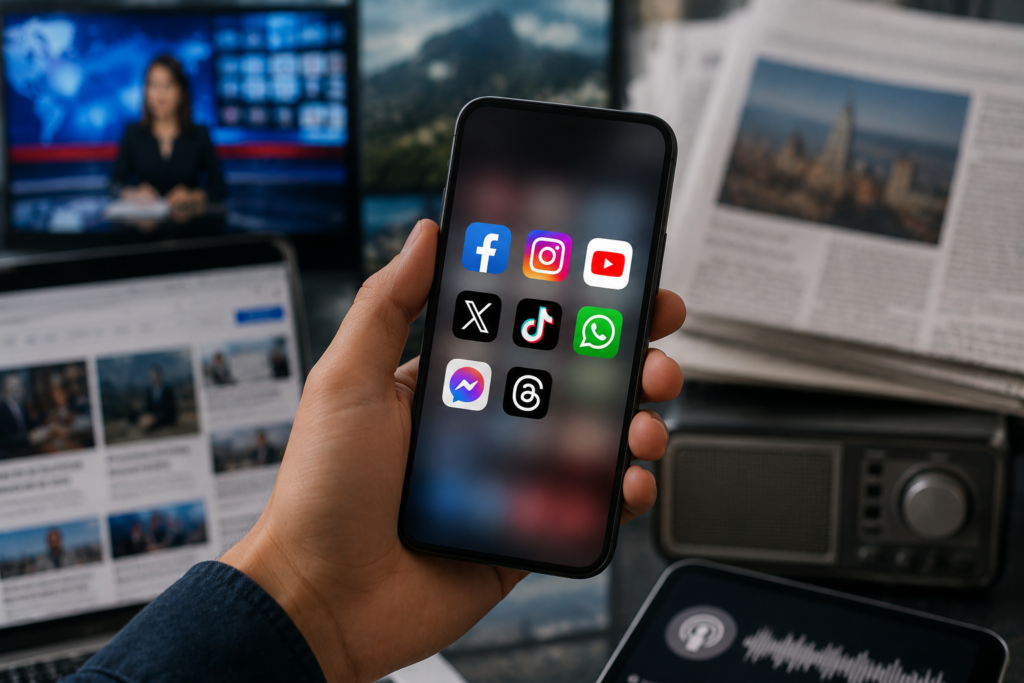
Image Credentials: Image Title: Social Media Overtakes Traditional Media as the World’s Main News Source, Reuters Report Finds. Source: (chatgpt.com) Date: June 2026. Attribution: This image was created using AI-generated imagery (chatgpt.com) by Open Chronicle and does not depict a real-world scene.
By Open Chronicle with agencies
For the first time, social media and video platforms have become the world’s leading source of news, surpassing television, newspaper websites, and radio, according to the latest annual report from the Reuters Institute for the Study of Journalism. The findings highlight a profound transformation in the way audiences consume information and raise fresh concerns about the future sustainability of traditional journalism.
The 2026 Digital News Report, produced by the Reuters Institute at the University of Oxford, is based on surveys of nearly 100,000 people across 48 countries. According to the study, 54 percent of respondents said they had accessed news through social media or video-sharing platforms during the previous week. When AI-powered chatbots, including tools such as ChatGPT, are included, that figure rises to 56 percent.
By comparison, 52 percent said they relied on television news, 51 percent on newspaper websites or mobile applications, and just 21 percent on radio broadcasts. The report describes the shift as a “significant milestone” in the evolution of the global media landscape.
Lead author Jim Egan noted that while the transition has been gradual rather than sudden, it marks an important turning point. In several countries, especially among younger audiences, digital platforms have already surpassed traditional media. However, many European nations still show stronger reliance on established news websites and broadcasters.
Age remains one of the biggest factors influencing news consumption habits. Among people aged 18 to 24, nearly half identify social media or video platforms as their primary source of news. In contrast, television continues to dominate among audiences aged 45 and older.
The report also reveals that different platforms serve different purposes. Users often visit X and YouTube specifically to follow current events and breaking stories, while many encounter news incidentally while browsing Facebook, Instagram, or TikTok for other content.
Traditional Media Faces Growing Financial Pressure
The findings underscore the financial challenges confronting traditional news organizations. Only 17 percent of respondents said they pay for online news, making it increasingly difficult for publishers to generate enough revenue to sustain quality reporting.
At the same time, major technology companies such as Google and Meta continue to dominate the global digital advertising market, drawing away a substantial share of revenue that once supported newspapers, broadcasters, and magazines.
The report suggests that the weakening connection between audiences and traditional media outlets could have long-term consequences for journalism, especially as younger generations show little inclination to make news websites or apps their first destination for information.
Trust in News Reaches New Low
Alongside changing consumption habits, public confidence in the media continues to decline. Just 37 percent of respondents said they trust “most news most of the time,” the lowest level recorded since the Reuters Institute began tracking the metric.
The study also points to the growing role of artificial intelligence in the information ecosystem. Around 10 percent of participants reported using AI chatbots for news every week, an increase from 7 percent in the previous year. Researchers believe the rapid adoption of generative AI technologies will force news organizations and policymakers to rethink how journalism is produced, distributed, and verified.
Egan described the rise of AI as one of the most significant challenges facing the industry, arguing that the combination of geopolitical uncertainty, technological disruption, and evolving audience behavior is creating an especially volatile environment for news providers around the world.
As media organizations adapt to a digital-first future, the report concludes that the battle for audience attention, public trust, and sustainable funding models is likely to become even more intense.