
Image: from GMan | GMan’s Chronicle X @FAB87F
By Open Chronicle with agencies
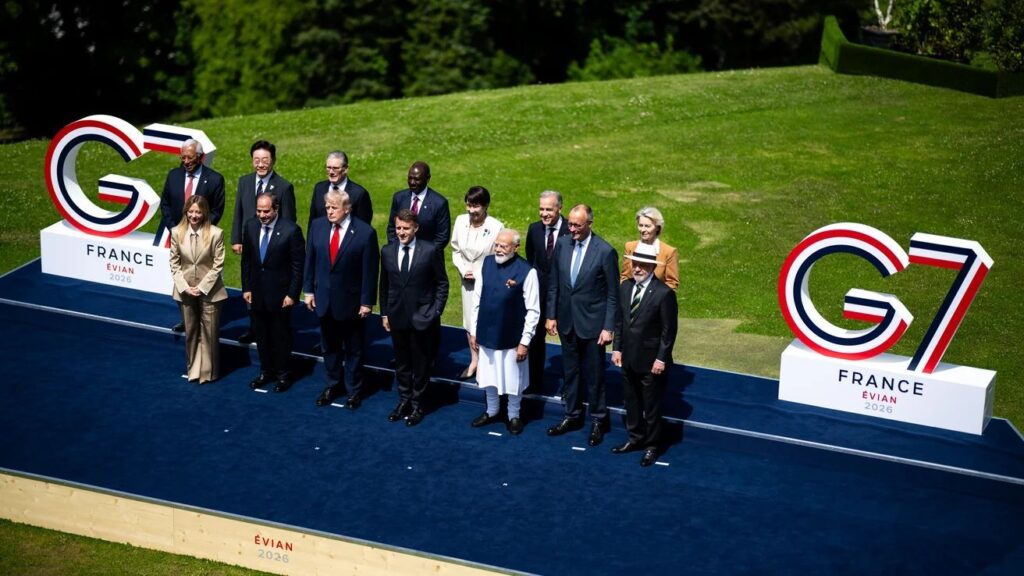
Leaders of the Group of Seven nations concluded their summit in Évian-les-Bains, France, on Wednesday with a renewed commitment to increase pressure on Russia over its war in Ukraine, while also witnessing a major diplomatic development in the Middle East as U.S. President Donald Trump signed a memorandum of understanding aimed at ending the conflict with Iran.
The three-day gathering brought together the leaders of the United States, Canada, France, Germany, Italy, Japan, and the United Kingdom, with discussions largely focused on Ukraine, Russia, global security, artificial intelligence, and the evolving situation in the Middle East.
🇺🇸🇫🇷🇬🇧🇩🇪🇨🇦🇯🇵🇮🇹🤝🇺🇦 The G7 countries have agreed to significantly strengthen military support for Ukraine.
➡️ G7 leaders agreed to increase military assistance to Ukraine, in particular the supply of additional air defense assets, new anti-aircraft systems, missile interceptors,… pic.twitter.com/JPi6M42f7X— NSTRIKE (@NSTRIKE1231) June 17, 2026
Increased Pressure on Russia
Von der Leyen Listens as G7 Leaders Push for Ukraine Peace Deal in Évian!@vonderleyen listens closely as G7 leaders meet in Évian, France, for a working session focused on Ukraine and Russia’s war. The roundtable comes as Reuters reports that President @realDonaldTrump said… pic.twitter.com/HyWqp44zVv
— euDebates.tv (@eudebates) June 16, 2026
One of the summit’s most significant outcomes was the agreement among G7 members to strengthen sanctions targeting Russia’s economy, particularly revenues generated through fossil fuel exports.
The final communiqué emphasized continued support for Ukraine and outlined plans to expand deliveries of air defense systems while increasing economic pressure on Moscow.
German Chancellor Friedrich Merz described the agreement as a diplomatic success, noting that reaching a consensus among the participating nations required considerable effort.
French President Emmanuel Macron suggested that Washington’s position on the war had evolved, arguing that President Trump now appeared more convinced that Russian President Vladimir Putin was not genuinely pursuing peace negotiations.
Italian Prime Minister Giorgia Meloni also highlighted the level of agreement among leaders, describing discussions on Ukraine as notably constructive.
Trump’s Shift on Ukraine
Donald Trump: Remarks on the G7 Summit and Iran Agreement
Donald Trump: Thank you. It's a lot of press. That's good.
We had a great event. This was something very special. I want to thank President Macron and Brigitte—his really lovely wife, a fantastic person—for welcoming us… pic.twitter.com/zRPF3Km3ZE
— BlueX (@blueberry_feed) June 18, 2026
Throughout the summit, Trump adopted a noticeably firmer tone toward Moscow than in previous international gatherings. He expressed frustration over the continuing human and economic cost of the war and indicated that Russia would eventually need to engage seriously in negotiations.
Ukrainian President Volodymyr Zelensky attended the summit and held talks with several leaders, including Trump. According to diplomatic sources, G7 members also agreed to support licensing arrangements that would allow Ukrainian companies to manufacture long-range missile systems and air defense equipment domestically.
Despite his tougher rhetoric, Trump maintained that both Putin and Zelensky wanted a resolution to the conflict.
“They both want to do something, they just don’t know how to do it,” he told reporters during his closing press conference.
Iran Deal Overshadows Summit
While Ukraine dominated many discussions, attention increasingly shifted to the Middle East following Trump’s signing of a memorandum of understanding with Iran intended to halt the months-long conflict that has destabilized the region and disrupted global energy markets.
The signing took place during a private dinner hosted by Macron at the Palace of Versailles outside Paris. The ceremony marked a major diplomatic moment after months of warfare involving Iran, Israel, and the United States.
The agreement is expected to reopen critical shipping routes, including the Strait of Hormuz, and begin a 60-day process aimed at negotiating a more comprehensive settlement.
However, Trump warned that military action could resume if Iran fails to honor its commitments.
“If they don’t behave, we’ll go right back to dropping bombs,” he said.
AI Regulation Takes Center Stage
Another major topic at the summit was artificial intelligence and digital governance.
Several leading figures from the technology sector attended discussions, including OpenAI Chief Executive Sam Altman, Anthropic CEO Dario Amodei, DeepMind founder Demis Hassabis and Mistral AI founder Arthur Mensch.
G7 leaders issued a joint statement urging technology companies to ensure that digital platforms provide safe and age-appropriate experiences, particularly for younger users.
Macron called for stronger international cooperation and regulation of artificial intelligence, warning that democratic nations risk falling behind if they fail to establish common standards.
Altman, meanwhile, encouraged governments to remain actively involved in shaping AI policy rather than leaving responsibility solely to private companies.
Diplomatic Symbolism at Versailles
The summit concluded with an unusual display of diplomacy as Macron hosted Trump at the historic Palace of Versailles.
The American president toured several iconic sections of the palace, including the Hall of Mirrors and galleries dedicated to France’s support for American independence, before attending a private dinner with political and business leaders.
The event underscored France’s effort to maintain strong transatlantic ties while navigating disagreements on trade, security, and global governance.
As the summit ended, leaders projected an image of greater unity on Ukraine, cautious optimism regarding the Iran agreement, and a shared recognition that geopolitical tensions continue to shape the global agenda.
Whether the commitments announced in Évian translate into concrete progress on the battlefield in Ukraine and stability in the Middle East remains one of the key questions facing world leaders in the months ahead.