
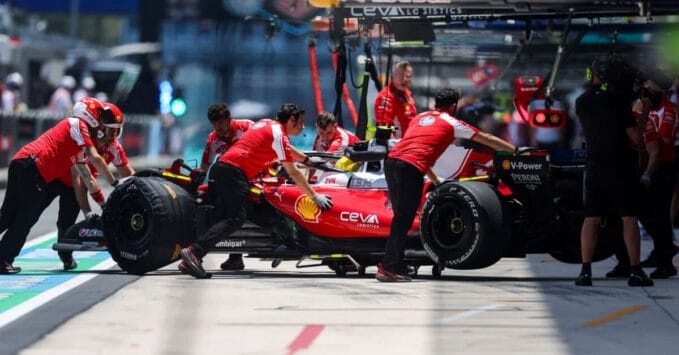
Image: from PitWall Pixels X @PitWallPixels
By Open Chronicle with agencies
Lewis Hamilton’s long-awaited first victory with Ferrari at the Spanish Grand Prix in Barcelona was not the result of a single breakthrough. Instead, it reflected a combination of technical progress, bold strategic decisions, and a flawless performance from one of Formula 1’s most accomplished drivers.
The win marked a significant milestone for both Hamilton and Ferrari, but it also raised an important question across the paddock: has Ferrari finally found the formula to consistently challenge for victories in 2026?
Lewis Hamilton just won his first ever Grand Prix for Ferrari at the 2025 Spanish Grand Prix and I am not okay.
"Thank you for continuing to remind me who I am."
bro. BRO. do you understand what that line means coming from Lewis Hamilton specifically?? this man left the… pic.twitter.com/kThp9ysUDu— F1 Moments Daily (@F1MomentsDaily) June 18, 2026
A Ferrari That Looked Stronger Than Expected
Did we just witness the rare ferrari strategy masterclass?!
Lewis Hamilton’s first win for ferrari
& his first win in 2 yearsmeanwhile, Charles Leclerc… #barcelonagp pic.twitter.com/CGfirjnWsR
— Kevin Thang (@Skip2MyJays) June 14, 2026
Throughout the opening stages of the season, Ferrari’s performances fluctuated from race to race. At times, the Italian team appeared capable of fighting near the front. On other weekends, it struggled to match the pace of Mercedes and McLaren.
Barcelona painted a different picture.
Widely regarded as one of Formula 1’s most complete and demanding circuits, the Circuit de Barcelona-Catalunya tests every aspect of a car’s performance, from aerodynamic efficiency and high-speed cornering to tire management and traction in slower sections.
Ferrari demonstrated competitive pace throughout the weekend, not only in qualifying but also over long race stints. More importantly, the car showed consistency in varying conditions and across different phases of the race.
While Ferrari may not yet possess the outright fastest package on the grid, the Spanish Grand Prix suggested that the gap to championship-leading Mercedes has narrowed considerably compared to the beginning of the season.
A Strategy That Made the Difference
If one factor had the most immediate impact on the final result, it was Ferrari’s strategic approach.
Rather than following the more conventional strategies adopted by many rivals, Ferrari opted for an aggressive three-stop race plan. The team identified an opportunity to maximize the car’s pace and executed the strategy with remarkable precision.
In a Formula 1 season where margins between the leading teams have become increasingly small, race strategy often determines the outcome.
Ferrari reacted effectively to changing race conditions, managed tire degradation well, and capitalized on key moments to place Hamilton in a position to attack when the race entered its decisive stages.
The victory was not simply the product of a different strategy. It was the result of a strategy that worked exactly as intended.
Hamilton Delivered When It Mattered
The victory cannot be explained solely by technical improvements or tactical decisions.
Hamilton himself played a decisive role.
The seven-time world champion delivered one of his most complete performances since joining Ferrari. He combined a strong qualifying pace with intelligent tire management and racecraft that have defined much of his Formula 1 career.
There is a significant difference between having a car capable of winning and converting that opportunity into a victory. Hamilton remains one of the most efficient drivers on the grid when it comes to capitalizing on race-winning chances.
Throughout much of the season, Ferrari often appeared dependent on perfect circumstances to challenge Mercedes. In Barcelona, however, the driver and team operated in complete harmony from start to finish.
Turning Point or One-Off Success?
The key question now facing Ferrari is whether Barcelona represents a genuine turning point or simply an exceptional weekend.
The significance of the victory is amplified by the fact that it came at a circuit traditionally viewed as a benchmark for measuring a car’s true competitiveness. At the same time, one race is not enough to completely reshape the competitive order in Formula 1.
Mercedes remains the most consistent team in the championship, while Andrea Kimi Antonelli continues to lead the drivers’ standings. McLaren also remains firmly in contention at the front.
Nevertheless, the Ferrari that left Barcelona appears notably different from the team that began the season in Australia. The car looks more predictable, the operational execution has improved, and confidence throughout the organization appears stronger.
Perhaps the most important change is not a specific aerodynamic upgrade or mechanical development. Instead, it may be the successful combination Ferrari has been searching for all season: a competitive car, an effective strategy, and an elite driver capable of extracting the maximum result.
For the first time in 2026, all three elements aligned perfectly.
The result was a victory that may prove to be worth far more than the 25 points Hamilton added to his championship tally.