
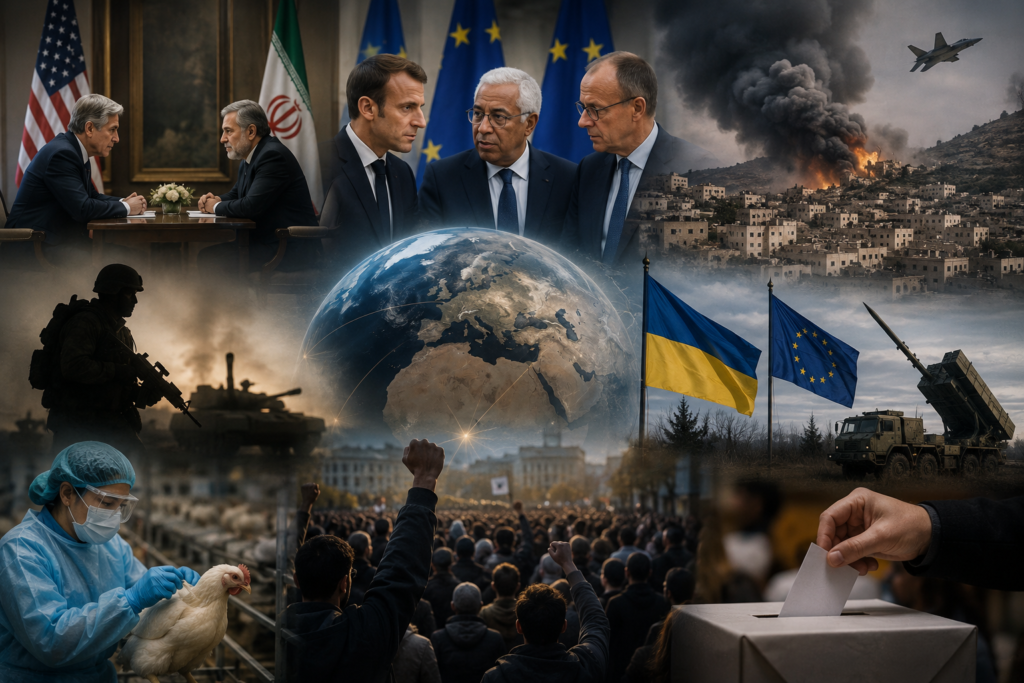
Image Credentials: Image Title: Global News Brief: Key Events and Developments for June 19, 2026. Source: (chatgpt.com) Date: June 2026. Attribution: This image was created using AI-generated imagery (chatgpt.com) by Open Chronicle and does not depict a real-world scene.
By Open Chronicle with agencies
The international landscape on June 19 was dominated by uncertainty surrounding U.S.–Iran diplomacy, renewed violence in the Middle East, political turbulence in Europe, and growing security concerns across several regions.
U.S.–Iran Talks Face New Setbacks
Efforts to stabilize relations between the United States and Iran suffered a significant setback after planned follow-up negotiations in Switzerland were postponed. The delay came despite recent diplomatic breakthroughs that had raised hopes of reducing tensions between Washington and Tehran.
Regional contacts intensified throughout the day as governments across the Middle East sought clarity regarding the future of the agreement. U.S. Vice President JD Vance unexpectedly canceled a planned trip to Switzerland, fueling speculation about disagreements over the implementation of the accord.
The suspension of talks has generated criticism from both American and Iranian political figures. Iranian officials argued that Washington accepted deal terms from a position of weakness, while critics in the United States warned that the agreement could provide Tehran with substantial financial resources.
The postponement also raised broader questions about the durability of the emerging diplomatic framework and the future balance of power in the Middle East.
Violence Escalates Along the Israel–Lebanon Front
Despite diplomatic activity surrounding Iran, fighting intensified between Israel and Hezbollah along the Lebanese border.
Israeli airstrikes struck multiple locations across southern Lebanon and the Bekaa Valley overnight. Lebanese sources reported numerous casualties, while the Israeli military confirmed the deaths of four soldiers, including a tank battalion commander, following a Hezbollah attack in southern Lebanon.
The escalation triggered strong reactions within Israel’s political establishment. Several officials called for tougher military measures, while opposition figures warned that the country’s international standing could be damaged by the widening conflict.
Lebanese authorities reiterated their commitment to existing ceasefire arrangements but insisted that Israel must fully comply with withdrawal commitments before long-term stability can be achieved.
Europe Divided Over Russia Strategy
Within Europe, divisions emerged over proposals for renewed contacts with Moscow.
French President Emmanuel Macron and German Chancellor Friedrich Merz reportedly opposed a proposal associated with António Costa that would have opened additional channels of communication with Russia.
The disagreement highlighted continuing differences among European leaders regarding how to balance pressure on Moscow with diplomatic engagement.
At the same time, European Union leaders reaffirmed support for Ukraine and increased pressure on Russia to accept a ceasefire, while also agreeing to extend sanctions for an additional year.
Britain’s Political Landscape Shifts
In the United Kingdom, Andy Burnham secured a significant by-election victory, strengthening his position as a potential challenger to Prime Minister Keir Starmer.
The result has energized debate within British politics about Labour’s future leadership and direction. Analysts suggest Burnham’s success could reshape internal party dynamics ahead of future national elections.
Security Concerns Across Africa
Security challenges continued to affect several African nations.
In Niger, at least 13 people were reported killed during an attack on a military compound in the capital, Niamey. The incident highlighted ongoing concerns about instability across the Sahel region.
Elsewhere, African governments continued discussions on regional security cooperation, economic partnerships and educational initiatives, including growing interest in Chinese language education across the continent.
Ukraine Receives New Military Support
Germany announced a new military assistance package for Ukraine that includes additional air defense capabilities and air-to-air missiles.
The move reflects Berlin’s continuing commitment to supporting Kyiv’s defense efforts amid ongoing hostilities and Russian attacks, including reported strikes targeting civilian shipping in the Black Sea.
Health and Climate Alerts
Australian authorities reported the country’s first suspected case of H5 bird flu, raising concerns among public health and agricultural officials.
Meanwhile, climate scientists warned that a potentially powerful El Niño event could significantly intensify extreme weather patterns worldwide, affecting food security, water supplies and disaster preparedness efforts across multiple continents.
Other Developments
Several additional stories drew international attention throughout the day:
• The United States announced sanctions targeting Lebanese officials and a business network allegedly linked to Hezbollah.
• Two men in Britain were sentenced to prison after being convicted of spying for China.
• North Korea criticized recent G7 calls for denuclearization.
• Egypt confirmed plans to host a meeting involving foreign ministers from Pakistan, Saudi Arabia and Türkiye.
• Zimbabwe’s parliament approved legislation that could extend the president’s time in office.
• New York celebrated the NBA champion New York Knicks with a massive parade attended by thousands of fans.
Outlook
As June 19 unfolds, uncertainty remains the defining feature of international affairs. The postponement of U.S.–Iran negotiations, renewed fighting between Israel and Hezbollah, growing political divisions within Europe and continuing security crises across Africa all underscore the fragile state of global stability.
Diplomatic efforts continue on multiple fronts, but the coming days will likely determine whether recent agreements can survive mounting political pressure and escalating regional conflicts.