
Image: from The National Pulse X @TheNatPulse
By Open Chronicle with agencies
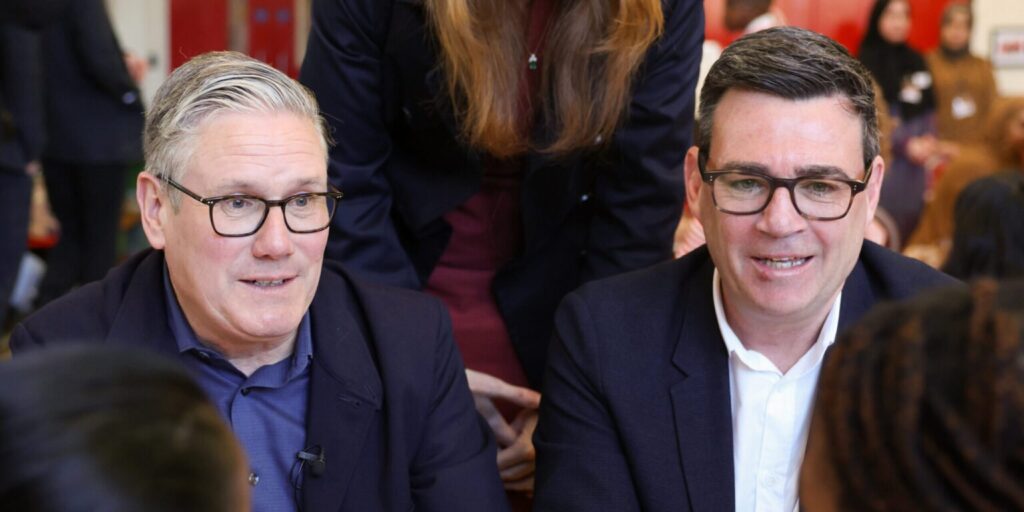
British Prime Minister Keir Starmer has congratulated prominent Labour figure Andy Burnham on his decisive parliamentary by-election victory in Makerfield, while firmly rejecting calls to step down and pledging to contest any future challenge to his leadership of the Labour Party.
Speaking to reporters at an event in London, Starmer described Burnham’s success as a significant achievement and said he had already sent his congratulations to the newly elected MP.
“I have not spoken directly to Andy yet, but I will. I have already sent my congratulations. It is a really important victory,” Starmer said.
The prime minister argued that the result demonstrated growing momentum for Labour and suggested that support for the right-wing populist Reform Party may be beginning to decline.
“This is a very good result. It shows that the tide is turning against Reform and that they have probably reached the peak of their support, which is now falling,” he said.
Refusing to Step Aside
Starmer was also questioned about renewed calls from Labour MPs, including some previously loyal supporters, urging him to resign following recent political setbacks.
The Labour leader dismissed speculation about an imminent leadership contest and insisted that he remained committed to leading both the party and the government.
“At the moment, there is no leadership contest. As I have said on many occasions, I do not believe it would be good for the country to plunge ourselves into chaos,” Starmer stated.
He called on party members to unite ahead of the election for a new Mayor of Manchester, a position vacated by Burnham following his return to Westminster.
“If there is a contest, then yes, I will stand. I will put myself forward and, as I have repeatedly said, I am not going to run away,” Starmer added.
Burnham Secures Comfortable Victory
Burnham won the parliamentary by-election in Makerfield, located in northwest England, with a commanding 55 percent of the vote, securing 24,927 ballots. His nearest challenger, Reform Party candidate Robert Kenyon, finished second with 35 percent and 15,696 votes.
The victory strengthens Burnham’s position as one of Labour’s most influential figures and has intensified speculation about his future ambitions within the party.
In his victory speech, Burnham described the result as a potential turning point in British politics.
“Everyone knows politics is not working. Everyone feels the country is not where it should be. Tonight may, just may, be the turning point. From now on, I will give everything I have to make that happen,” he told supporters.
While stopping short of announcing an immediate leadership challenge, Burnham delivered a clear warning to Labour.
“This is the last chance to change. That is what people told me directly on the hundreds of doorsteps I visited. We have to hear that message, act on it, and get it right. There will not be a second chance,” he said.
A Potential Leadership Battle Looms
Burnham has positioned himself as an advocate for a more unifying political vision, arguing that Britain should avoid the increasingly divisive style of politics seen elsewhere.
He said he wanted to “build a new politics based on unity and hope,” moving away from what he described as darker and more polarised political trends.
Speculation over Labour’s future leadership has continued to grow. Former Health Secretary Wes Streeting, who resigned in May, has already expressed interest in running, while British media have also mentioned Energy Secretary Ed Miliband and former Defence Minister Al Carns as possible contenders.
Under Labour Party rules, any candidate seeking to trigger a leadership election must be a sitting MP and secure the backing of at least 81 fellow Labour parliamentarians. Candidates would also need the support of 5 percent of local Labour constituency parties or at least three affiliated organisations, such as trade unions.
Should a leadership election take place, Labour members and affiliated organisations would vote to select a new leader. Because Labour currently holds a parliamentary majority in the House of Commons, the successful candidate could become prime minister without a new general election.