
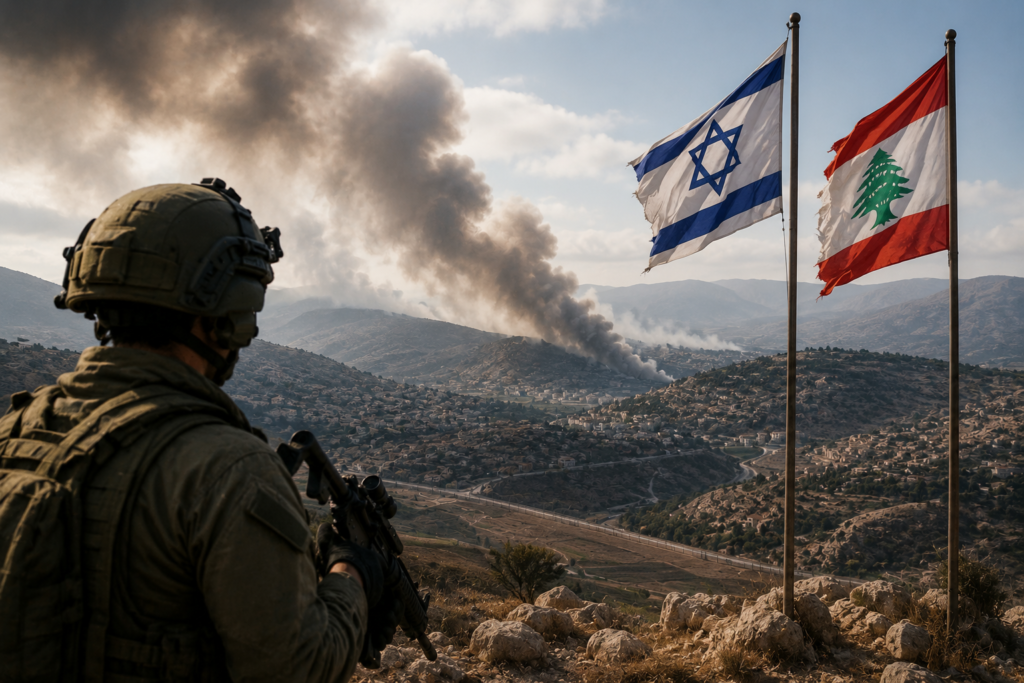
Image Credentials: Image Title: Israel Orders Ceasefire in Lebanon as Regional Tensions Remain High. Source: (chatgpt.com) Date: June 2026. Attribution: This image was created using AI-generated imagery (chatgpt.com) by Open Chronicle and does not depict a real-world scene.
By Open Chronicle with agencies
JERUSALEM — Israeli Prime Minister Benjamin Netanyahu and Defense Minister Israel Katz have reportedly instructed the Israeli military to cease fire in Lebanon, according to a report by Israel’s Channel 12 News on Saturday.
The decision comes amid heightened tensions along the Israel-Lebanon border following weeks of military exchanges involving Israeli forces and the Lebanese armed group Hezbollah.
Despite the reported ceasefire order, Israeli forces have not withdrawn from positions they currently hold in southern Lebanon, according to the report cited by Xinhua. The continued military presence is likely to remain a source of tension as efforts to stabilize the border area continue.
Hezbollah has responded forcefully to recent Israeli operations, with clashes resulting in significant losses and damage on both sides. The confrontation has raised concerns about the potential for a broader regional escalation involving multiple actors across the Middle East.
The developments in Lebanon have also intersected with growing tensions involving Iran. Iranian officials announced that the Strait of Hormuz would remain closed until what Tehran describes as Israeli violations of the ceasefire are halted and the United States fully implements its commitments under an existing memorandum of understanding.
The Strait of Hormuz is one of the world’s most strategically important maritime routes, carrying a substantial share of global oil and gas shipments. Any prolonged disruption to shipping through the waterway could have significant implications for international energy markets and global trade.
Diplomatic efforts are expected to continue in the coming days as regional and international actors seek to prevent further escalation and preserve fragile ceasefire arrangements across multiple fronts.
Analysts warn that while the ceasefire order may help reduce immediate hostilities, unresolved territorial disputes, continued military deployments, and broader regional rivalries could complicate efforts to achieve a lasting de-escalation.
The situation remains fluid, with governments and markets closely monitoring developments in Lebanon, Israel, and the wider Gulf region.