
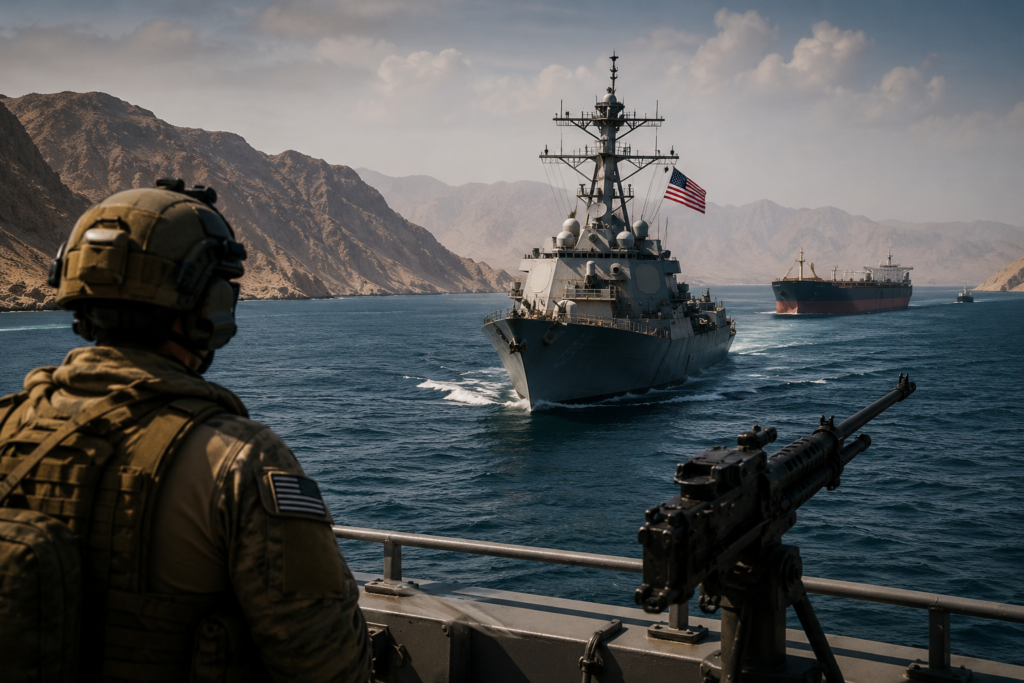
Image Credentials: Image Title: US Military Remains Vigilant After Iran Announces Closure of Strait of Hormuz. Source: (chatgpt.com) Date: June 2026. Attribution: This image was created using AI-generated imagery (chatgpt.com) by Open Chronicle and does not depict a real-world scene.
By Open Chronicle with agencies
WASHINGTON — The United States military said on Saturday that it remains “present and vigilant” in the Strait of Hormuz after Iran announced the closure of the strategic waterway in response to recent Israeli strikes on Lebanon.
In a statement, the US Central Command (CENTCOM), which oversees American military operations across the Middle East, stressed that US forces continue to monitor the situation closely and are committed to ensuring regional stability.
“US forces remain present and vigilant to ensure all aspects of the agreement with Iran are adhered to, obeyed, and in full force and effect,” CENTCOM said.
The announcement came shortly after Tehran declared that it was closing the Strait of Hormuz, one of the world’s most important maritime chokepoints. Iranian officials described the move as a response to Israeli military actions in Lebanon, which they argued had violated the fragile agreement recently established between Iran and the United States.
Despite the heightened tensions, CENTCOM reported that commercial navigation through the waterway remained uninterrupted. According to the command, 55 commercial vessels successfully transited the strait on Saturday, with safe passage continuing through the international shipping lane.
The Strait of Hormuz is a critical route for global energy supplies, connecting the Persian Gulf to international markets. Any disruption to shipping in the area has the potential to affect global oil prices and international trade flows.
The latest developments come at a sensitive moment in US-Iran relations. Negotiators from both countries are expected to meet in Switzerland in the coming days to continue discussions on implementing the existing agreement and reducing regional tensions.
US Vice President JD Vance indicated before Iran’s announcement that he anticipated traveling to Switzerland within the next few days to participate in the negotiations, highlighting Washington’s continued commitment to diplomatic engagement.
Meanwhile, maritime tracking companies reported that traffic through the Strait of Hormuz reached its busiest level in two months on Friday, underlining the strategic importance of the route for global commerce and energy markets.
As diplomatic efforts continue, regional and international observers are closely watching developments in the Gulf, where any escalation could have significant geopolitical and economic consequences far beyond the Middle East.