
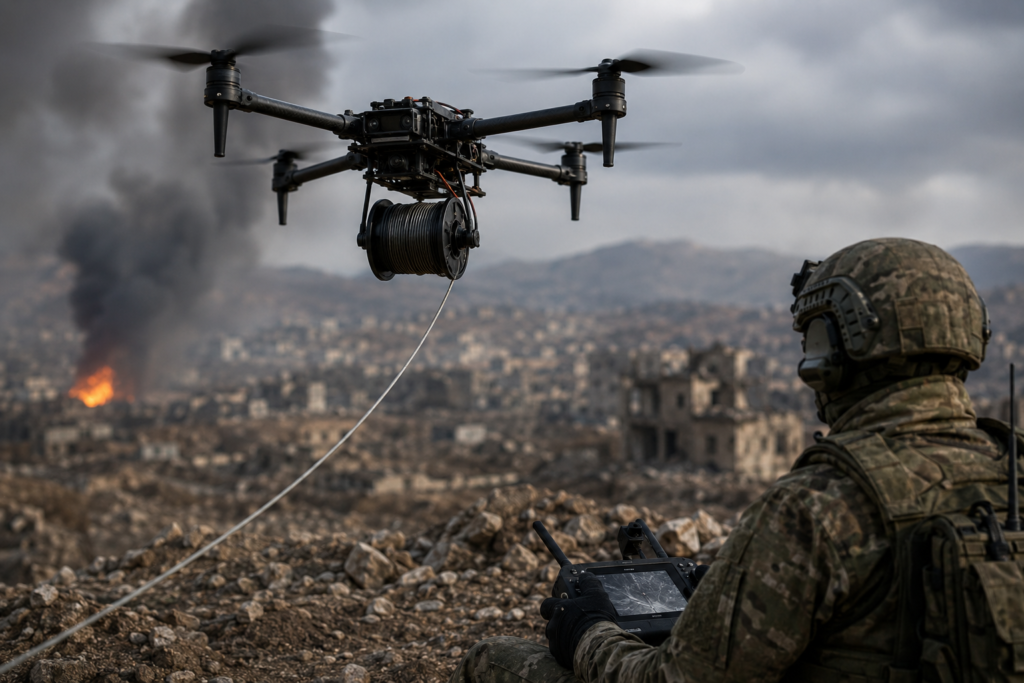
Image Credentials: Image Title: The Rise of Fibre-Optic Drones: How Ukraine and Lebanon Are Reshaping the Future of Warfare. Source: (chatgpt.com) Date: June 2026. Attribution: This image was created using AI-generated imagery (chatgpt.com) by Open Chronicle and does not depict a real-world scene.
By Open Chronicle
The battlefields of the 21st century are increasingly defined not only by firepower and maneuverability, but by control of the electromagnetic spectrum. In conflicts ranging from the war in Ukraine to the fighting in southern Lebanon, military planners have discovered that one of the most effective ways to defeat modern electronic warfare is to bypass it entirely.
That realization has propelled fibre-optic drones from a niche technological concept into one of the most closely watched military innovations of recent years.
Unlike conventional unmanned aerial vehicles that rely on radio frequencies for communication, fibre-optic drones remain physically connected to their operators through ultra-thin cables made of glass or polymer fibres. These cables transmit commands and video feeds directly, creating a secure link that cannot be jammed by traditional electronic warfare systems.
As armies invest billions in jammers, signal interceptors, GPS spoofers, and anti-drone defenses, fibre-optic drones have emerged as an unexpected solution to one of modern warfare’s most pressing challenges.
The Electronic Warfare Revolution
For much of the past decade, military analysts predicted that drones would become increasingly vulnerable as electronic warfare capabilities expanded.
The war in Ukraine confirmed those concerns.
Both Russian and Ukrainian forces deployed extensive electronic warfare networks capable of disrupting communications, blocking GPS signals, and interfering with drone operations across large sections of the front line.
Many commercially adapted drones, particularly first-person-view (FPV) systems, became vulnerable to these countermeasures. Operators frequently reported losing control of aircraft, suffering video feed interruptions, or seeing navigation systems rendered useless.
The result was a technological race between drone manufacturers and electronic warfare specialists.
While software solutions and encrypted communications improved survivability, engineers began exploring a more radical approach: eliminating the radio link.
What Are Fibre-Optic Drones?
A fibre-optic drone is an unmanned aircraft connected to its operator through a spool of fibre-optic cable.
As the drone flies, the cable unwinds behind it, maintaining a continuous physical connection between the aircraft and the operator.
This connection transmits:
• Flight commands
• High-definition video
• Telemetry data
• Targeting information
• Navigation updates
Because information travels through the cable rather than radio waves, the system becomes largely immune to conventional jamming techniques.
An adversary cannot simply disrupt a fibre-optic signal with electromagnetic interference.
To stop the drone, the cable itself must be physically cut or the aircraft destroyed.
Why Ukraine Became the Testing Ground
The war in Ukraine has become the world’s largest laboratory for drone warfare.
Both sides have deployed thousands of drones daily for reconnaissance, artillery spotting, logistics support, and direct attacks.
As electronic warfare intensified, fibre-optic systems began appearing along some of the most contested sectors of the front.
Reports from the battlefield suggest that fibre-optic FPV drones are increasingly used against armored vehicles, command posts, artillery systems, and air-defense assets.
Their principal advantage is reliability.
Where radio-controlled drones may lose contact in heavily jammed areas, fibre-optic systems continue transmitting video and receiving commands.
This allows operators to navigate accurately through forests, urban areas, and trench networks, even in environments saturated with electronic warfare equipment.
Military observers note that these systems are particularly effective during the final stages of an attack, when precision and uninterrupted control become critical.
Southern Lebanon and the Expanding Battlefield
The fighting in southern Lebanon has also highlighted the growing importance of fibre-optic technology.
The region presents unique operational challenges.
Mountainous terrain, dense urban environments, and extensive surveillance networks create conditions where conventional radio-controlled drones can face significant limitations.
In such environments, fibre-optic drones offer several advantages:
Reliable communications in contested electromagnetic environments.
Reduced vulnerability to signal interception.
Stable video feeds during complex operations.
Improved resistance to GPS disruption.
As non-state actors and national militaries alike adapt to increasingly sophisticated electronic warfare systems, fibre-optic platforms may become more attractive for reconnaissance and precision strike missions.
Advantages Over Conventional Drones
Resistance to Jamming
The most important benefit is immunity to radio-frequency jamming.
Traditional drones depend on wireless communication channels that can be disrupted by electronic warfare units.
Fibre-optic drones do not.
Enhanced Security
The physical connection makes interception significantly more difficult.
An adversary cannot simply monitor radio transmissions to identify the drone’s location or mission.
High-Quality Video Transmission
Fibre-optic cables can carry large amounts of data with minimal latency.
Operators receive clearer and more reliable video feeds, improving targeting accuracy.
Operational Reliability
In environments where radio communications are heavily degraded, fibre-optic drones can continue operating effectively.
This reliability is increasingly valuable in high-intensity conflicts.
The Drawbacks and Limitations
Despite their advantages, fibre-optic drones are not a perfect solution.
Limited Range
The drone’s operational radius is constrained by the length of the cable.
Most systems operate within a defined distance determined by the size of the fibre spool.
Physical Vulnerability
The cable can become entangled in trees, buildings, utility poles, or battlefield debris.
A severed cable may result in immediate mission failure.
Additional Weight
Carrying kilometres of fibre-optic cable increases the drone’s weight.
This can reduce speed, endurance, and payload capacity.
Manufacturing Challenges
Producing durable fibre-optic systems capable of surviving combat conditions remains technically demanding and potentially expensive.
The Future of Drone Warfare
The emergence of fibre-optic drones illustrates a broader trend in military innovation.
Modern warfare is becoming a contest between offensive technologies and the systems designed to neutralize them.
For years, electronic warfare appeared poised to dominate the drone battlefield. Fibre-optic systems represent a counter-response, restoring a degree of control and survivability in environments where radio communications are increasingly contested.
Defense companies across Europe, North America, Russia, China, and the Middle East are reportedly investing in next-generation tethered and fibre-linked systems.
Future developments may include stronger cables, lighter materials, longer operational ranges, and hybrid systems capable of switching between fibre-optic and radio communications depending on battlefield conditions.
A New Era of Military Technology
The wars in Ukraine and southern Lebanon have demonstrated that innovation often emerges from necessity.
As electronic warfare becomes more sophisticated, military forces continue searching for ways to maintain operational effectiveness in increasingly hostile electromagnetic environments.
Fibre-optic drones may not replace conventional drones entirely, but they are rapidly becoming an important addition to modern arsenals.
Their success reflects a simple reality of contemporary conflict: when every signal can be intercepted, jammed or manipulated, the most reliable connection may once again be a physical one.