
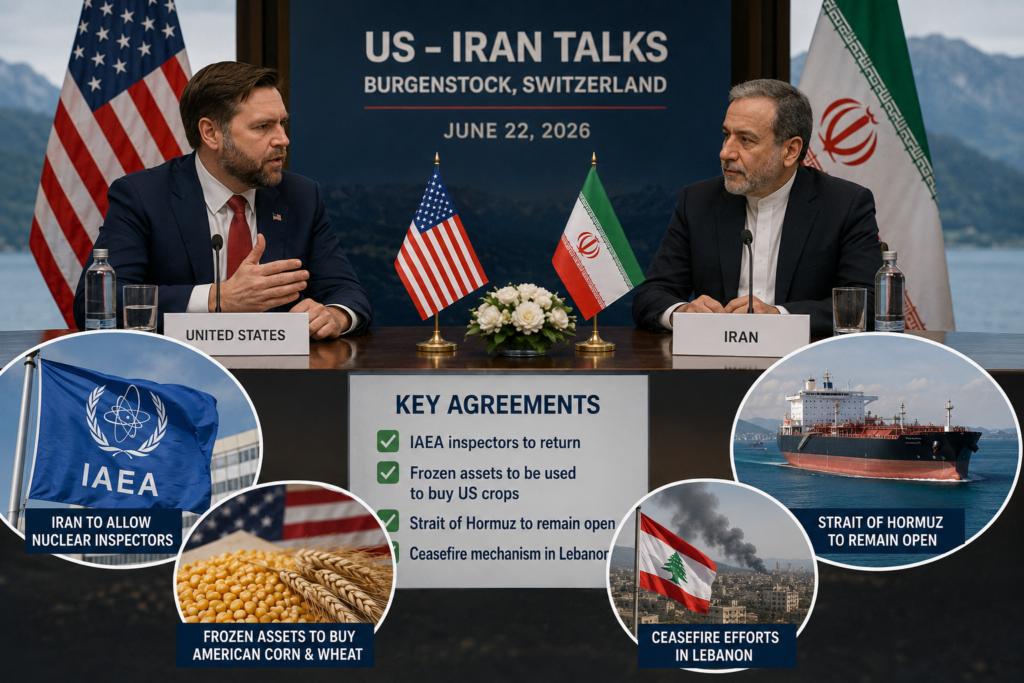
Image Credentials: Image Title: Iran Agrees to Nuclear Inspections as US Talks Advance, Vance Says. Source: (chatgpt.com) Date: June 2026. Attribution: This image was created using AI-generated imagery (chatgpt.com) by Open Chronicle and does not depict a real-world scene.
By Open Chronicle with agencies
Fresh momentum has emerged in negotiations between the United States and Iran after a new round of talks in Switzerland, with US Vice President JD Vance announcing progress on nuclear inspections, sanctions-related issues, and regional security arrangements.
Speaking after high-level discussions at the Swiss resort of Bürgenstock, Vance said Iran had agreed to allow inspectors from the International Atomic Energy Agency to return to the country, describing the move as a breakthrough.
Nuclear Inspections Set to Resume
According to Vance, discussions regarding the return of IAEA inspectors could begin as early as this week.
“That is a major milestone for the American people, and the first step in permanently denuclearising or permanently ending a nuclear weapons programme in Iran,” he said.
Iran suspended cooperation with the IAEA following the 12-day conflict involving Iran, Israel, and the United States in June 2025. Since then, inspectors have faced restrictions in accessing several key nuclear facilities.
The agreement to reopen access is being viewed as one of the most significant developments since negotiations resumed.
Foundation for a Final Agreement
Vance characterized the talks as highly productive and said negotiators had succeeded in establishing the framework for a broader settlement.
“We laid a very good foundation for a successful final deal,” he said.
“The final deal is the house. We set the foundation, we haven’t built the house, but we’ve laid a successful foundation to get to a good place for the American people.”
The negotiations have focused on Iran’s nuclear program, sanctions relief, regional security, and maritime stability.
Frozen Assets Could Be Used to Buy US Crops
One of the most notable proposals discussed during the talks concerns billions of dollars in frozen Iranian assets.
Vance revealed details of a mechanism that would allow limited access to some Iranian funds while maintaining oversight by both the United States and Qatar.
The proposal was reportedly developed by Jared Kushner in cooperation with Qatari officials.
Under the framework, any unfrozen Iranian assets would be directed toward approved humanitarian purchases, including American agricultural products.
“The money would actually go to buy American corn and American wheat for the benefit of the Iranian people,” Vance said.
Supporters argue the arrangement would provide humanitarian relief while preventing funds from being diverted to militant activities or military programs.
Strait of Hormuz Remains a Priority
Negotiators also addressed security concerns surrounding the Strait of Hormuz, one of the world’s most important energy shipping routes.
Vance said participants were working on mechanisms to guarantee freedom of navigation and support the restoration of normal commercial activity.
“First, we wanted to build a mechanism for keeping the Strait of Hormuz open. It is open,” he said.
The waterway remains vital to global energy markets, with a significant share of the world’s oil exports passing through the narrow passage.
Lebanon Ceasefire Efforts Continue
Regional stability, particularly in Lebanon, formed another major part of the discussions.
According to Vance, negotiators worked on a separate framework designed to prevent renewed escalation between Israel and Hezbollah.
Qatar and Pakistan confirmed that both sides agreed to establish a “de-confliction cell” focused on supporting ceasefire efforts and reducing the risk of further military confrontation in southern Lebanon.
The vice president described the process as ongoing but said recent developments had been encouraging.
“The previous 24 hours were pretty good,” Vance said. “This is a work in progress, but we’ve set up the operation so that we can ensure it doesn’t spiral out of control.”
Trump Remarks Did Not Derail Negotiations
The talks briefly faced uncertainty after Iran temporarily stepped away from discussions following remarks by Donald Trump threatening additional military action if Tehran failed to restrain regional proxy groups.
However, Vance rejected suggestions that the comments had damaged the diplomatic process.
“There was a little bit of threatening, there was a little bit of whining, but at the end of the day, the talks continued, and we made great progress,” he said.
Next Phase of Negotiations
Although Vance is returning to Washington, technical teams from both countries are expected to continue working on the details of a final agreement in the coming weeks.
Diplomats caution that major challenges remain, including the scope of sanctions relief, long-term nuclear monitoring arrangements and broader regional security issues.
Nevertheless, officials from the United States, Iran, Qatar, and Pakistan have all described the latest round of talks as constructive, raising hopes that years of confrontation may eventually give way to a more comprehensive diplomatic settlement.