
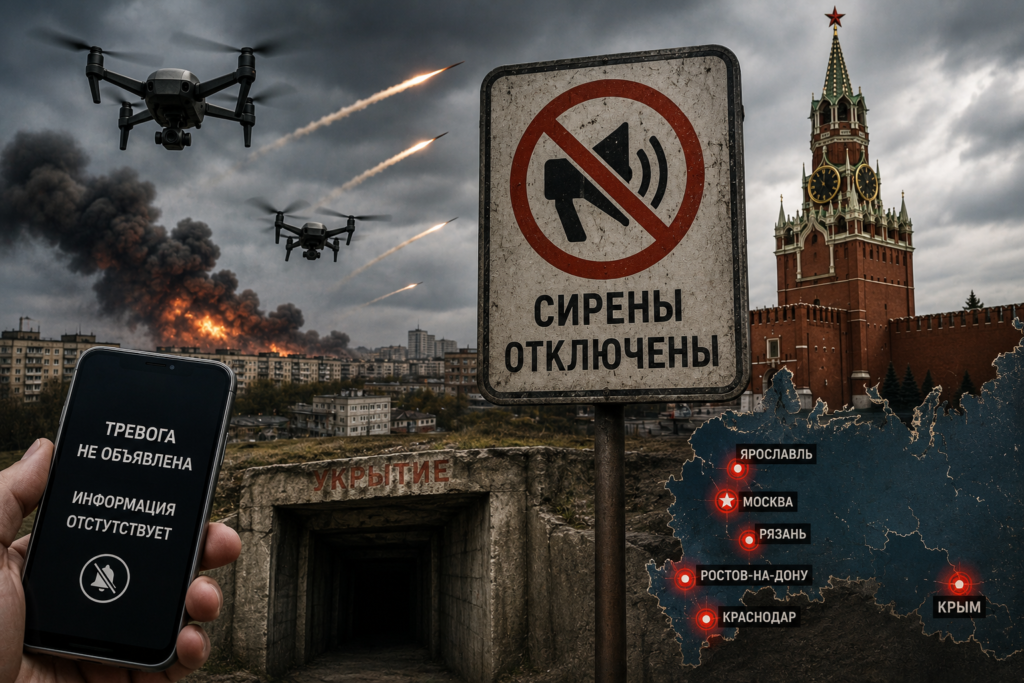
Image Credentials: Image Title: Russian Regions Accused of Silencing Air-Raid Sirens to Conceal Scale of Ukrainian Strikes. Source: (chatgpt.com) Date: June 2026. Attribution: This image was created using AI-generated imagery (chatgpt.com) by Open Chronicle and does not depict a real-world scene.
By Open Chronicle with agencies
Russian regional authorities are increasingly refusing to activate air-raid sirens during missile and drone threats in an effort to conceal the growing frequency of Ukrainian strikes on Russian territory, according to an assessment released by Ukraine’s Foreign Intelligence Service.
The report, published on June 22, argues that local governments across Russia have adopted different explanations for limiting public alerts, but all share a common objective: preserving the image of normalcy promoted by the Kremlin despite the expanding reach of the war.
According to the intelligence assessment, attacks have become frequent enough that regular warnings would make it impossible to maintain the perception that the conflict remains distant from everyday Russian life.
Crimea Among Regions Reducing Alerts
The report highlighted several regions where authorities have reportedly scaled back warning systems.
In occupied Crimea, officials allegedly decided to stop responding to every reported drone overflight. The assessment cited Crimean official Oleg Kryuchkov, who reportedly argued that activating sirens for every incident would result in alarms sounding for up to 22 hours a day.
The findings suggest local authorities concluded that continuous alerts would become impractical and could undermine public confidence.
Different Explanations, Same Outcome
In the southern Rostov region, officials reportedly justified reducing siren use by referencing practices in the Russian-occupied territories of Donetsk and Luhansk, claiming that residents often rush outdoors during alerts and increase their exposure to danger.
Authorities in Yaroslavl reportedly stated that sirens were being withheld to avoid causing panic among the population.
Meanwhile, officials in Krasnodar argued that drone threats should not automatically trigger civil defense warnings, while authorities in Ryazan maintained that excessively frequent alerts could diminish the effectiveness of emergency signals.
The Ukrainian intelligence report described these explanations as part of a broader effort to minimize public awareness of security risks.
Shelter Information Also Restricted
The report further claimed that some authorities have restricted access to information about bomb shelters and civil defense facilities.
In the Moscow-region city of Kotelniki, officials reportedly declined to disclose shelter locations, stating that such information would only be distributed during mobilization or wartime conditions.
Residents in Moscow and surrounding areas have also reportedly complained about receiving no warnings during drone incidents.
According to the assessment, local officials defended the policy by arguing that mass notifications during uncertain situations could create panic and social disruption.
Psychological Impact of the War
The intelligence service drew particular attention to comments attributed to Radiy Khabirov.
According to the report, Khabirov linked the reduction in daily sirens to increasing levels of antidepressant use among the Russian population.
Ukrainian analysts interpreted the statement as an acknowledgment that the growing number of strikes inside Russia is having a measurable psychological impact on civilians.
War Reaches Deeper Into Russia
Since the beginning of the war, Ukrainian forces have increasingly targeted military, industrial and energy infrastructure deep inside Russian territory using long-range drones and other systems.
The expanding range and frequency of such attacks have brought the conflict closer to Russian civilians, particularly in border regions and around major cities.
The Ukrainian intelligence report concludes that decisions to limit public warnings are no longer primarily logistical but political.
According to the assessment, Russian authorities face a growing challenge in maintaining public confidence while the effects of the conflict become increasingly visible inside the country.
The Kremlin has not publicly responded to the allegations, and Russian authorities have consistently argued that security measures are designed to balance public safety with the need to prevent unnecessary panic.