
Image: from NEXTA X @nexta_tv
By Open Chronicle with agencies
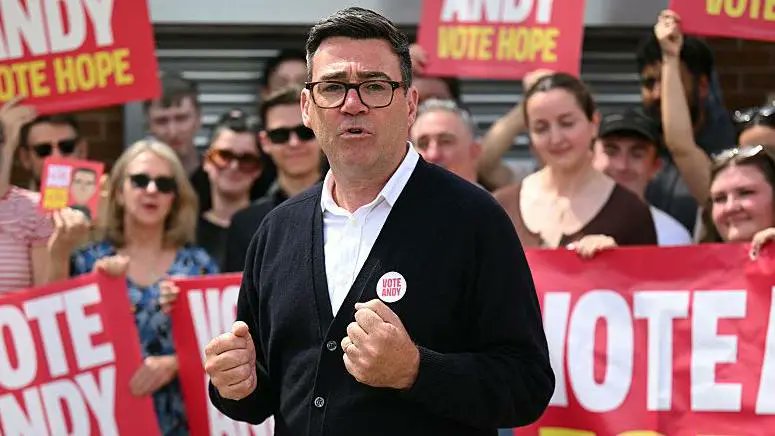
With the resignation of former British Prime Minister Keir Starmer, attention has rapidly turned to the man widely viewed as the frontrunner to replace him: Andy Burnham.
A long-time figure within the Labour Party and one of the most recognizable political leaders outside London, Burnham now appears closer than ever to securing the leadership role he unsuccessfully pursued on two previous occasions.
His supporters see him as the politician capable of reconnecting Labour with its traditional working-class base, while critics argue that many of his policy positions remain undefined.
From Manchester Mayor to Westminster Contender
Until last week, Burnham served as Mayor of Greater Manchester, a position he held for nearly a decade.
He resigned from the mayoralty to contest the parliamentary by-election in Makerfield, a constituency in Greater Manchester, where he secured a comfortable victory and returned to the House of Commons.
The result was politically significant. Makerfield represents the type of traditionally Labour, working-class constituency that has increasingly become contested territory amid the rise of right-wing populist movements.
Labour strategists viewed Burnham’s victory as evidence that the party could still regain support in areas where voters have drifted toward parties such as Nigel Farage’s Reform UK.
A Familiar Face in Labour Politics
Although Burnham often presents himself as a voice outside the London political establishment, he has spent much of his career in national politics.
He served in cabinet positions under former Prime Ministers Tony Blair and Gordon Brown and spent 16 years as a Labour Member of Parliament before becoming mayor in 2017.
His national profile grew substantially during the COVID-19 pandemic when he publicly challenged the government of then-Prime Minister Boris Johnson over financial support for northern England.
The confrontation earned him widespread recognition and strengthened his image as a defender of regional interests.
The “King of the North”
Burnham’s popularity in northern England has led supporters and media commentators to nickname him the “King of the North.”
He has consistently advocated greater regional autonomy and investment outside London, promoting a vision sometimes referred to as “Manchesterism” that emphasizes local decision-making, economic development, and civic pride.
Supporters argue that his appeal lies in his ability to connect with voters who feel ignored by the political establishment.
His approachable communication style and working-class image contrast sharply with Starmer’s more technocratic and legalistic political persona.
Where Does Burnham Stand?
Despite his popularity, questions remain about how different a Burnham government would be from the administration he may inherit.
A Conservative lawmaker recently described him as “Keir Starmer with a Northern accent,” reflecting skepticism that major policy changes would follow his arrival in Downing Street.
Burnham has occasionally shifted positions on key issues.
Earlier this year, he criticized some of Labour’s tougher immigration policies before later suggesting stricter measures to reduce legal migration and expand detention capacity for undocumented arrivals.
He previously supported the possibility of Britain eventually rejoining the European Union but has since moderated that stance, recognizing the political sensitivities surrounding Brexit.
Relations with the United States
One area attracting particular attention is how Burnham would manage relations with the United States and President Donald Trump.
While Burnham has stressed the importance of maintaining the transatlantic alliance, he has also warned against importing American-style political polarization into Britain.
“Politics is getting more polarized,” he told supporters during his recent campaign.
“The path we’re on, if we are not careful, is a path towards the politics of the United States of America, a polarized, poisonous politics where people in communities don’t work together anymore.”
How Burnham Could Become Prime Minister
Unlike presidential systems, British voters do not directly elect their prime minister.
Instead, the leader of the party holding a majority in the House of Commons typically becomes head of government.
If Labour lawmakers and party members choose Burnham as their new leader, he would automatically become prime minister without a general election.
Such leadership transitions have become increasingly common in Britain. If Burnham succeeds Starmer, he would become the seventh person to occupy 10 Downing Street in just ten years.
Momentum Builds
Burnham’s path to the premiership received a major boost when former Health Secretary Wes Streeting announced his support shortly after Starmer’s resignation.
The endorsement significantly reduced the likelihood of a divisive leadership contest and strengthened Burnham’s position as the clear favourite.
For many Labour supporters, Burnham represents a fresh start and a chance to reconnect with voters increasingly frustrated by economic pressures, political instability and concerns over immigration.
Whether he ultimately succeeds in securing the leadership and leading Labour into the next general election remains to be seen, but for now, the “King of the North” stands closer than ever to Britain’s highest office.