
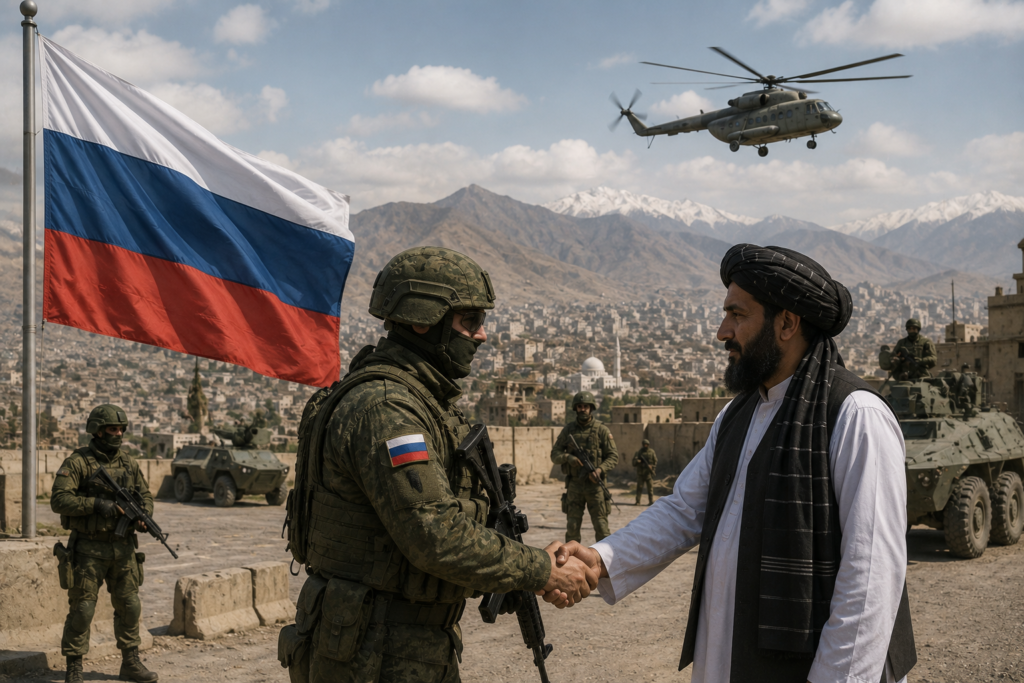
Image Credentials: Image Title: Russia Returns to Afghanistan 37 Years After Soviet Withdrawal. Source: (chatgpt.com) Date: June 2026. Attribution: This image was created using AI-generated imagery (chatgpt.com) by Open Chronicle and does not depict a real-world scene.
By Open Chronicle with agencies
Thirty-seven years after the last Soviet soldier crossed the Friendship Bridge out of Afghanistan, Russia has returned to the country in a move that is drawing attention from geopolitical observers across the world.
Moscow has signed a new defense agreement with Afghanistan’s Taliban-led government, committing to train and equip Afghan security forces. The development marks a remarkable chapter in a relationship once defined by one of the Soviet Union’s most painful military defeats.
In February 1989, Soviet troops completed their withdrawal from Afghanistan after nearly a decade of war. The conflict became a symbol of Soviet decline and was widely viewed as a contributing factor in the eventual collapse of the Soviet Union. At the time, few imagined that Russian military cooperation with Kabul would re-emerge within a generation.
Today, Russia finds itself engaged in a prolonged conflict in Ukraine while simultaneously expanding its influence in Central Asia. Moscow has become the only major power to formally recognize the Taliban government, positioning itself as one of Kabul’s most important international partners.
A Return Shaped by History
For many Russian leaders, Afghanistan remains a deeply symbolic issue.
The Soviet withdrawal in 1989 was viewed by many Russians as a national humiliation. Among those who witnessed that period was Russian President Vladimir Putin, then serving as a young KGB officer.
Analysts suggest that the Kremlin’s renewed engagement with Afghanistan reflects both strategic calculations and historical lessons. Russia’s leadership appears determined to prevent any return of Western influence in the country while strengthening its own position in Central Asia.
The move also revives echoes of the historic rivalry known as the “Great Game,” the nineteenth-century competition between the Russian Empire and the British Empire for influence across Central Asia and Afghanistan.
Strategic Competition Continues
Afghanistan remains strategically important because of its location at the crossroads of Central Asia, South Asia, China, and the Middle East.
During both the Cold War and the post-9/11 era, major powers viewed control and influence in Afghanistan as essential to broader regional strategies.
Former US President Donald Trump has repeatedly expressed interest in the former American military facility at Bagram Air Base, suggesting it could play an important role in monitoring China. The Soviet Union originally built the base before being expanded by the United States during its two-decade presence in Afghanistan.
The American withdrawal in 2021 ended Washington’s direct military role in the country, creating opportunities for other powers to expand their influence.
Russia and China Deepen Their Presence
While Russia has taken the lead politically through recognition of the Taliban government and military cooperation, China has emerged as Afghanistan’s largest foreign investor.
Both Moscow and Beijing support greater economic integration between Afghanistan and neighboring Central Asian states, including Turkmenistan and Kazakhstan.
Despite concerns over Taliban ideology, regional governments increasingly view engagement with Kabul through the lens of security, economic interests, and geopolitical competition.
Neither Russia nor China wants Afghanistan to return to the sphere of influence of the United States or its allies.
Security Concerns Remain
The renewed Russian presence comes amid continued concerns about militant activity inside Afghanistan.
Several international assessments and United Nations reports have warned that extremist groups continue to operate within the country. Security experts remain divided on the extent of the threat, but many agree that Afghanistan’s stability remains fragile.
For Moscow, strengthening ties with the Taliban may be viewed as a way to manage potential security risks before they spread into Central Asia and Russia itself.
A New Chapter in an Old Story
Russia’s return to Afghanistan represents one of the most striking geopolitical reversals of recent decades.
A country once synonymous with Soviet military failure has become a new arena for Russian diplomatic and military engagement. Whether Moscow can achieve greater success than it did during the Soviet era remains uncertain.
As global attention focuses on conflicts in Ukraine, the Middle East, and elsewhere, Russia’s growing role in Afghanistan signals that the strategic importance of Central Asia remains as significant today as it was during the age of empires.
History rarely repeats itself exactly, but Moscow’s return to Kabul ensures that Afghanistan remains at the center of a geopolitical contest that has endured for centuries.