
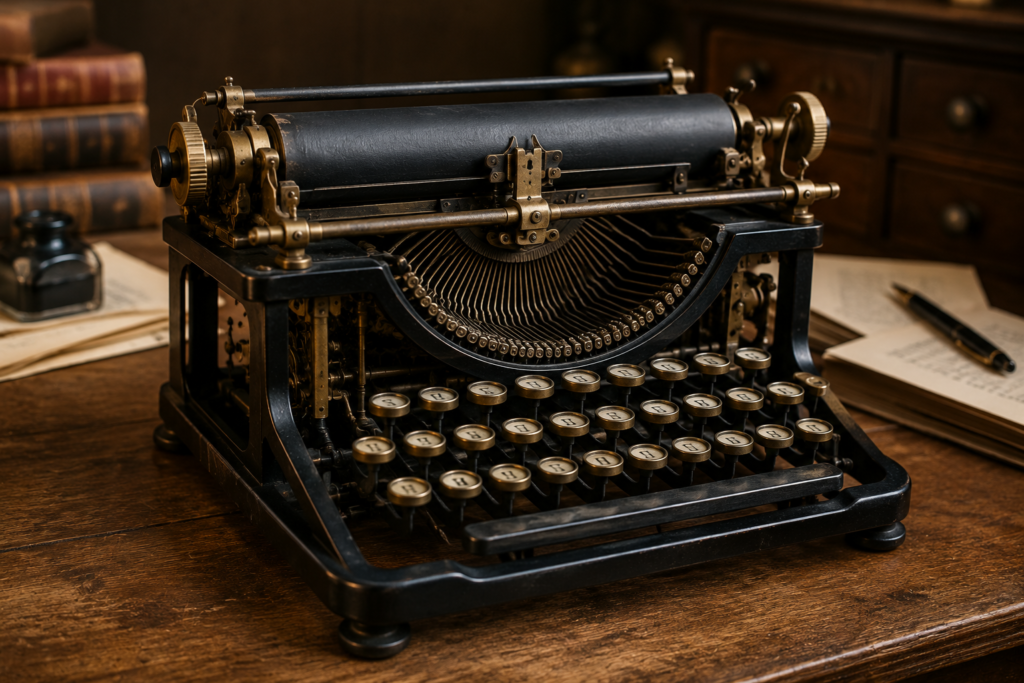
Image Credentials: Today in History, June 23: Introducing the First Typewriter. Source: (chatgpt.com) Date: June 2026. Attribution: This image was created using AI-generated imagery (chatgpt.com) by Open Chronicle and does not depict a real-world scene.
By Open Chronicle with agencies
June 23, 1868
On this day in 1868, American inventors Christopher Latham Sholes, Samuel W. Soulé, and Carlos Glidden were granted a United States patent for a revolutionary new device: the typewriter. Though modest in appearance, the invention would transform communication, business, journalism, and literature, laying the foundation for the modern keyboard.
The patented machine, officially described as an “Improvement in Type-Writing Machines,” was the result of years of experimentation. Sholes, a newspaper editor and inventor from Wisconsin, had become interested in developing a machine that could produce printed text more quickly and clearly than handwriting. Working alongside Soulé and Glidden, he helped create a mechanism capable of imprinting letters onto paper through the pressing of keys.
Early versions of the machine were far from perfect. They were bulky, mechanically complex, and difficult to operate. Nevertheless, they demonstrated the enormous potential of mechanical writing. Continued refinements eventually led to commercial production, most notably through the Remington company, which introduced one of the first successful mass-produced typewriters in the 1870s.
One of the most enduring legacies of the invention was the development of the QWERTY keyboard layout. Designed to reduce the likelihood of mechanical typebars jamming during rapid typing, the arrangement placed commonly used letter combinations farther apart. Although alternative keyboard designs were later proposed, QWERTY became the global standard and remains in widespread use on computers, smartphones, and other digital devices today.
The arrival of the typewriter dramatically changed office work. Businesses could create documents more quickly and legibly, government agencies improved record keeping, and professional typists emerged as an essential part of the modern workforce. The machine also opened new employment opportunities for women, many of whom entered offices as typists and stenographers during the late nineteenth century.
Writers and journalists quickly embraced the new technology. Authors gained the ability to prepare cleaner manuscripts, while newspapers could produce written material more efficiently than ever before. Over time, the typewriter became a symbol of modernity, productivity, and intellectual work.
Although largely replaced by computers during the late twentieth century, the typewriter’s influence remains unmistakable. Every time a person uses a keyboard, they are interacting with a design whose origins can be traced back to the patent granted on June 23, 1868.