
Image: from ARISE NEWS X @ARISEtv
By Open Chronicle with agencies
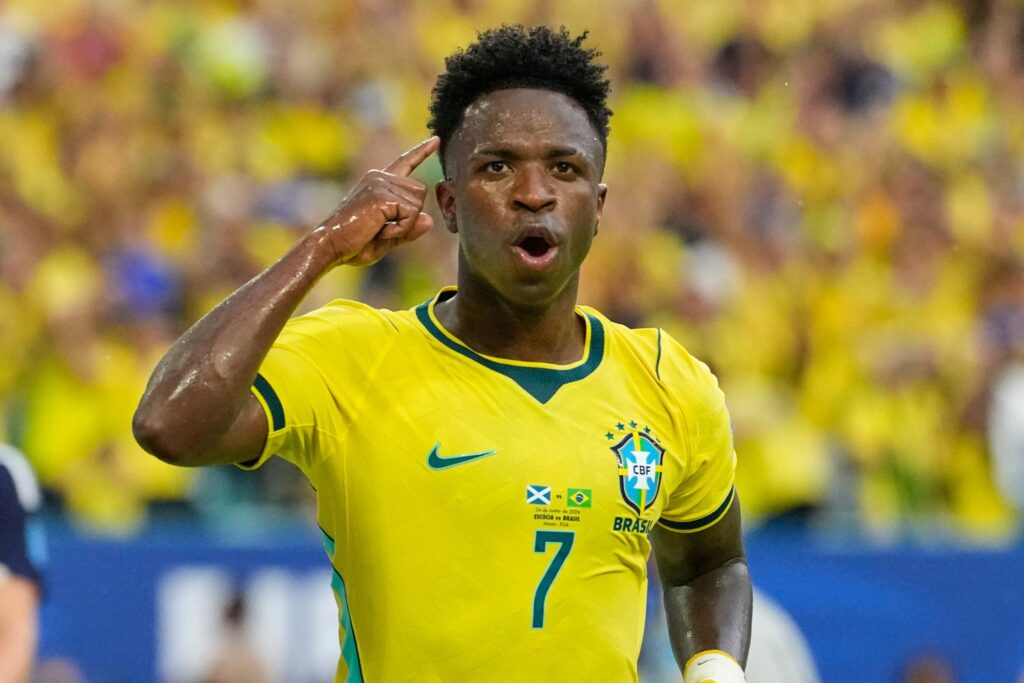
Brazil produced another commanding performance at the FIFA World Cup 2026, defeating Scotland with authority to secure top spot in Group C, as Vinícius Júnior delivered a man-of-the-match display and continued his outstanding tournament.
For Scotland, the defeat extended a painful World Cup record. Steve Clarke’s side once again failed to reach the knockout stage, remaining without a victory against South American opposition in World Cup history despite entering the match with hopes of advancing, even as one of the tournament’s best third-placed teams.
Vinícius Strikes Early
Scotland needed a confident start but suffered a costly defensive mistake after only seven minutes.
Scott McKenna hesitated while attempting to clear the ball, allowing Rayan to intercept before the loose ball fell perfectly for Vinícius Júnior. The Brazilian forward rounded goalkeeper Angus Gunn and calmly finished into an empty net to score his third goal of the tournament.
The strike also placed Vinícius alongside Brazilian legends Jairzinho, Romário, Ronaldo, and Rivaldo as the only players from Brazil to score in three consecutive World Cup matches.
With Brazil unbeaten in its previous 12 World Cup matches after opening the scoring, Scotland immediately faced an uphill battle.
Brazil Controls the Match
Brazil dominated possession and dictated the tempo through an impressive midfield trio of Casemiro, Bruno Guimarães, and Lucas Paquetá, whose passing accuracy consistently denied Scotland any sustained control.
Guimarães, Matheus Cunha, and Vinícius all threatened before Vinícius thought he had doubled the advantage midway through the first half. However, the goal was ruled out after VAR detected a foul during the build-up.
Despite the disallowed effort, Vinícius remained unstoppable. His pace, movement, and creativity repeatedly exposed Scotland’s central defenders, Scott McKenna and Jack Hendry, while Brazil continued to create wave after wave of attacks.
Scotland managed only occasional moments of relief through Lewis Ferguson and Kenny McLean, but Brazil remained firmly in command.
Just before halftime, Bruno Guimarães delivered another dangerous cross that found Vinícius at the far post, allowing the Real Madrid star to score Brazil’s second goal deep into first-half stoppage time.
Cunha Puts the Result Beyond Doubt
Scotland attempted to respond after the interval and nearly reduced the deficit when Scott McTominay forced Alisson into an excellent save with a powerful header.
The effort briefly lifted the Scottish side, but Brazil quickly regained complete control.
Shortly after the hour mark, Guimarães produced another decisive contribution, finding Matheus Cunha, who calmly finished to make it 3,0 and effectively end the contest.
Brazil continued attacking throughout the second half, finishing with 21 shots, the highest total recorded by any team in a single match at the 2026 World Cup.
Although Scotland attempted over 500 passes, also a tournament high, much of that possession came after Brazil had already established an unassailable lead.
Vinícius Delivers a Complete Performance
Vinícius Júnior was unquestionably the standout performer.
The winger registered eight shots, five on target, completed five successful dribbles from eight attempts, won nine of his fifteen individual duels, and constantly stretched Scotland’s defensive line throughout the match.
His movement created space not only for himself but also for teammates such as Cunha and Paquetá, making Brazil’s attack almost impossible to contain.
Neymar Makes Tournament Return
One of the biggest moments of the evening came late in the match when Neymar made his long-awaited first appearance of the tournament.
The Brazilian star entered as a substitute to a thunderous reception from supporters, marking his return after injury and providing another boost to Brazil ahead of the knockout rounds.
With three consecutive victories, Brazil advances to the Round of 16 as Group C winners, while Scotland’s World Cup campaign comes to an end despite moments of resilience throughout the group stage.