
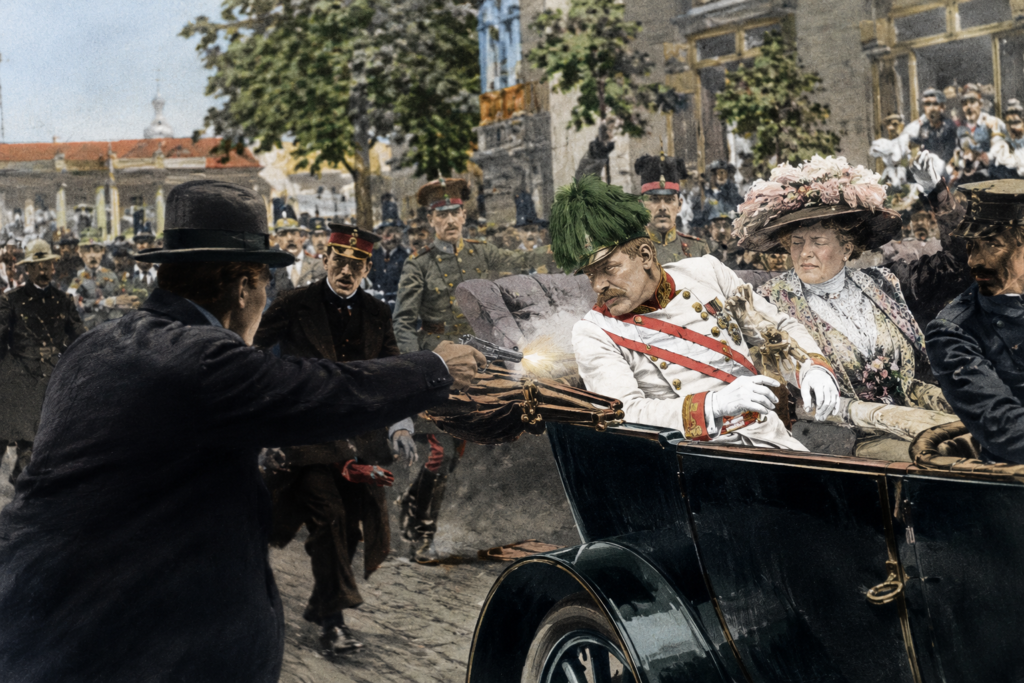
Image Credentials: Image Title: Today in History, June 28: The Assassination That Sparked the First World War. Source: (chatgpt.com) Date: June 2026. Attribution: This image was created using AI-generated imagery (chatgpt.com) by Open Chronicle and does not depict a real-world scene.
By Open Chronicle
June 28, 1914
On this day in 1914, Archduke Franz Ferdinand of Austria, heir to the Austro-Hungarian throne, and his wife, Sophie, Duchess of Hohenberg, were assassinated in Sarajevo. The killings set in motion a diplomatic crisis that, within weeks, escalated into the First World War, one of the deadliest conflicts in human history.
Franz Ferdinand was visiting Sarajevo, the capital of the Austro-Hungarian province of Bosnia and Herzegovina, to inspect military exercises and attend official events. The visit took place amid rising nationalist tensions in the Balkans, where many Slavic groups sought independence from Austro-Hungarian rule or union with neighboring Serbia.
A group of young Bosnian Serb nationalists, supported by members of the secret organization known as the Black Hand, planned to assassinate the Archduke during his visit. Earlier in the day, one conspirator threw a bomb at the royal motorcade, but it failed to kill its intended target, instead injuring several members of the entourage.
After the failed attack, Franz Ferdinand insisted on visiting those wounded in the hospital. During a change to the planned route, the Archduke’s driver mistakenly turned onto a side street where another conspirator, nineteen-year-old Gavrilo Princip, happened to be standing. Seizing the unexpected opportunity, Princip stepped forward and fired two shots at close range. Franz Ferdinand was struck in the neck, while Sophie was fatally wounded in the abdomen. Both died within minutes.
The assassination sent shockwaves across Europe. Austria-Hungary quickly blamed Serbia for supporting the plot, although the Serbian government denied direct involvement. In the weeks that followed, diplomatic negotiations collapsed as Europe’s complex system of alliances drew one nation after another into the crisis.
On July 28, exactly one month after the assassination, Austria-Hungary declared war on Serbia. Russia mobilized in support of Serbia, Germany backed Austria-Hungary, and France and Britain soon entered the conflict. What had begun as a regional dispute rapidly expanded into a global war involving dozens of nations across Europe, Africa, the Middle East, Asia, and the oceans.
The First World War lasted from 1914 to 1918 and claimed the lives of an estimated 16 million people, while millions more were wounded. It led to the collapse of four major empires, redrew the political map of Europe, and created conditions that would contribute to the outbreak of the Second World War two decades later.
Today, the assassination of Archduke Franz Ferdinand is remembered not only as a dramatic act of political violence but also as the event that ignited one of the most consequential conflicts in modern history.