
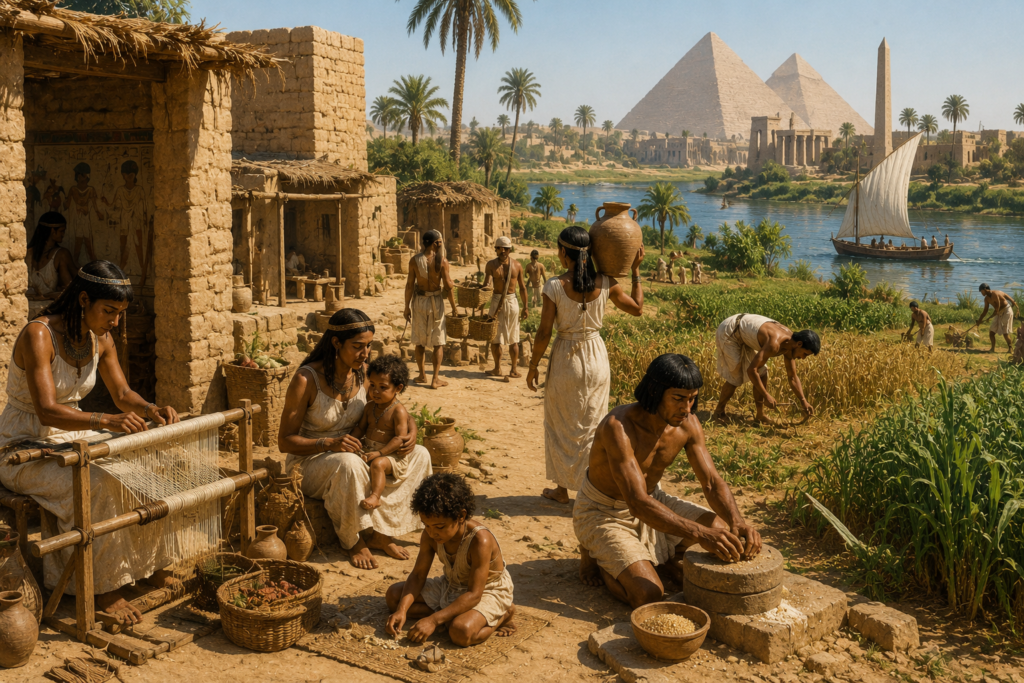
Image Credentials: Image Title: Ancient Egypt Beyond the Pharaohs: Inside the Daily Lives of Ordinary People. Source: (chatgpt.com) Date: June 2026. Attribution: This image was created using AI-generated imagery (chatgpt.com) by Open Chronicle and does not depict a real-world scene.
By Open Chronicle History Desk with Agencies
The monumental pyramids, towering temples, and richly decorated tombs of Ancient Egypt have captivated historians for centuries. While the achievements of the pharaohs dominate much of the historical record, the vast majority of Egyptians lived far from royal palaces, spending their lives farming, raising families, practicing trades, and serving their communities along the Nile.
Although ordinary people rarely left behind grand monuments, archaeological discoveries and surviving texts provide a fascinating glimpse into everyday life in one of history’s longest-lasting civilizations.
A deeply structured society
Ancient Egyptian society was highly organized and hierarchical. At its summit stood the pharaoh, regarded not only as the ruler of Egypt but also as the divine intermediary between humanity and the gods.
Below the royal family were powerful nobles, priests, and government officials who controlled much of the country’s wealth and administration. Skilled artisans, merchants, soldiers, and scribes formed a growing middle class, while the largest segment of society consisted of farmers, laborers, and servants whose work sustained the kingdom’s economy.
Agriculture remained the foundation of Egyptian civilization, with the annual flooding of the Nile providing fertile land for wheat, barley, vegetables, and flax cultivation.
The family formed the foundation of society
Family life was central to Ancient Egyptian culture. Marriage was viewed primarily as an economic and social partnership rather than a romantic union. Men and women were expected to marry young and raise large families, providing labor and security in a world where illness and high mortality were common.
Children typically followed the occupations of their parents. Boys learned trades from their fathers and male relatives, while girls remained at home, where they were taught domestic responsibilities by their mothers before marrying in their early teens.
Without any formal welfare system, relatives formed the essential support network throughout every stage of life.
Women enjoyed notable legal rights
Despite the traditional division of household responsibilities, women in Ancient Egypt enjoyed legal rights that were unusually advanced for the ancient world.
Women could own property, inherit wealth, conduct business, initiate divorce, and represent themselves before courts without requiring a male guardian. While husbands generally worked outside the home, wives managed family finances, food preparation, clothing production, and childcare.
Artistic representations often portrayed women with lighter skin and men with darker complexions, symbolizing their respective indoor and outdoor roles rather than actual appearance.
Birth and childhood
Childbirth was both a routine and a dangerous part of life. Medical knowledge remained limited, and women often relied on protective amulets depicting the hippopotamus goddess Taweret and the dwarf deity Bes to safeguard mothers and infants.
Birth usually took place while the mother squatted on specially designed birthing bricks, assisted by a midwife using simple stone tools. Breastfeeding commonly continued for up to three years, helping improve infant survival in an era without modern medicine.
Homes built from mud brick
Unlike the massive stone monuments that still dominate Egypt today, ordinary homes were constructed almost entirely from mud brick.
One of the best preserved examples is the workers’ village of Deir el-Medina, where the craftsmen responsible for building the royal tombs lived.
Typical houses were narrow, with several small rooms, a kitchen containing a mud-brick oven, and stairways leading to flat rooftops that served as additional living space during cooler evenings.
Because mud brick deteriorates over time, relatively few ancient houses have survived compared with temples and tombs.
Bread, beer, and the Nile
The fertile Nile Valley ensured that most Egyptians enjoyed a stable food supply during years of normal flooding.
Bread made from wheat or barley formed the staple of every meal, accompanied by onions, beans, lentils, vegetables, and fish caught in the Nile. Hunting provided occasional wild game, while wealthier families regularly consumed beef, lamb, and poultry.
Beer served as the everyday beverage for almost everyone, including children, because fermentation made it safer than untreated water. Wine, meanwhile, remained largely reserved for the elite.
Clothing made from linen
Egyptians wore lightweight linen garments suited to the hot climate. Cotton and silk were still unknown.
Women generally wore simple linen dresses, while men commonly dressed in tunics or kilts, depending on their work. Clothing represented a valuable possession, often being repaired repeatedly before eventually serving as wrapping material during burial.
Laundry was washed using natron, a naturally occurring mineral salt harvested in Egypt.
Medicine mixed science and magic
Egyptian physicians were highly respected throughout the ancient Mediterranean and combined practical observation with religious rituals.
Doctors treated illnesses using herbal remedies, minor surgical procedures, and written prescriptions, while also employing protective spells and magical charms.
Medical specialists existed in several fields, including gynecology, where physicians offered treatments related to fertility, pregnancy, and contraception, although many methods proved unreliable by modern standards.
Religion shaped everyday existence
Religion permeated every aspect of Egyptian life.
Thousands of deities formed a vast religious system ranging from powerful national gods to local protective spirits. While official temple rituals remained largely reserved for priests and the royal family, ordinary Egyptians practiced personal devotion through household shrines, offerings, and prayers to local gods and deceased ancestors.
Magic was considered inseparable from religion and medicine, protecting against illness, bad fortune, and supernatural dangers.
Preparing for eternity
Belief in the afterlife profoundly influenced Egyptian society.
Wealthier families invested heavily in elaborate mummification procedures designed to preserve the body so that the soul could continue its existence after death. Embalmers removed internal organs, dried the body with natron salt, and carefully wrapped it in linen bandages before burial.
Most ordinary Egyptians, however, could not afford such costly treatment. Instead, they were buried in simple graves dug into the desert sand, leaving historians to wonder what expectations of the afterlife existed among the majority of the population.
Although history often celebrates the reigns of famous pharaohs, it was the millions of ordinary Egyptians, farmers, builders, artisans, merchants, and families, whose daily labor sustained one of the world’s greatest civilizations for more than three millennia.