
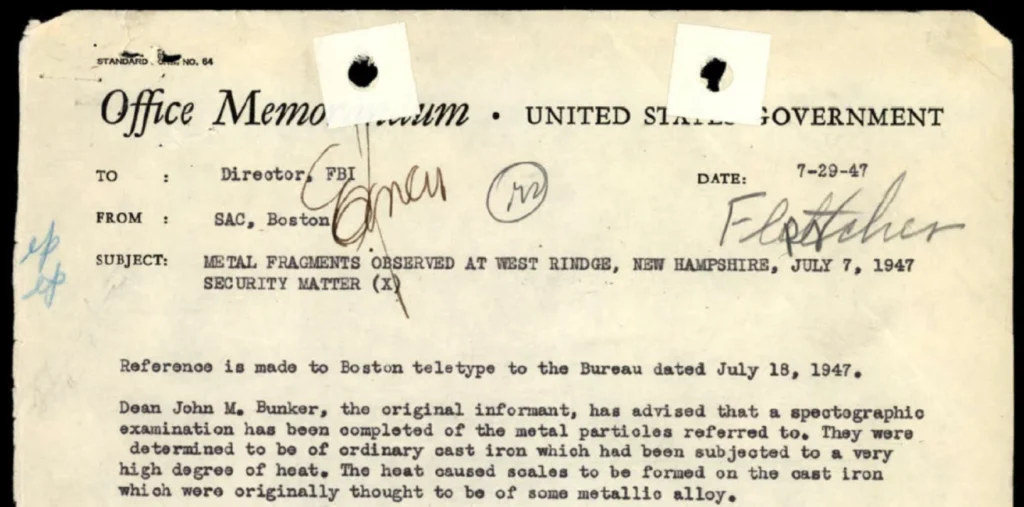
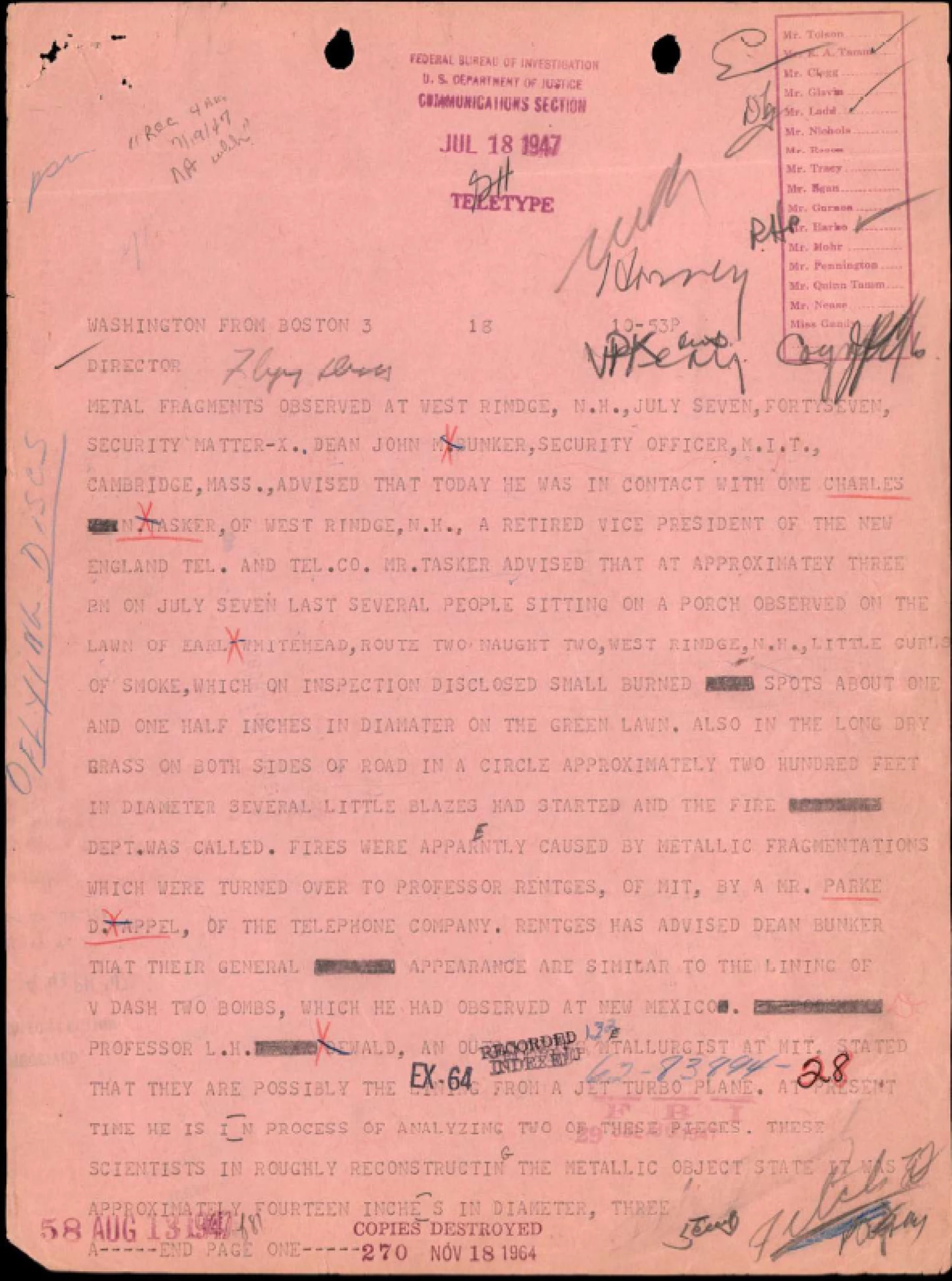
Image: by U.S. Department of Defense – A memo addressed to the director of the FBI in July 1947, recently declassified by the Pentagon.
By Open Chronicle News Desk with Agencies
Newly declassified Pentagon files have revived interest in one of New England’s oldest unexplained aerial mysteries, revealing previously classified FBI investigations into mysterious metal fragments that fell from the sky in West Rindge, New Hampshire, during the summer of 1947.
The documents, released as part of a broader disclosure of historical records relating to Unidentified Anomalous Phenomena (UAP), detail an extensive investigation involving the FBI, the Massachusetts Institute of Technology (MIT), and leading scientists of the era. Despite months of analysis, investigators were unable to determine the origin of the strange objects.
A strange afternoon in New Hampshire
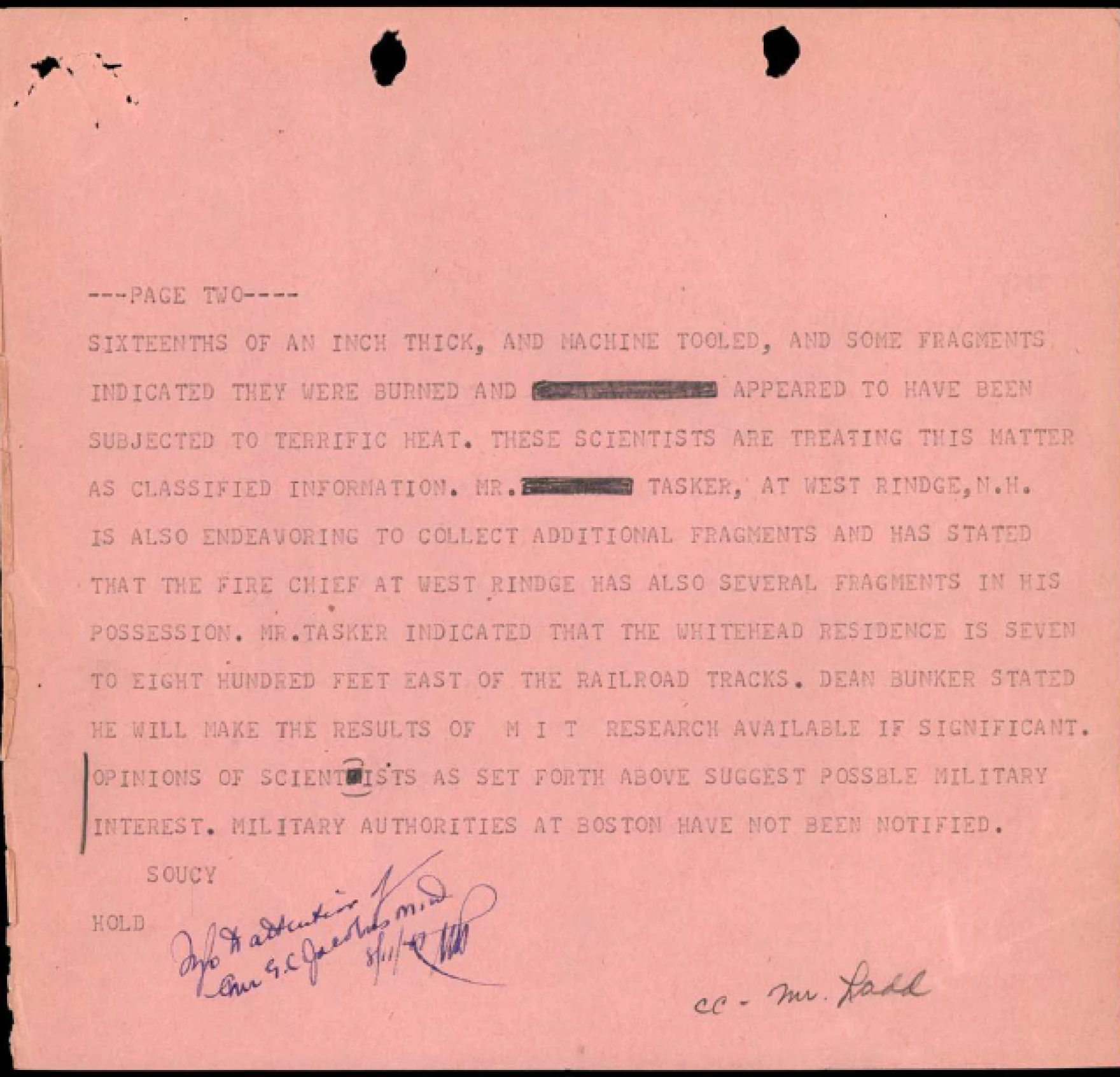
On the afternoon of July 7, 1947, retiree Charles N. Tasker was sitting on the porch of a home in West Rindge when he noticed thin curls of smoke rising from the lawn.
Upon closer inspection, several small burned patches measuring roughly one and a half inches across were found scattered across the grass. Nearby, additional fires had ignited along Route 202, forming what investigators later described as a roughly 200-foot-wide circular area containing numerous small metallic fragments.
Local firefighters quickly extinguished the fires while several of the fragments were collected and delivered to researchers at MIT for scientific examination.
Scientists search for answers
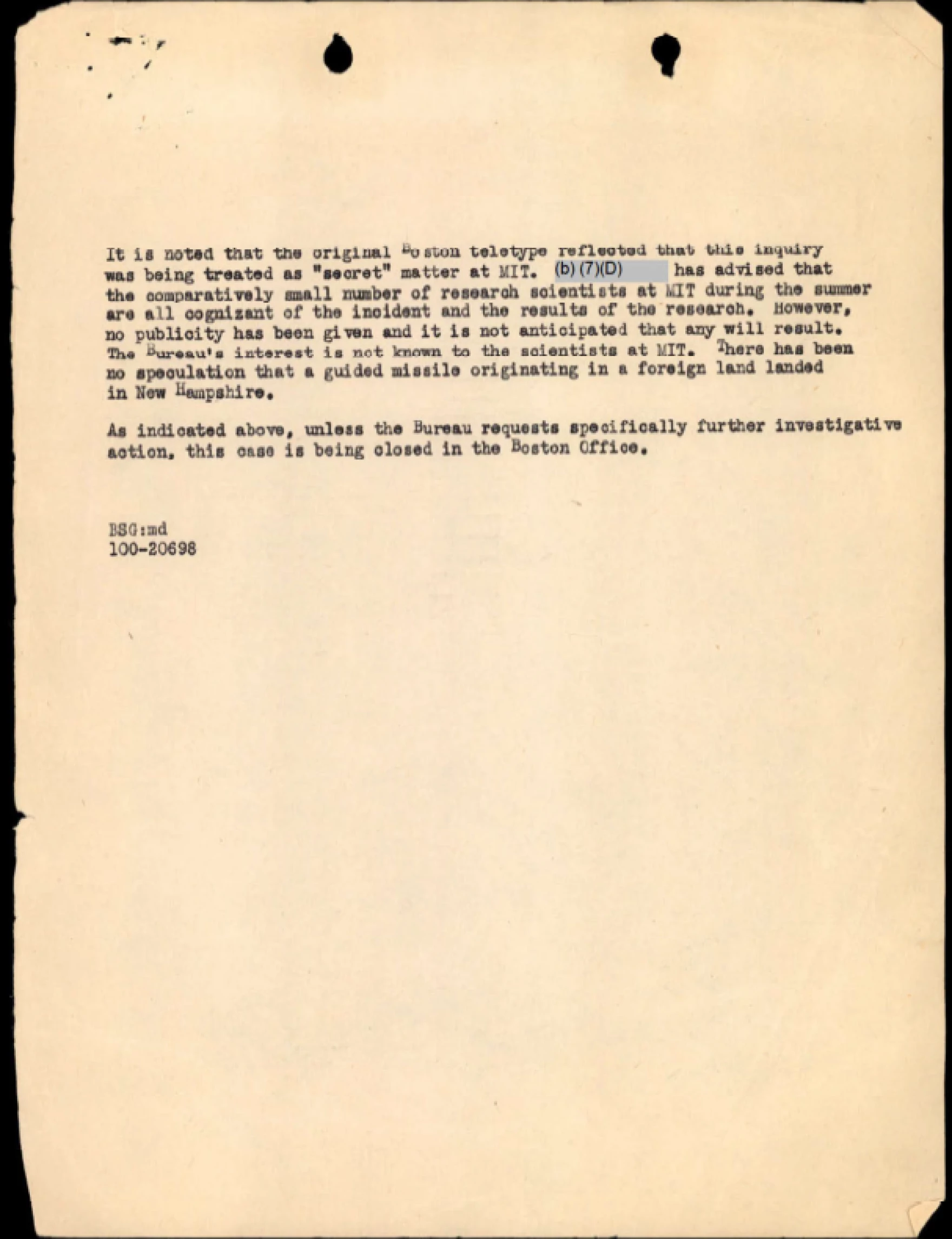
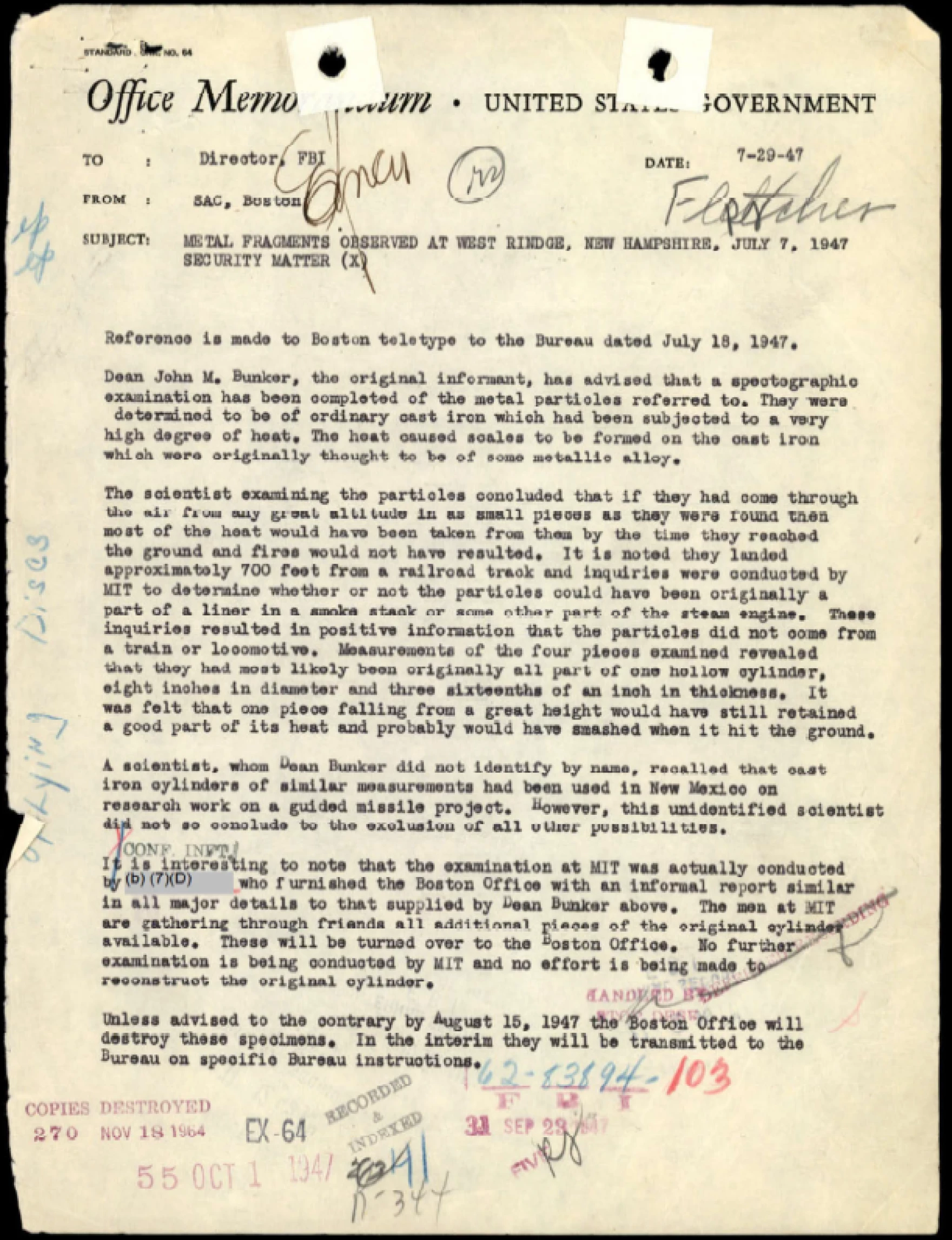
Using spectrographic analysis, MIT researchers determined that the recovered material consisted primarily of ordinary iron that had been subjected to extremely high temperatures, producing characteristics similar to cast iron.
Investigators initially considered whether the fragments had originated from a passing steam locomotive, given the proximity of a nearby railway line. However, detailed testing ruled out that explanation.
Attention then turned toward aviation.
Some scientists suggested the fragments could have originated from an early jet engine, while others questioned whether any object falling from high altitude would retain enough heat to ignite fires upon reaching the ground.
Researchers eventually concluded that the fragments may once have formed part of a hollow cylindrical object approximately eight inches in diameter and manufactured using industrial machinery.
Links to early rocket research
One of the investigators, Professor J. Francis Reintjes of MIT, noted similarities between the recovered fragments and components he had previously observed from German V,2 rockets being tested by the United States at White Sands Missile Range following World War II.
At the time, captured V,2 rockets were being used to advance American missile and atmospheric research.
However, scientists ultimately concluded that the available evidence was insufficient to definitively connect the West Rindge fragments to the classified rocket program.
Modern experts have also questioned the theory.
Historians at White Sands note that V,2 test launches generally landed within about 100 miles of the New Mexico test range, making it highly unlikely that debris could have travelled more than 2,000 miles to New Hampshire.
Additionally, physicists point out that V,2 rockets were primarily constructed from steel rather than cast iron, making the composition of the recovered fragments difficult to reconcile with that explanation.
Meteorite or something else?
Meteorites were also considered a possible explanation.
Although iron meteorites are known to reach Earth’s surface, planetary scientists say the evidence does not fit.
According to experts, meteorites do not normally remain hot enough upon impact to ignite vegetation, and their chemical composition is distinctive enough that researchers in 1947 would likely have recognized them immediately.
That leaves the mystery unresolved.
UFO era begins
The timing of the incident has continued to fuel speculation.
The West Rindge event occurred only weeks after pilot Kenneth Arnold’s famous sighting of unidentified flying objects in June 1947, the event that helped launch America’s modern fascination with so-called “flying saucers.”
Several of the newly released FBI memoranda contain handwritten references to “Flying Discs,” reflecting the atmosphere of uncertainty surrounding unexplained aerial reports during that period.
While some UFO researchers continue to believe extraterrestrial explanations cannot be entirely dismissed, others argue that no conclusive evidence links the incident to alien technology.
Mystery remains after nearly 80 years
The declassified files indicate that the FBI intended to destroy the recovered metal specimens unless instructed otherwise by August 1947.
Today, the Boston FBI Field Office says it has been unable to locate records confirming whether the fragments were preserved or destroyed.
Without the original material available for modern forensic analysis, the true origin of the mysterious iron fragments may never be known.
Nearly eight decades after small fires appeared in a quiet New Hampshire field, the West Rindge incident remains one of America’s oldest unresolved UAP investigations, sitting somewhere between Cold War technology, unexplained aerial phenomena, and enduring mystery.