
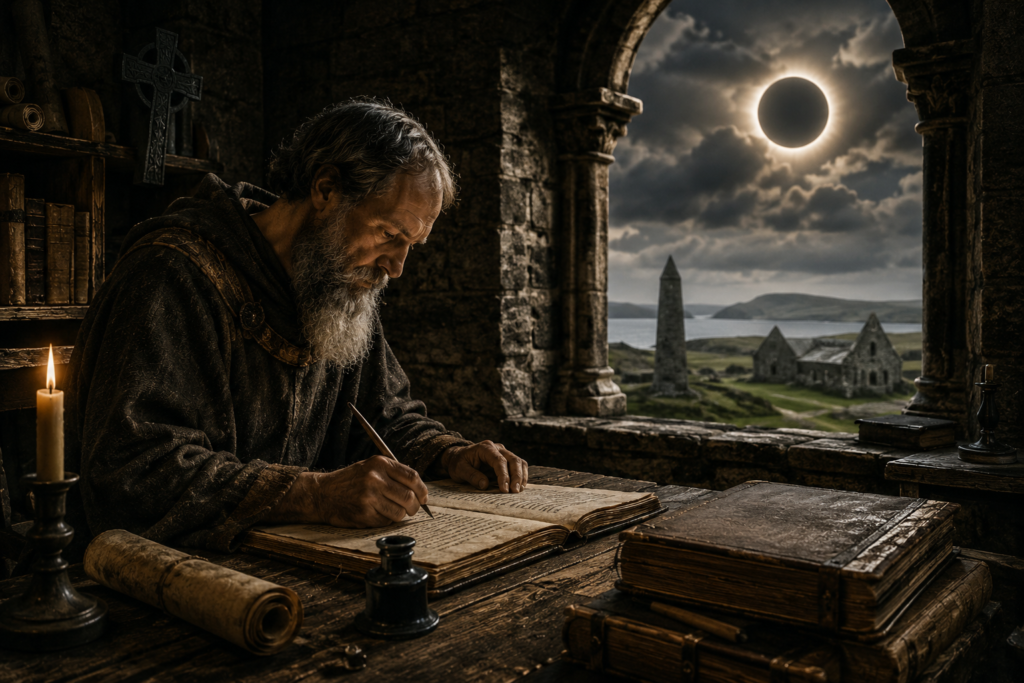
Image Credentials: Image Title: A Solar Eclipse Recorded in Early Medieval Ireland. Source: (chatgpt.com) Date: June 2026. Attribution: This image was created using AI-generated imagery (chatgpt.com) by Open Chronicle and does not depict a real-world scene.
By Open Chronicle with agencies
June 29, 512
On this day in 512, a solar eclipse was recorded by a monastic chronicler in Ireland, leaving behind one of the earliest surviving written observations of an astronomical event in the country’s history. Though brief in its original description, the account has become an important reference for both historians and astronomers seeking to understand the chronology of the early Middle Ages.
During the sixth century, Ireland was home to a growing network of Christian monasteries that served not only as centres of worship but also as places of learning and record keeping. Monks carefully documented significant events, including the deaths of rulers and church leaders, unusual weather, natural disasters, and rare celestial phenomena. Their work laid the foundations for what would later become the Irish annals.
The eclipse of June 29, 512, was notable enough to be preserved in these early records. While the chroniclers lacked a scientific explanation for the event, eclipses were widely regarded throughout Europe as extraordinary signs in the heavens. Many people interpreted them as divine warnings, omens of political change, or symbols of God’s intervention in human affairs.
Modern astronomical calculations have confirmed that a solar eclipse was indeed visible from parts of Ireland on that date. Such confirmations demonstrate the remarkable accuracy of many early medieval chronicles and allow historians to use astronomical events as fixed reference points when reconstructing historical timelines.
The record also highlights the growing intellectual tradition within Irish monastic communities. Long before the establishment of universities, monks devoted themselves to preserving knowledge through manuscripts, copying classical texts, recording historical events, and observing the natural world. Their dedication ensured that valuable information survived the centuries despite periods of political upheaval and Viking raids.
Astronomical observations recorded in medieval chronicles continue to provide important evidence for modern researchers. By comparing ancient descriptions with modern calculations of eclipses and other celestial events, scholars can verify historical dates and better understand how earlier civilizations experienced the natural world.
Although only a short entry in a medieval manuscript, the eclipse recorded in 512 remains a lasting reminder of humanity’s enduring fascination with the skies. It stands as one of the earliest documented astronomical observations in Ireland and an enduring testament to the careful work of the island’s early chroniclers.