
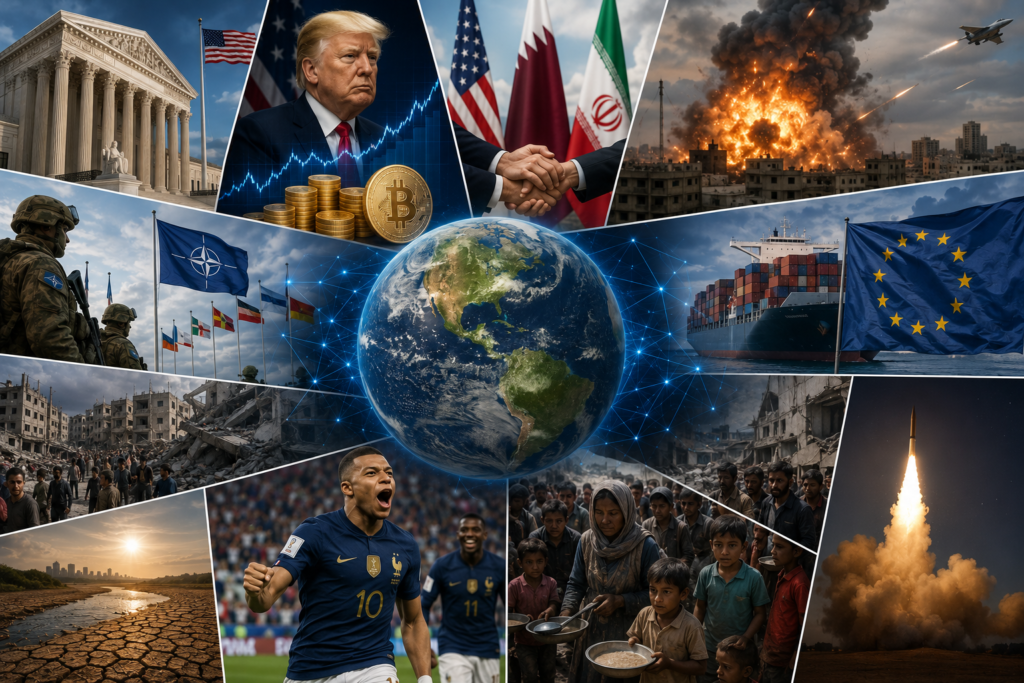
Image Credentials: Image Title: Global News Brief: Key Developments Around the World on July 1, 2026. Source: (chatgpt.com) Date: June 2026. Attribution: This image was created using AI-generated imagery (chatgpt.com) by Open Chronicle and does not depict a real-world scene.
By Open Chronicle News Desk with Agencies
Developments across the globe on July 1 reflected a rapidly shifting international landscape, with major legal decisions in the United States, renewed diplomatic efforts over Iran, escalating tensions involving Russia and Ukraine, economic disputes, humanitarian crises, and continued geopolitical competition.
In the United States, the Supreme Court delivered one of its most significant constitutional rulings in recent years, rejecting former President Donald Trump’s executive order aimed at restricting birthright citizenship. The 6,3 decision reaffirmed the protections of the Fourteenth Amendment, preserving automatic citizenship for nearly all children born on American soil. The ruling immediately sparked strong reactions across the political spectrum.
Trump also remained in the headlines after new financial disclosures revealed that his business ventures generated more than $1.8 billion in income, with cryptocurrency investments accounting for a substantial share. Reports indicated that his meme coin project alone generated hundreds of millions of dollars.
Diplomatic attention remained focused on the Middle East as representatives from Qatar and the United States continued discussions on Iran and Lebanon in Doha. Despite speculation surrounding possible direct negotiations, officials confirmed that no high-level US-Iran talks had been scheduled. US Vice President JD Vance described Tehran’s denial of planned meetings as a “Persian negotiating tactic,” while China urged both sides to continue advancing diplomatic efforts.
Israeli Prime Minister Benjamin Netanyahu warned that Israel would not hesitate to launch additional military operations against Iran if it believed Tehran was rebuilding its nuclear capabilities, reinforcing concerns that the regional ceasefire remains fragile.
The war in Ukraine continued to reshape Europe’s security environment. Ukrainian forces reportedly struck targets more than 1,300 kilometres inside Russian territory, including the Ufa oil refinery and a missile-linked industrial facility in Penza. Additional drone attacks reportedly targeted Russian military manufacturing infrastructure, while Kyiv urged Western allies to expand military assistance to maintain battlefield momentum.
Economic pressure inside Russia also intensified, with new polling showing growing public concern over worsening living standards. A Gallup survey reported that 60 percent of Russians believe economic conditions are deteriorating, the highest level recorded in two decades. Ukrainian attacks on refineries have also reportedly contributed to fuel rationing and long queues at petrol stations.
NATO preparations dominated European security discussions as alliance leaders gathered ahead of the summit in Ankara. Secretary General Mark Rutte called for concrete implementation of defence commitments, while the United Kingdom announced a further $26 billion increase in military spending. Critics, however, argued that the investment still falls short of current security requirements.
Russia announced the temporary closure of seven railway border crossings with Finland, Latvia and Estonia, while Moscow also faced renewed scrutiny following reports that senior officials had approved secret military cooperation exercises with China linked to the war in Ukraine.
In South Korea, regulators accused Google of abusing its dominant position within the Android app marketplace, opening another major antitrust challenge against the technology giant.
The European Union unveiled new measures aimed at addressing the surge in low-cost imports from Asian online retailers. A new fee on inexpensive parcels will affect platforms including Shein, Temu and AliExpress as Brussels seeks to protect European retailers and improve customs oversight.
Elsewhere in Asia, Pakistan was struck by tragedy after the collapse of a private tuition centre in Lahore killed at least 14 children and injured dozens more. Authorities have launched an investigation into the structural failure.
Myanmar’s humanitarian crisis continued to deepen, with conflict monitoring groups estimating that more than 100,000 people have died since the military coup in 2021. Separately, Amnesty International accused Sudan’s Rapid Support Forces of committing crimes against humanity during operations in El Fasher.
Natural disasters also remained a concern. A magnitude 6.0 earthquake struck off Mexico’s western coast without immediate reports of widespread damage, while Spain confirmed more than 1,000 heat-related deaths following an intense June heatwave. Scientists also warned that global ocean temperatures reached record highs during the month.
In sport, France advanced comfortably at the FIFA World Cup after Kylian Mbappé scored twice against Sweden, bringing his tournament tally to six goals and drawing level with Lionel Messi in the race for the Golden Boot. Mexico ended a four-decade knockout stage drought by defeating Ecuador to reach the Round of 16.
As July begins, governments around the world continue to navigate an increasingly volatile international environment shaped by conflict, economic uncertainty, climate pressures and accelerating geopolitical competition.