
By Open Chronicle with Agencies
NATO allies have unveiled two major multinational defence initiatives aimed at strengthening the Alliance’s strategic air mobility and airborne surveillance capabilities during the NATO Summit Defence Forum in Ankara. The announcements mark another significant step in NATO’s long-term effort to modernise its military infrastructure while improving interoperability among member states.
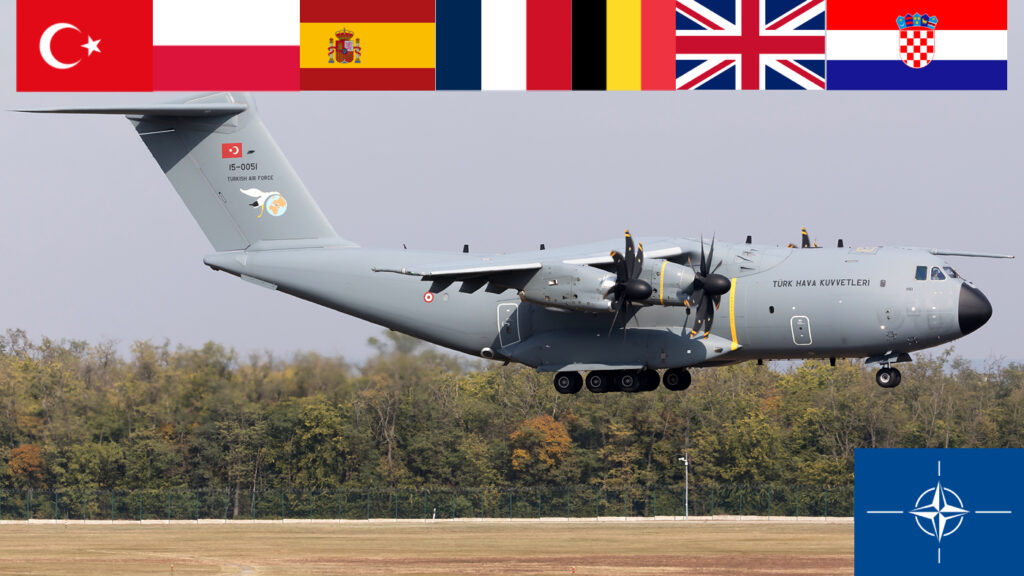
Seven NATO members, Belgium, Croatia, France, Poland, Spain, Türkiye and the United Kingdom, officially launched a High Visibility Project centred on the Airbus A400M military transport aircraft. The initiative seeks to establish a multinational fleet capable of providing strategic airlift services through a shared ownership and operational model inspired by the successful Multinational MRTT Fleet (MMF).
At the #NATOSummit in Ankara, Türkiye 🇹🇷, @NATO paves the way towards a Multinational #A400M Fleet with European governments designed to address strategic airlift capability gaps among European allies.
The objective is to establish a ‘pooling and sharing’ strategy similar to the… pic.twitter.com/Q8loR4H1Wd— Airbus Defence (@AirbusDefence) July 7, 2026
The project follows NATO’s growing emphasis on “pooling and sharing” defence assets, allowing participating nations to reduce costs while increasing operational flexibility. Beyond operating a common fleet of A400M aircraft, the programme will also include shared maintenance, training, infrastructure and procurement, creating a comprehensive multinational capability.
The Airbus A400M has become one of Europe’s principal military transport aircraft, with more than 135 aircraft currently in service worldwide and over 270,000 flight hours accumulated. Designed for strategic and tactical missions, the aircraft can perform airlift operations, aerial refuelling, medical evacuation, humanitarian relief missions, and aerial firefighting.
Ben Bridge, Chairman of Airbus Defence and Space UK, described the selection of the aircraft as recognition of its strategic importance.
“The selection of the A400M for this multinational fleet underlines its key strategic airlift capabilities. With more than 135 aircraft in operation and more than 270,000 flight hours achieved by the global fleet, the A400M has become the backbone of Air Mobility for the largest European NATO countries, and with its future capability roadmap, its role will become even more essential for decades to come,” he said.
Multinational MRTT Fleet Continues to Expand
Alongside the new A400M programme, NATO confirmed Finland’s accession to the Multinational MRTT Fleet, further expanding one of the Alliance’s most successful cooperative defence initiatives.
The MMF now includes nine participating nations: the Netherlands, Luxembourg, Norway, Germany, Belgium, Czechia, Sweden, Denmark and Finland.
Operating nine Airbus A330 MRTT aircraft from a planned fleet of twelve, the programme has already supported NATO operations on the Alliance’s Eastern Flank, evacuation missions from Afghanistan, humanitarian operations, and multinational exercises throughout the Indo-Pacific region.
The programme continues to serve as one of Europe’s leading examples of multinational defence cooperation, combining shared ownership with operational flexibility and significant cost savings.
NATO Selects Saab GlobalEye for Future Airborne Warning Mission
NATO Secretary General Mark Rutte:
"NATO is replacing its aging E-3 surveillance planes with up to 10 new Saab GlobalEye aircraft to keep its early warning systems strong for the future.
Allied countries are also working together to buy more warning systems like the GlobalEye… pic.twitter.com/ByBqpxoVZU
— Mintel World (@mintelworld) July 7, 2026
The summit also marked an important milestone for NATO’s future airborne surveillance capabilities.
Secretary General Mark Rutte announced that NATO will begin formal negotiations with Saab and the NATO Support and Procurement Agency (NSPA) regarding the acquisition of up to ten GlobalEye Airborne Early Warning and Control (AEW&C) aircraft.
Although no contract has yet been signed, the announcement confirms that NATO has selected the GlobalEye system as its preferred successor to the Alliance’s ageing airborne warning capability.
Developed by Saab and based on the Bombardier Global 6500 business jet, GlobalEye combines the Erieye Extended Range radar with an advanced multi-sensor suite and integrated command and control systems capable of monitoring air, land, and maritime domains simultaneously.
The aircraft is designed to detect low-observable targets, stealth aircraft, drones, ballistic missiles, and hypersonic threats even in highly contested electronic warfare environments.
Saab President and Chief Executive Officer Micael Johansson welcomed NATO’s decision.
“We are honoured and proud to support NATO in its next-generation AEW&C capability. We are confident that GlobalEye is the right choice for the Alliance, delivering proven capability, adaptability and long-term operational advantage,” Johansson said.
Strengthening NATO’s Future Capabilities
The combined announcements demonstrate NATO’s increasing focus on multinational procurement programmes that maximise interoperability while reducing costs across the Alliance.
By expanding strategic transport through the Airbus A400M initiative, strengthening aerial refuelling with the MRTT programme and preparing to introduce the advanced GlobalEye surveillance platform, NATO is investing in capabilities intended to support military operations, humanitarian missions and collective defence well into the coming decades.
The initiatives also reinforce Europe’s growing industrial role in NATO defence projects, while maintaining close transatlantic cooperation among Allied defence industries.