
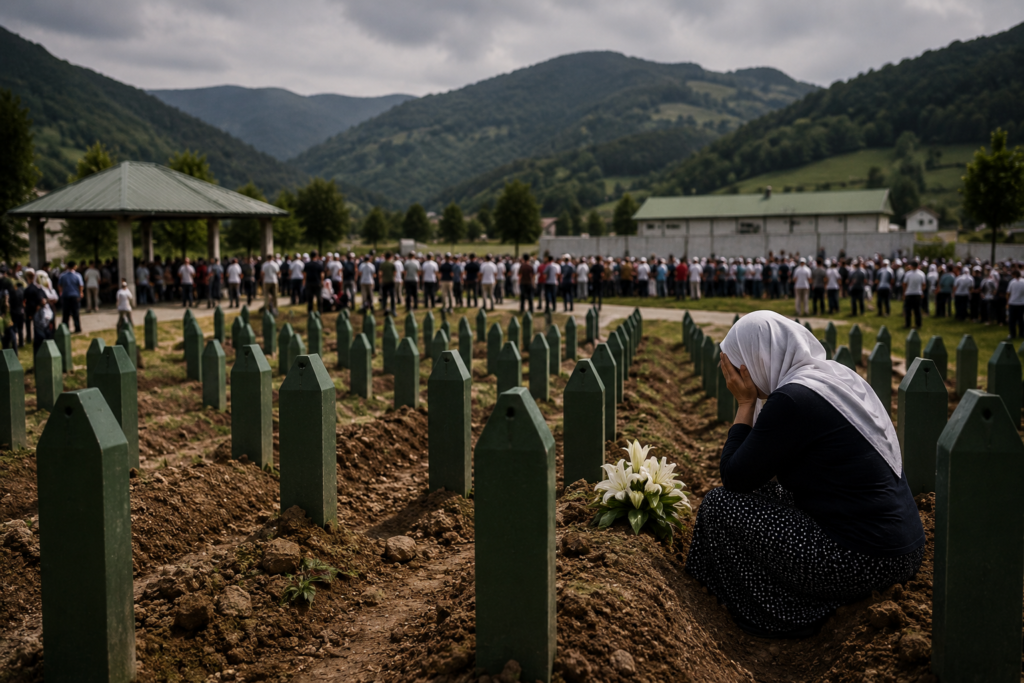
Image Credentials: Image Title: 1995 More Than 8,000 Bosniak Men and Boys Are Massacred at Srebrenica. Source: (chatgpt.com) Date: July 2026. Attribution: This image was created using AI-generated imagery (chatgpt.com) by Open Chronicle and does not depict a real-world scene.
By Open Chronicle
11 July 1995
On 11 July 1995, Bosnian Serb forces captured the United Nations-designated “safe area” of Srebrenica in eastern Bosnia and Herzegovina, setting in motion the systematic murder of more than 8,000 Bosniak men and boys over the following days. Recognised by international courts as genocide, the Srebrenica massacre remains the worst atrocity committed in Europe since the end of the Second World War.
The massacre occurred during the Bosnian War, which erupted in 1992 following the breakup of Yugoslavia. The conflict involved Bosniaks, Bosnian Serbs, and Bosnian Croats and was marked by widespread ethnic violence, sieges, and the forced displacement of civilians. Srebrenica had become a refuge for tens of thousands of Bosniak civilians fleeing surrounding areas, leading the United Nations to declare the town a protected safe area in 1993. A contingent of lightly armed Dutch peacekeepers was deployed to defend the enclave.
Despite its protected status, Bosnian Serb forces under the command of General Ratko Mladić launched a major offensive against Srebrenica in July 1995. On 11 July, the town fell after little effective resistance. Thousands of terrified civilians sought shelter at the United Nations base in Potočari, while others attempted to escape on foot through forests toward Bosnian government-held territory.
In the days that followed, Bosnian Serb forces systematically separated men and boys from women, children, and elderly civilians. The women and younger children were transported away by bus, while thousands of men and teenage boys were detained. Many were executed in schools, warehouses, fields, and other isolated locations before being buried in mass graves. In an effort to conceal the crimes, many of the graves were later excavated and the remains reburied in secondary burial sites.
The international community was widely criticised for failing to prevent the massacre despite the presence of United Nations peacekeepers and repeated warnings about the deteriorating situation. The fall of Srebrenica exposed the limitations of international peacekeeping operations operating without sufficient military support or political authority.
In the years following the war, extensive investigations uncovered evidence documenting the scale and organisation of the killings. The International Criminal Tribunal for the former Yugoslavia and the International Court of Justice concluded that the murders constituted genocide. Numerous military and political leaders were prosecuted, including Ratko Mladić and Radovan Karadžić, both of whom were convicted of genocide and other crimes against humanity.
The identification of victims has continued for decades through DNA analysis and forensic investigations. Every year, newly identified victims are laid to rest at the Srebrenica Memorial Centre in Potočari, where thousands gather to honour those who lost their lives and to remember one of the darkest chapters in modern European history.
The legacy of Srebrenica extends far beyond Bosnia and Herzegovina. The massacre profoundly influenced international humanitarian law, peacekeeping doctrine, and global discussions surrounding genocide prevention and the responsibility of the international community to protect civilian populations from mass atrocities.
Today, the Srebrenica genocide stands as a solemn reminder of the devastating consequences of ethnic hatred, political extremism, and international inaction. Its memory continues to shape efforts to promote justice, accountability and reconciliation while reinforcing the importance of safeguarding human rights and preventing future genocides.