
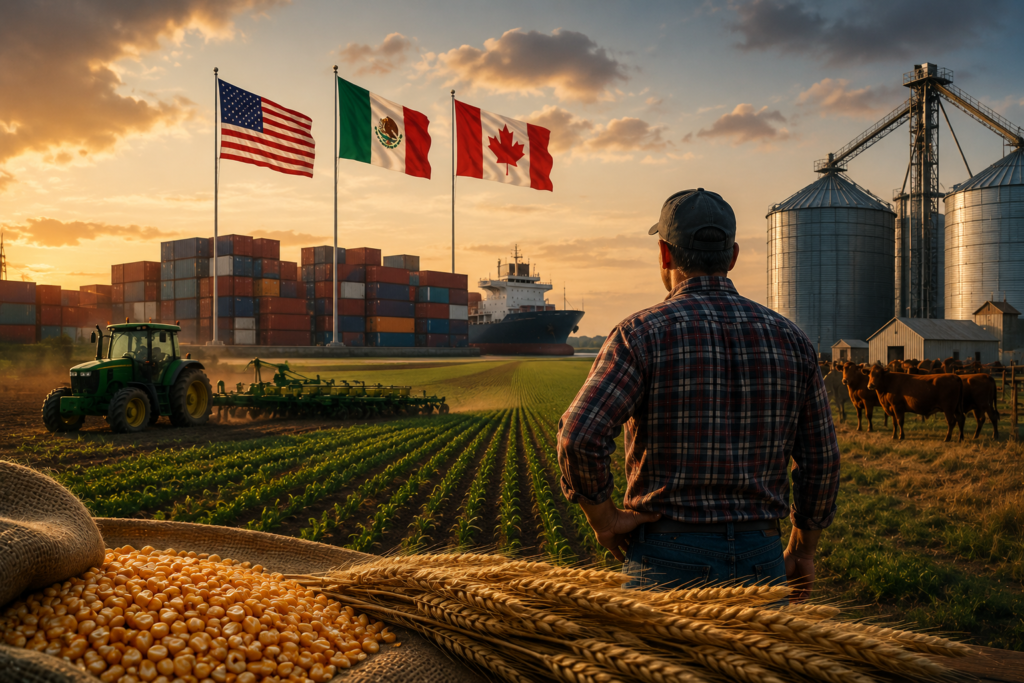
Image Credentials: Image Title: Oklahoma Agriculture Faces Fresh Uncertainty After USMCA Renewal Deadline Passes. Source: (chatgpt.com) Date: July 2026. Attribution: This image was created using AI-generated imagery (chatgpt.com) by Open Chronicle and does not depict a real-world scene.
By Open Chronicle
Oklahoma’s agricultural sector is facing renewed uncertainty after the United States declined to renew the United States, Mexico, Canada Agreement (USMCA), raising questions about the future of one of North America’s most important trade partnerships. Although the agreement remains in force for now, farmers and industry experts warn that prolonged uncertainty could affect long-term investment and export planning.
Under the terms of the agreement, the failure to renew does not immediately terminate USMCA. Instead, the three countries now enter a review period that could extend for up to ten years while negotiations continue over the future framework governing trade between the United States, Mexico, and Canada.
For Oklahoma, the stakes are particularly high. Mexico remains the state’s largest export market for wheat, corn, milo, and oilseeds, making stable trade relations essential for agricultural producers.
Todd Hubbs, a grain marketing specialist with Oklahoma State University Extension, said growers are closely watching developments.
According to Hubbs, Oklahoma producers would face significant challenges if the agreement were eventually dismantled. While there has been no indication of a formal U.S. withdrawal, he noted that the annual review process introduces additional uncertainty into an industry that depends on long-term planning.
The trade concerns come as farmers are already grappling with difficult economic conditions. Higher fuel and fertilizer costs, partly linked to ongoing geopolitical tensions involving Iran, have increased production expenses, while global crop prices remain relatively weak following abundant harvests worldwide.
Many agricultural organizations had supported renewing the USMCA, arguing that the agreement has provided predictable access to key North American markets. Industry experts say current trade flows, particularly corn and wheat exports to Mexico and ethanol shipments to Canada, have generally benefited producers.
Livestock producers are also monitoring the situation. Derrell Peel, a livestock marketing specialist at Oklahoma State University Extension, said the greatest risk is not an immediate market shock but the uncertainty that could discourage future investment and cross-border business planning. He noted that the cattle industry operates on long production cycles where stable trade relationships are particularly important.
Additional pressure has come from the temporary closure of the southern border to live cattle imports as authorities work to prevent the spread of the New World screwworm, further tightening already limited cattle supplies in the United States.
While no immediate disruption to agricultural trade is expected, analysts believe prolonged uncertainty surrounding USMCA negotiations could weigh on producer confidence, investment decisions and export opportunities across Oklahoma’s farming and ranching industries.