
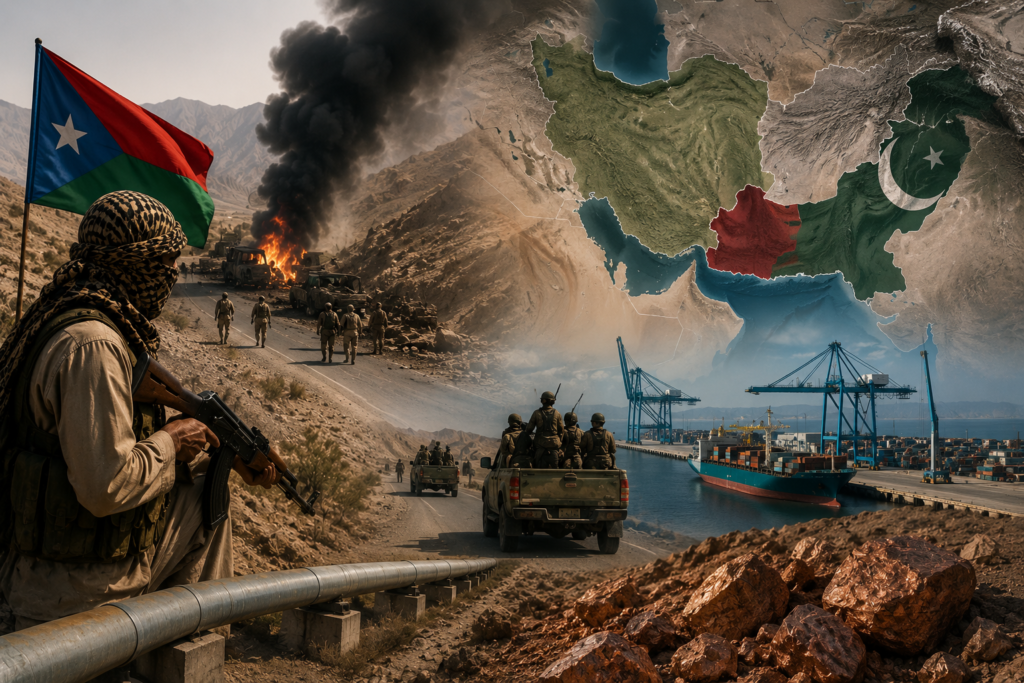
Image Credentials: Image Title: Zelensky Establishes Dedicated Long-Range Strike Command to Intensify Attacks Inside Russia. Source: (chatgpt.com) Date: July 2026. Attribution: This image was created using AI-generated imagery (chatgpt.com) by Open Chronicle and does not depict a real-world scene.

Strategic Analysis | By Open Chronicle
The latest surge of violence in Pakistan’s Balochistan province has once again drawn international attention to one of Asia’s most strategically significant yet chronically unstable regions. Over several days, coordinated attacks across Ziarat, Kharan and sections of the N,25 highway left dozens of people dead, including members of Pakistan’s security forces and civilians, highlighting the persistence of an insurgency that has shaped the province for decades.
For Islamabad, these attacks are not isolated acts of militancy but part of a broader security challenge involving separatist organizations operating across difficult terrain, cross-border sanctuaries, and alleged foreign involvement. Pakistani officials have repeatedly accused India of supporting Baloch militant groups and have also raised concerns about militants operating from Afghan territory. India has consistently rejected such accusations.
Beyond the immediate security implications, however, Balochistan has become the focus of an increasingly complex geopolitical contest involving regional powers, global trade routes and competing visions for the future of Eurasia.
A province of extraordinary strategic value
Balochistan covers nearly 44 percent of Pakistan’s territory but contains only a small share of its population. Despite its sparse settlement, the province possesses immense strategic and economic importance.
It contains significant reserves of natural gas, copper, gold, and other critical minerals that are increasingly valuable in the global competition for industrial resources and advanced manufacturing.
Equally important is its coastline along the Arabian Sea, where the deep water port of Gwadar has become one of the flagship projects of the China Pakistan Economic Corridor, or CPEC, itself a major component of China’s Belt and Road Initiative.
For Beijing, Gwadar offers direct maritime access to the Arabian Sea while reducing dependence on longer shipping routes through Southeast Asia. For Pakistan, the project represents an opportunity to transform Balochistan into a logistics, industrial, and energy hub linking South Asia, Central Asia, and the Middle East.
The insurgency predates modern geopolitical competition
The current insurgency did not begin with CPEC or China’s regional ambitions.
Baloch nationalist movements have existed since shortly after Pakistan’s independence in 1947. Several armed uprisings have taken place over the decades, driven by demands ranging from greater provincial autonomy to outright independence.
Militant organizations, including the Baloch Liberation Army (BLA), have carried out attacks against Pakistani security forces, government institutions, energy infrastructure, and Chinese interests operating in the province.
Pakistan classifies the BLA and several affiliated organizations as terrorist groups. Similar designations have been adopted by countries including the United States and the United Kingdom.
Competing narratives over foreign involvement
One of the most controversial aspects of the Balochistan conflict concerns allegations of foreign intelligence involvement.
Pakistani officials have frequently accused India’s intelligence services of supporting separatist organizations operating inside Balochistan. New Delhi has repeatedly denied these claims.
The user-supplied material also alleges that the CIA has historically cultivated Baloch separatist groups as proxy assets designed to pressure both Pakistan and Iran.
While it is true that U.S. intelligence agencies have supported proxy forces in various regions during the Cold War and afterwards, there is no publicly available evidence confirming current CIA direction or sponsorship of Baloch separatist organizations. Such claims remain the subject of political debate, speculation, and competing intelligence narratives rather than independently verified fact.
Historical reporting has documented American interest in developments affecting Pakistan, Afghanistan, and Iran, particularly during periods of regional conflict. However, establishing direct operational links between present-day militant attacks and U.S. intelligence agencies would require evidence that has not been publicly produced.
The China factor
What is far less disputed is China’s growing importance in Balochistan.
Beijing has invested billions of dollars in infrastructure, roads, energy projects, and the development of Gwadar Port under CPEC.
These investments have transformed Balochistan from a largely neglected province into one of the most strategically valuable regions in China’s overseas economic network.
Militant organizations have repeatedly targeted Chinese engineers, construction projects, and diplomatic facilities, apparently viewing them as symbols of Islamabad’s authority and foreign economic influence.
United Nations reporting has documented attacks by militant groups against infrastructure projects connected with CPEC, reflecting the security challenges facing large-scale investment in the province.
Balochistan within the emerging Eurasian landscape
The province’s importance extends well beyond Pakistan.
If current regional integration projects continue expanding, Balochistan could become a critical junction connecting:
- China to the Arabian Sea.
- Pakistan to Central Asia.
- Iran to eastern trade corridors.
- Future BRICS-related transport and energy networks.
Such connectivity would potentially reduce dependence on maritime chokepoints dominated by Western naval power while strengthening overland Eurasian trade.
Whether this ultimately benefits BRICS as a bloc remains uncertain, but Balochistan clearly occupies an increasingly important position in discussions surrounding multipolar economic development.
The Iran dimension
The Baloch issue is not confined to Pakistan.
Ethnic Baloch communities also live across southeastern Iran, where Tehran faces its own long-running insurgency involving separatist and militant organizations.
Iran and Pakistan have periodically coordinated border security operations against armed groups operating across the frontier.
Although their broader regional interests do not always align, both governments share concerns about organizations advocating the creation of a “Greater Balochistan” that would incorporate territory from both countries.
This shared security concern has encouraged increasing intelligence cooperation despite other geopolitical differences.
Infrastructure as a strategic target
Modern conflicts increasingly focus on disrupting logistics rather than simply capturing territory.
Roads, pipelines, ports, railways, and energy facilities have become primary targets because they represent long-term economic power.
The strategic N,25 highway, attacked during the recent violence, forms an important transportation corridor linking different parts of Balochistan.
Disrupting such infrastructure can have effects extending well beyond immediate casualties by slowing commerce, discouraging investment, and increasing security costs.
A proxy battlefield or a domestic insurgency?
Some analysts interpret Balochistan primarily through the lens of internal politics, emphasizing longstanding grievances related to governance, economic development and political representation.
Others view the province as a classic arena for great power competition, where local insurgencies intersect with broader geopolitical rivalries involving China, India, the United States and regional actors.
The available evidence supports elements of both perspectives.
There is little doubt that Balochistan possesses immense strategic value, making it an area of international interest. Likewise, insurgent groups have demonstrated an ability to exploit difficult terrain and conduct sophisticated attacks.
At the same time, claims regarding direct foreign sponsorship by specific intelligence agencies often remain difficult to verify publicly and should therefore be treated cautiously unless supported by independently confirmed evidence.
A province at the crossroads of competing futures
Balochistan illustrates how geography continues to shape global politics.
Its mineral wealth, maritime access, proximity to Iran and Afghanistan, and central role in emerging Eurasian transport networks ensure that developments there will remain closely watched by governments across Asia and beyond.
Whether future instability reflects primarily domestic insurgency, regional rivalry, or broader geopolitical competition is likely to remain the subject of intense debate.
What is beyond dispute is that Balochistan has become one of the most strategically important regions in the evolving contest over trade, energy, connectivity and influence across Eurasia.
The Grand Strategy Institute
Continue Exploring Strategic Analysis
Return to The Grand Strategy Institute for strategic assessments, long-form analysis and research examining geopolitics, military affairs, international security, emerging technologies and the changing international order.
← Back to The Grand Strategy Institute