
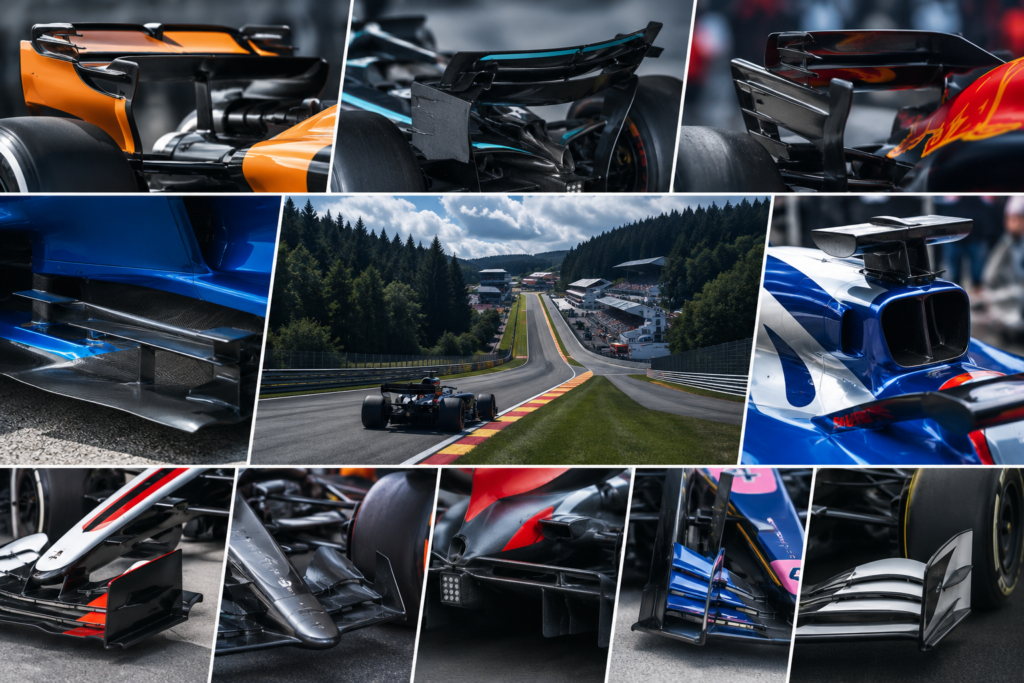
Image Credentials: Image Title: Technical Updates: Spa-Francorchamps Becomes a Key Development Test as Teams Introduce New Aerodynamic Packages. Source: (chatgpt.com) Date: July 2026. Attribution: This image was created using AI-generated imagery (chatgpt.com) by Open Chronicle and does not depict a real-world scene.
By Open Chronicle
The 2026 Belgian Grand Prix has become more than just another stop on the Formula One calendar. Spa, with its unique blend of long straights, sweeping high-speed corners, and dramatic elevation changes, has prompted almost every team to introduce technical updates aimed at improving aerodynamic efficiency ahead of the second half of the season.
Only Ferrari and Aston Martin arrived in Belgium without declaring new components, while the remaining teams brought a variety of upgrades ranging from circuit-specific rear wings to significant bodywork revisions.
McLaren Focuses on Rear Wing Efficiency
Championship contender McLaren has introduced one of the most notable updates of the weekend with a revised rear wing package designed specifically for Spa Francorchamps.
The new assembly reduces aerodynamic drag while maintaining the downforce levels required through iconic sections such as Eau Rouge, Raidillon, and Blanchimont. Engineers have also modified the rear wing endplates to improve airflow conditioning across a wider operating range, allowing the car to remain efficient under varying aerodynamic loads.
The changes are aimed at maximising straight-line speed without sacrificing cornering performance, an essential balance at one of Formula One’s fastest circuits.
Mercedes Fine Tunes Aerodynamics
Mercedes has also concentrated its efforts on aerodynamic efficiency.
The team introduced a low-drag rear wing tailored to Spa, complemented by increased camber on the upper edge of the front wing endplates and revised rear brake drum winglets. Together, the modifications seek to improve airflow management while reducing drag on the circuit’s long full-throttle sections.
Red Bull Revises Rear Wing After Earlier Difficulties
Red Bull’s update is more subtle but strategically important.
Rather than unveiling an entirely new rear wing, the team has modified the pylon profiles to improve airflow stability around the rear of the car. The changes also follow Red Bull’s decision to abandon its experimental rotating “Straight Mode” rear wing after reliability concerns and two separate incidents involving Max Verstappen during previous races.
The revised configuration prioritises consistency and reliability while preserving aerodynamic efficiency.
Williams Continues Floor Development
Williams has focused on refining the floor, an area that remains one of the most influential aerodynamic components under the current regulations.
The updated floor body redistributes diffuser expansion volume across different ride heights, improving aerodynamic consistency throughout the car’s operating window. Engineers have also introduced a local floor trim to optimise drag and balance, alongside lower load rear brake duct winglets designed specifically for Spa’s demands.
Racing Bulls Unveil the Weekend’s Largest Upgrade Package
Among all teams, Racing Bulls has brought the most comprehensive development package.
The update includes a redesigned engine cover, narrower roll hoop, revised front corner assembly, and an entirely new rear wing.
The reshaped engine cover improves airflow around the sidepods, while the slimmer roll hoop allows cleaner airflow towards the rear wing. Engineers have also redesigned both the mainplane and flap profiles of the rear wing to generate downforce more efficiently with reduced aerodynamic penalties.
The scale of the package suggests Racing Bulls is targeting a significant step forward in overall performance.
Haas, Audi, Alpine, and Cadillac Also Bring New Components
Several midfield teams have introduced targeted improvements.
Haas has developed a new front wing featuring redesigned endplates, along with revised front corner deflectors and a lower downforce beam wing suited to Spa’s characteristics.
Audi has combined a revised upper rear wing configuration with an updated diffuser incorporating modified sidewall winglets to improve airflow management at the rear of the car.
Alpine’s sole aerodynamic update is a revised Halo winglet, while Cadillac has introduced a redesigned front wing endplate intended to improve airflow around the front tyres.
Belgium Provides the Perfect Development Benchmark
Spa Francorchamps has long served as one of Formula One’s most demanding aerodynamic tests.
The circuit requires teams to find an optimal compromise between straight-line speed and cornering performance, making it an ideal venue to evaluate new concepts before the championship enters its decisive phase.
With almost every team bringing fresh components, the Belgian Grand Prix represents an important opportunity to validate development directions that could shape performance throughout the remainder of the 2026 season.