
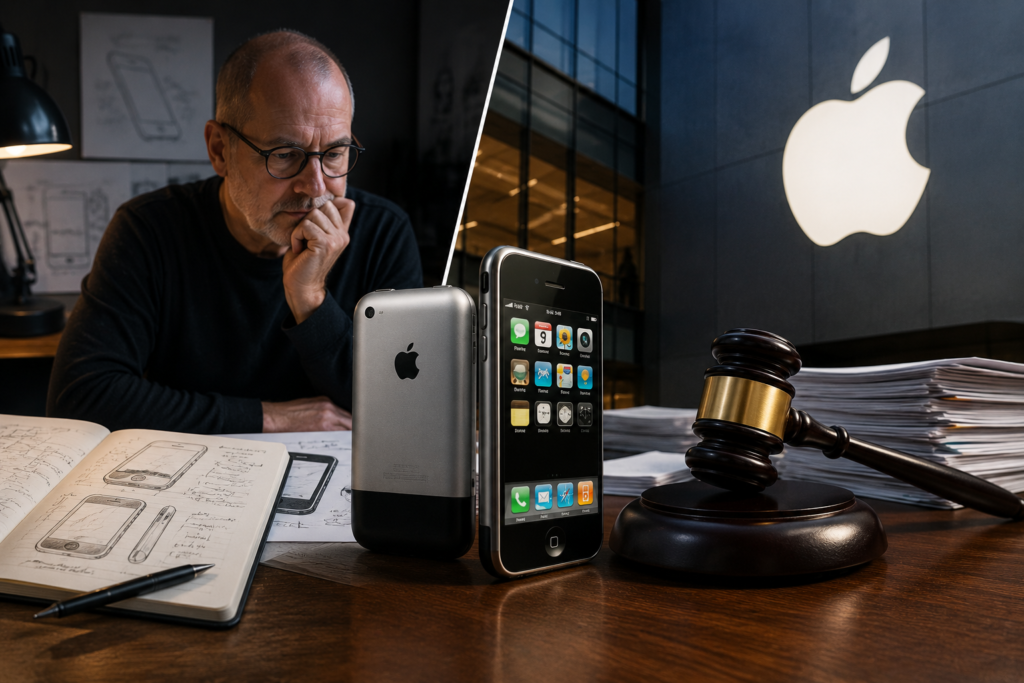
Image Credentials: Image Title: Apple Enters Legal Battle With British Designer Behind the Original iPhone Concept. Source: (chatgpt.com) Date: July 2026. Attribution: This image was created using AI-generated imagery (chatgpt.com) by Open Chronicle and does not depict a real-world scene.
By Open Chronicle News Desk with Agencies
Apple has become embroiled in a legal dispute with British product designer David Law, who claims he played a pivotal role in creating the original design concepts that eventually evolved into the iPhone.
The case has attracted significant attention because it revisits the origins of one of the world’s most influential consumer electronics products and raises broader questions about intellectual property, design ownership and recognition within the technology industry.
Designer claims key role in iPhone’s creation
David Law, an experienced British industrial designer, argues that he developed a series of concepts in the early 2000s that closely resemble the design language later adopted by Apple’s first-generation iPhone.
According to Law, his work included minimalist handheld devices with large touch-sensitive displays, rounded corners and a clean interface that anticipated many of the characteristics that became synonymous with Apple’s iconic smartphone.
Law contends that his contributions have never been properly acknowledged and is seeking legal recognition of his role in the product’s development.
Apple rejects the allegations
Apple has strongly disputed the claims, maintaining that the iPhone was independently conceived and developed by its own teams under the leadership of the late Steve Jobs.
The company argues that the iPhone emerged from years of internal research, engineering and industrial design led by Apple’s product development and design divisions, including the influential work of former Chief Design Officer Sir Jony Ive.
Apple has consistently defended its intellectual property and has historically engaged in numerous legal battles involving patents, trademarks and product design.
Revisiting the birth of a technological icon
When Apple introduced the first iPhone in January 2007, it fundamentally transformed the mobile phone industry.
The device combined a multi-touch display, internet connectivity, media playback and smartphone functionality into a single product, establishing design standards that competitors would follow for years.
Since then, Apple has sold billions of iPhones worldwide, making it one of the company’s most successful and profitable product lines.
The legal dispute therefore touches not only on historical design concepts but also on the legacy of one of the most significant technological innovations of the 21st century.
Intellectual property at the center of the dispute
Legal experts note that proving authorship or ownership over early design concepts can be particularly challenging.
Industrial design often involves multiple iterations, collaborative teams and evolving prototypes, making it difficult to establish direct links between preliminary sketches and final commercial products.
To succeed, claimants typically must demonstrate clear evidence that their work directly influenced the finished design and that intellectual property protections were violated.
Apple, meanwhile, is expected to argue that the similarities reflect broader design trends of the period rather than the use of any specific external concept.
Wider implications for the technology industry
The case highlights ongoing debates about how innovation is credited within large technology companies.
Major products frequently result from years of collaborative development involving engineers, designers and software specialists, while independent designers sometimes argue that their early ideas influenced commercially successful products without receiving formal recognition.
Although legal disputes over patents are common in the technology sector, cases focusing on the origins of industrial design remain comparatively rare.
Case expected to attract global attention
The proceedings are likely to be closely watched by intellectual property specialists, designers and technology companies alike.
Regardless of the eventual outcome, the dispute offers a renewed look at the complex process behind the creation of one of modern history’s most recognizable consumer products.
If the court accepts Law’s arguments, it could have implications for future claims involving historical product designs. If Apple prevails, the case would reinforce the company’s long-standing position regarding the independent development of the iPhone and its associated intellectual property.