
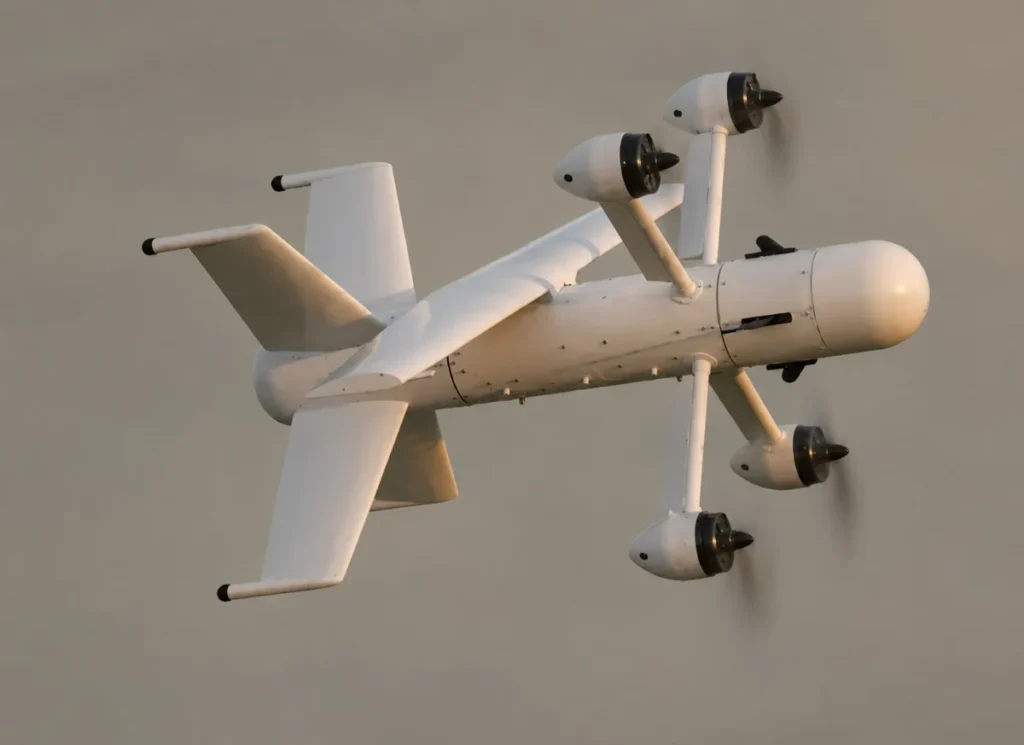
Image by Lockheed Martin
By Open Chronicle News Desk with Agencies
Lockheed Martin has introduced a new directed-energy system designed to counter one of the fastest-growing threats on the modern battlefield: large-scale drone attacks. The company’s latest High-Power Microwave (HPM) weapon is intended to disable multiple unmanned aerial systems simultaneously by emitting powerful bursts of electromagnetic energy capable of disrupting or destroying onboard electronics.
As militaries around the world face increasingly sophisticated drone swarms, microwave-based defenses are emerging as a potentially cost-effective complement to traditional missile interceptors and laser weapons.
Hoje: a Lockheed Martin apresenta o MORFIUS X-Rotor, um "destruidor de drones" reutilizável e movido a micro-ondas, projetado para neutralizar mais de 50 drones inimigos em um único voo. pic.twitter.com/TOpvcj2E9n
— No Front Militar (@noFrontMilitar) July 20, 2026
A new approach to counter-drone warfare
The newly unveiled system uses high-power microwave technology rather than kinetic interceptors or laser beams.
Instead of physically destroying an incoming drone, the weapon projects intense electromagnetic pulses that overload electronic circuits, disrupt communications, disable navigation systems, and render unmanned aircraft inoperable.
Unlike missile-based defenses, which typically engage one target at a time, microwave weapons can potentially affect multiple drones within a single beam, making them particularly effective against coordinated swarm attacks.
Lockheed Martin says the technology is designed to provide layered protection for military bases, critical infrastructure, airports and deployed forces operating in increasingly contested environments.
Responding to the drone revolution
Small, inexpensive drones have transformed modern warfare.
Conflicts in Ukraine, the Middle East and elsewhere have demonstrated how commercial quadcopters, loitering munitions and autonomous attack drones can threaten armored vehicles, air-defense systems and even strategic infrastructure at relatively low cost.
This has created an imbalance in which relatively inexpensive drones often require expensive missile interceptors to defeat them.
Directed-energy systems seek to reverse that equation by dramatically lowering the cost per engagement while providing rapid response against large numbers of airborne threats.
Advantages over conventional defenses
Microwave weapons offer several operational benefits compared with traditional air-defense systems.
Because they rely on electrical power rather than explosive interceptors, they can engage targets without consuming costly missiles. They also generate no shrapnel, reducing the risk of collateral damage in populated or sensitive areas.
Additional advantages include:
- Simultaneous engagement of multiple drones.
- Near-instantaneous response speed.
- Lower operating costs compared with missile interceptors.
- Deep magazine limited primarily by available electrical power.
- Reduced logistical burden compared with conventional ammunition.
These characteristics make microwave systems particularly attractive for defending fixed installations where large numbers of drones could overwhelm conventional air defenses.
Part of a broader directed-energy strategy
Lockheed Martin’s new system reflects a wider trend across the global defense industry.
Governments are investing heavily in directed-energy technologies, including both high-energy lasers and high-power microwave systems, to address emerging aerial threats.
While lasers excel at precisely destroying individual targets through concentrated heat, microwave weapons are optimized for disabling the electronic systems of multiple drones across a broader area.
Military planners increasingly view the two technologies as complementary components of future integrated air-defense networks.
Challenges remain
Despite their promise, microwave weapons are not without limitations.
Performance can be influenced by factors such as target distance, atmospheric conditions, terrain, and the level of electronic shielding incorporated into future drone designs.
Adversaries may also develop hardened electronics, improved electromagnetic protection or alternative operating concepts to reduce vulnerability to microwave attacks.
As a result, defense analysts expect microwave systems to complement—not replace—existing missile, gun and laser-based air-defense capabilities.
The future of counter-drone warfare
The rapid proliferation of autonomous drones is forcing armed forces to rethink traditional air-defense strategies.
Future battlefields are likely to feature layered defensive architectures combining radar, artificial intelligence, electronic warfare, lasers, microwave weapons and conventional interceptors into integrated systems capable of responding to a wide variety of aerial threats.
As drone technology continues to evolve, so too will the systems designed to defeat it. Lockheed Martin’s latest microwave weapon represents another step toward a future in which electronic warfare and directed energy become central elements of modern air defense.
The race between increasingly capable autonomous drones and equally sophisticated counter-drone technologies is expected to define military innovation throughout the coming decade.