
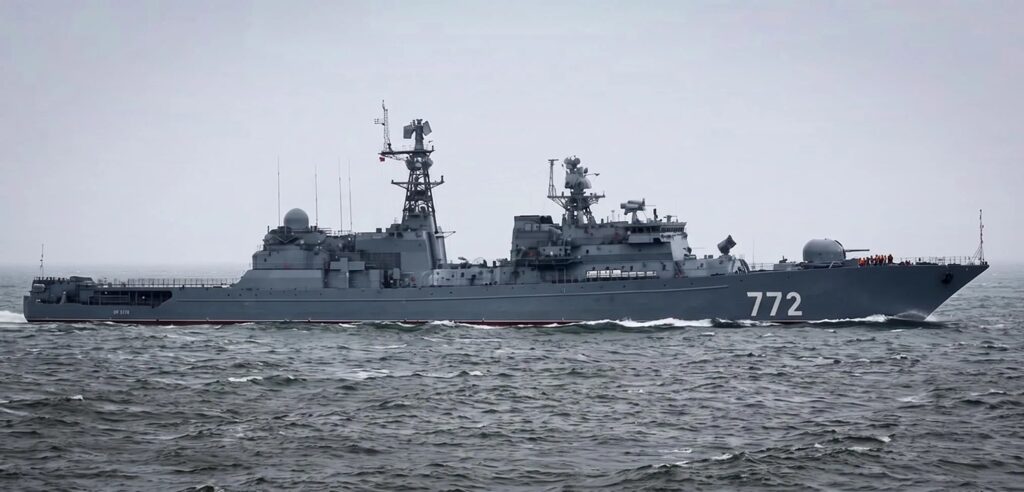
Image: from Navy Lookout X @NavyLookout
By Open Chronicle News Desk with Agencies
A Russian naval vessel reportedly fired warning shots while operating in waters near the English Channel during a closely monitored transit that drew the attention of the Royal Navy and NATO forces. The incident, which occurred off the coast of southwest England near Plymouth, has renewed concerns over rising military tensions between Russia and Western allies as naval encounters become increasingly frequent in European waters.
British defence officials monitored the Russian task group throughout its passage, with Royal Navy ships and aircraft tracking the formation as it transited international waters.
Warning shots reported during naval transit
According to reports, the Russian warship discharged warning rounds while escorting its formation during the transit, although the exact circumstances surrounding the firing remain unclear.
There have been no reports of injuries or damage, and British authorities have emphasized that the Russian vessels remained in international waters throughout the operation.
The Royal Navy maintained close surveillance of the task group, with warships and maritime patrol aircraft observing the movement from the moment the vessels entered areas of strategic interest around the British coastline.
Royal Navy closely monitored the task group
The Royal Navy routinely tracks foreign military vessels passing close to the United Kingdom.
During this latest operation, British forces monitored the Russian naval group as it sailed through the English Channel and adjacent waters, ensuring continuous awareness of its activities.
Such shadowing missions have become increasingly common since Russia’s full-scale invasion of Ukraine, as NATO members seek to monitor Russian military movements across Europe and the North Atlantic.
Officials stressed that the monitoring operation formed part of standard maritime security procedures.
Strategic importance of the English Channel
The English Channel remains one of the world’s busiest maritime corridors, carrying thousands of commercial vessels every year while also serving as an important transit route for naval forces.
Russian warships periodically use the route to move between the Baltic Sea, the North Atlantic and the Mediterranean.
Although these transits generally occur within international law, they are routinely observed by NATO navies because of their strategic significance and the broader security environment created by the war in Ukraine.
Rising military activity across Europe
The reported warning shots come amid heightened military activity throughout Europe.
Russian naval and air operations near NATO territory have increased over recent years, prompting more frequent interceptions by allied aircraft and maritime patrols.
At the same time, NATO has expanded its presence across the Baltic Sea, North Atlantic and Black Sea regions while strengthening maritime surveillance capabilities.
Military analysts note that encounters between Russian and NATO forces are becoming more frequent, increasing the importance of professional communication and established procedures to prevent incidents from escalating.
Avoiding unintended escalation
Despite ongoing geopolitical tensions, both Russia and NATO continue to operate under international maritime rules designed to reduce the risk of accidental confrontation.
Naval commanders regularly conduct shadowing operations without direct engagement, maintaining safe distances while gathering intelligence and ensuring freedom of navigation.
Defence experts warn that as military activity intensifies across European waters, maintaining disciplined conduct and clear communication between opposing forces will remain essential to avoiding unintended escalation.
The latest incident serves as another reminder of the increasingly contested security environment surrounding Europe, where routine naval operations are now conducted under heightened strategic scrutiny.